Question
'Analysis of age pyramids for human population can provide important inputs for long-term planning strategies'. Explain.

Answer

Age pyramid displays the age distribution (% individuals of a given age or age group) for the population. Population at any given time is composed of individuals of different ages. For human population, the age pyramids generally show age distribution of males and females in a cornbined diagram.

The shape of the pyramids reflects the growth status of the population that whether it is growing, stable or declining.

It tells us about an area's population, birth and death rates, dependants, young people and elderly people, etc. These are important inputs that can be used for long term planning strategies, e.g. to create job opportunities (if there are more young people), to focus on control of population (in case of high birth rate), to improve and invest more on medical facilities (in case of low elderly people), etc. Hence, through the in-depth analysis of the age pyramids, better planning strategies, resource allocation and other planning benefits can be obtained.

Need a full question paper?

Generate a complete, print-ready paper with questions like this in minutes — across 16+ boards, with answer keys.
Start Generating Free

Similar questions

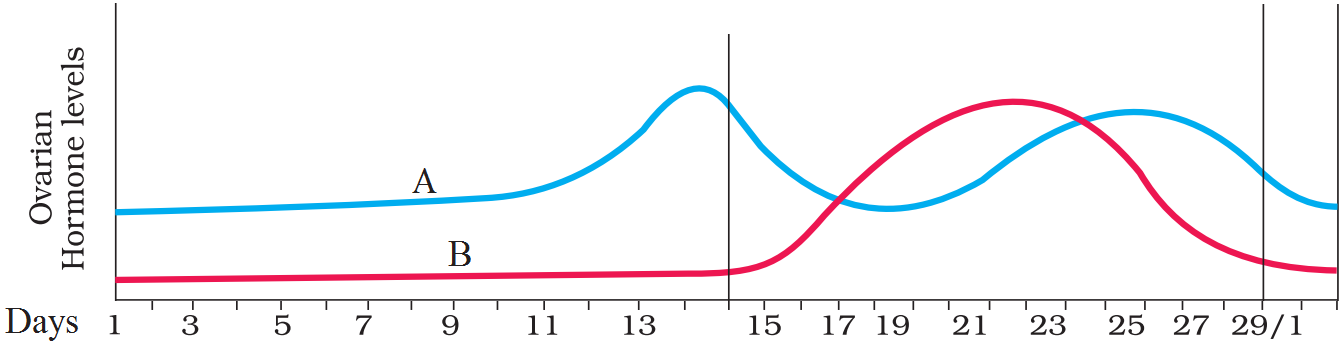
The graph given below shows the variation in the levels of ovarian hormones during various phases of menstrual cycle:

Reason out why A peaks before B.

Answer the following questions:
You are given tall pea plants with yellow seeds whose genotypes are unknown. How would you find the genotype of these plants? Explain with the help of cross.
  1. How is mature insulin different from proinsulin secreted by pancreas in humans?
  2. Explain how was human functional insulin produced using rDNA technology.
  3. Why is the functional insulin thus produced considered better than the ones used earlier by diabetic patients?
Define a cistron. Giving examples differentiate between monocistronic and polyeistronic transcription unit.
Write three important characteristics of population.
Match the terms in Column I with those in Column II.
S. No.
Column I
 
Column II
A
Transcription
1
A set of three bases on RNA that is complementary to the bases of codon on mRNA.
B
Anticodon
2
A unit of DNA that codes for a polypeptide.
C
Cistron
3
Process of synthesis of polypeptide as dictated by mRNA.
D
Translation
4
Process by which mRNA carries the information from nucleus to ribosomes.
Write two differences between spermatogenesis and oogenesis.
Write a short note on uterus.
  1. How did Hardy-Weinberg explain that allelic frequencies in a population are stable and are constant from generation to generation?
  2. Why does genetic equilibrium get disturbed in a population? Give reasons.
Enumerate the factors which are necessary to maintain good health.