MCQ
Answer the following by appropriately matching the lists based on the information given in the paragraph.

In a thermodynamics process on an ideal monatomic gas, the infinitesimal heat absorbed by the gas is given by $T \Delta X$, where $T$ is temperature of the system and $\Delta X$ is the infinitesimal change in a thermodynamic quantity $X$ of the system. For a mole of monatomic ideal gas

$X=\frac{3}{2} R \ln \left(\frac{T}{T_A}\right)+R \ln \left(\frac{V}{V_A}\right)$. Here, $R$ is gas constant, $V$ is volume of gas, $T_A$ and $V_A$ are constants.

The $List-I$ below gives some quantities involved in a process and $List-II$ gives some possible values of these quantities.

List-$I$ List-$II$
$(I)$ Work done by the system in process $1 \rightarrow 2 \rightarrow 3$ $(P)$ $\frac{1}{3} R T_0 \ln 2$
$(II)$ Change in internal energy in process $1 \rightarrow 2 \rightarrow 3$ $(Q)$ $\frac{1}{3} RT _0$
$(III)$ Heat absorbed by the system in process $1 \rightarrow 2 \rightarrow 3$ $(R)$ $R T _0$
$(IV)$ Heat absorbed by the system in process $1 \rightarrow 2$ $(S)$ $\frac{4}{3} RT _0$
  $(T)$ $\frac{1}{3} RT _0(3+\ln 2)$
  $(U)$ $\frac{5}{6} RT _0$

If the process carried out on one mole of monatomic ideal gas is as shown in figure in the PV-diagram with $P _0 V _0=\frac{1}{3} RT _0$, the correct match is,

$(1)$$I \rightarrow Q, II \rightarrow R , III \rightarrow P , IV \rightarrow U$

$(2)$ $I \rightarrow S , II \rightarrow R , III \rightarrow Q , IV \rightarrow T$

$(3)$ $I \rightarrow Q , II \rightarrow R , III \rightarrow S , IV \rightarrow U$

$(4)$ $I \rightarrow Q , II \rightarrow S , III \rightarrow R , IV \rightarrow U$

($2$) If the process on one mole of monatomic ideal gas is an shown is as shown in the $TV$-diagram with $P _0 V _0=\frac{1}{3} RT _0$, the correct match is

$(1)$ $I \rightarrow S, II \rightarrow T, III \rightarrow Q , IV \rightarrow U$

$(2)$ $I \rightarrow P , II \rightarrow R, III \rightarrow T , IV \rightarrow S$

$(3)$ $I \rightarrow P, II \rightarrow, III \rightarrow Q, IV \rightarrow T$

$(4)$ $I \rightarrow P, II \rightarrow R, III \rightarrow T, IV \rightarrow P$

Give the answer or quetion $(1)$ and $(2)$
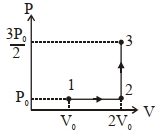
  • $3,4$
  • B
    $2,4$
  • C
    $1,4$
  • D
    $2,3$

Answer

Correct option: A.
$3,4$
a
$(I)$ Degree of freedom $f=3$

Work done in any proces $5$ Area under P-V graph $\Rightarrow$ Work dooe in $1 \rightarrow 2 \rightarrow 3= P _1 V$,

$=\frac{ RI _0}{3} \Rightarrow(Q)$

$(II)$ Change in intemal energy $1 \rightarrow 2 \rightarrow 3$

$\Delta U =\Delta C \Delta T$

$=\frac{f}{2} n R A T$

$=\frac{f}{2}\left(P_t V_t-P_2 V_i\right)$

$=\frac{3}{2}\left(\frac{3 P_0}{2} 2 V _4- P _0 V _0\right)$

$=3 P _0 V _0$

$\Delta U = RT _{ b } \Rightarrow( R )$

$(III)$ Heat absorbed in $1 \rightarrow 2 \rightarrow 3$

for any process, $I^4$ law of thermodymmics

$\Delta Q =\Delta W +\infty$

$\Delta Q = RT _4+\frac{R T_3}{3}$

$\Delta Q =\frac{4 RT }{3} \Rightarrow( s )$

$(IV)$ Heat absorbed in process $1 \rightarrow 2$

$\Delta Q=\Delta U+W$

$=\frac{f}{2}\left(P_t V_f-P_V V_0\right)+W$

$=\frac{3}{2}\left(P_a 2 V_0-P_0 V_0\right)+P_a V_0$

$=\frac{5}{2} P_0 V_a$

$=\frac{5}{2}\left(\frac{R I_0}{3}\right)$

$\Delta Q-\frac{5 R I_0}{6} \Rightarrow(U)$

($2$) Process $1 \rightarrow 2$ is isothermal (temmerature constaut)

Process $2 \rightarrow 3$ is isochoric (volme constant)

$(I)$ Work done in $1 \rightarrow 2 \rightarrow 3$

$W = W _{1 \rightarrow 2}+ W _{2 \rightarrow 1}$

$=n R T \ln \left(\frac{V_t}{V_i}\right)+ W _{2 \rightarrow 1}$

$=\frac{R I_0}{3} \ln \left(\frac{2 V_4}{V_0}\right)+0$

$W =\frac{R T_1}{3} \ln 2 \Rightarrow \text { (P) }$

$\text { (II) } \Delta U \text { in } 1 \rightarrow 2 \rightarrow 3$

$\Delta U=\frac{f}{2} n R\left(T_4-T_i\right)$

$=\frac{3}{2} R\left( T _0-\frac{T_4}{5}\right)$

$=\frac{3}{2} R\left(\frac{2 T_0}{3}\right)$

$\Delta U=R_0 \quad(R)$

$(III)$ For any system first law of thermodynamics for $1 \rightarrow 2 \rightarrow 3$

$\Delta Q=\Delta U+W$

$\Delta Q=R T_0+\frac{R T_1}{3} \ln 2$

$\Delta Q=\frac{R I_0}{3}(3+\ln 2) \Rightarrow \text { (T) }$

$(IV)$ For process $1 \rightarrow 2$ (isothermal)

$\Delta Q =\Delta U + W$

$=\frac{ f }{2} RR \left( I _e- T _{ i }\right)+ RRT \ln \left( V _e / V _{ i }\right)$

$=0+ R \left(\frac{ T _{ e }}{3}\right) \ln \left(\frac{2 v _{ e }}{ V _{ a }}\right)$

$\Delta Q =\frac{R T_4}{3} \ln 2 \Rightarrow( P )$

Need a full question paper?

Generate a complete, print-ready paper with questions like this in minutes — across 16+ boards, with answer keys.

Start Generating Free

Similar questions

A metal wire of linear mass density of $9.8\, g/m$ is stretched with a tension of $10 kg$ weight between two rigid supports $1$ metre apart. The wire passes at its middle point between the poles of a permanent magnet, and it vibrates in resonance when carrying an alternating current of frequency $n.$ The frequency $n$ of the alternating source is ..... $Hz$
A projectile is given an initial velocity of $(\hat i + 2\hat j)\ ms^{-1}$, where $\hat i$ is along the ground and $\hat j$ is along the vertical. If $g = 10\ m/s^2$ , the equation of its trajectory is
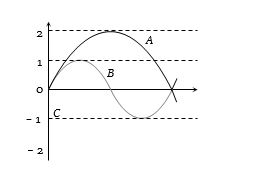
The displacement-time graphs for two sound waves $A$ and $B$ are shown in the figure, then the ratio of their intensities ${I_A}/{I_B}$ is equal to
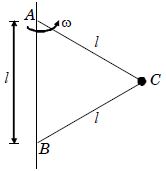
As shown in the figure, two strings of length $l$ each are attached with a vertical axis $AB$ of length $l$. Strings are $AC$ and $BC$. At point $C$ a point mass m is attached. Mass rotates about axis with angular velocity. Tensions in $AB$ and $BC$ are $T_1$ and $T_2$ respectively. Choose the $CORRECT$ alternative :-
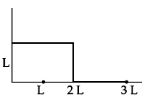
The position vector of the centre of mass $\vec r\, cm$ of an asymmetric uniform bar of negligible area of cross-section as shown in figure is
Newton's second law gives the measure of
A physical quantity $P$ is given by $P= \frac{{{A^3}{B^{\frac{1}{2}}}}}{{{C^{ - 4}}{D^{\frac{3}{2}}}}}$. The quantity which brings in the maximum percentage error in $P$ is
Water $\left(\rho=1000 \,kg / m ^3\right)$ and kerosene $\left(\sigma=800 \,kg / m ^3\right)$ are filled in two identical cylindrical vessels. Both vessels have small holes at their bottom. The speed of the water and kerosene coming out of their holes are $v_1$ and $v_2$ respectively. Select the correct alternative
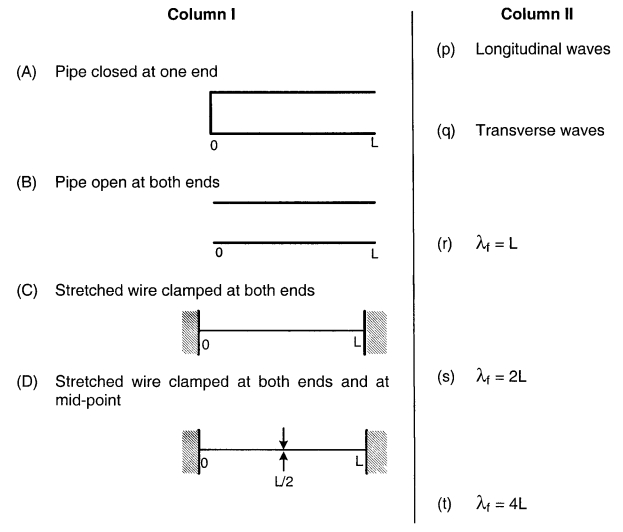
Column $I$ shows four systems, each of the same length $L$, for producing standing waves. The lowest possible natural frequency of a system is called its fundamental frequency, whose wavelength is denoted as $\lambda_{ f }$. Match each system with statements given in Column $II$ describing the nature and wavelength of the standing waves.
$A$ block of mass $m$ moving with a velocity $v_0$ on a smooth horizontal surface strikes and compresses a spring of stiffness $k$ till mass comes to rest as shown in the figure. This phenomenon is observed by two observers:

$A$: standing on the horizontal surface

$B$: standing on the block According to the observer $A$