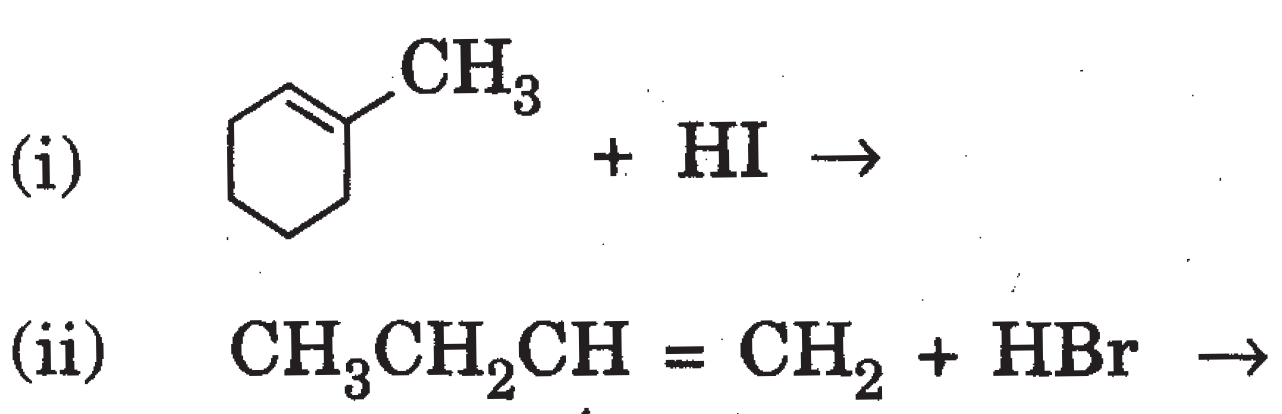
Question
Answer the following questions.
a-amino acids have relatively higher melting points than the corresponding halo acids. Explain.

Answer

$\alpha-\text{Amino}$ acids act as zwitter ions, (H3N+-CHR-COO- ) or dipolar ions. Due to this dipolar salt-like structure, they have strong dipole-dipole interactions. Therefore, their melting points are higher than the corresponding halo acids which do not exist as zwitter ions.

Need a full question paper?

Generate a complete, print-ready paper with questions like this in minutes — across 16+ boards, with answer keys.

Start Generating Free

Similar questions

(i) When does sickle cell anemia disease appears?
(ii) What is the difference between the structure formula of thymine and uracil?
(iii) Define heredity and chromosome.
Explain Pseudo first order reaction with example.
Compound (A) is formed when benzene diazonium chloride is mixed with KI solution. Compound (B) is formed when ( A ) reacts with sodium in the presence of dry ether. Write the names of (A) and (B) and the equations of the chemical reactions involved.
The initial concentration of $N _2 O _5$ in the following first order reaction.
$N _2 O _{5(g)} \rightarrow 2 NO _{2(g)}+\frac{1}{2} O _{2(g)}$ was $1.24 \times 10^{-2}$ $molL ^{-1}$ at 318 K. The concentration of $N _2 O _5$ after 60 minutes was $0.20 \times 10^{-2} molL ^{-1}$. Calculate the rate constant of the reaction at 318 K .
Nitrogen pentoxide decomposes according to equation: $\text{2N}_{2}\text{O}_{5}\text{(g)}\rightarrow\text{4NO}_{2}\text{(g)}+\text{O}_{2}\text{(g)}.$
This first order reactionwas allowed to proceed at 40° C and the data below were collected:
[N2O5](M) Time (min)
0.400 0.00
0.289 20.0
0.209 40.0
0.151 60.0
0.109 80.0
  1. Calculate the rate constant. Include units with your answer.
  2. What will be the concentration of N2O5 after 100 minutes?
  3. Calculate the initial rate of reaction.
Complete the following reaction equations:

How to find out $K_b$ and $K_f$ ?
A 1.00 molal aqueous solution of trichloroacetic acid (CCl3COOH) is heated to its boiling point. The solution has the boiling point of 100.18 °C. Determine the van't Hoff factor for trichloroacetic acid. (Kb for water = 0.512 K kg mol–1).
Define the following terms:
  1. Limiting molar conductivity.
  2. Fuel cell.
What is called electrochemical equivalent (Z)?