Question

Answer

(i) Above elements belong to group 1.
(ii)
Li152
Na186
K231
Rb244
Cs262

(iii) Yes. As we go down a group number of shells increases, therefore the atomic radii also increases.
(iv) 'Cs' has the biggest atom and 'Li' has the smallest atom.
(v) Atomic radii increases down a group, as number of shells are adding one at a time.

Need a full question paper?

Generate a complete, print-ready paper with questions like this in minutes — across 16+ boards, with answer keys.

Start Generating Free

Similar questions

The organs P and Q of two animals have different structures but similar functions. On the other hand, the two organs R and S of two other animals have the same basic structure but different functions.
  1. What are the organs like P and Q known as?
  2. Name the organs like P and Q. Also name the animals which have such organs.
  3. What are the organs like R and S called?
  4. Name the organs like R and S. Also name the animals which have such organs.
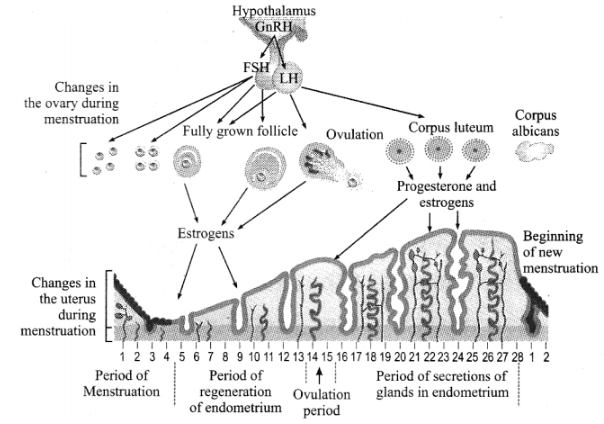
Observe the diagram of menstrual cycle and answer the following questions:
Image
(1) What is the period of menstruation?
(2) On which day does ovulation occur during menstrual cycle?
(3) During which period is corpus luteum active during menstrual cycle? Which hormones are secreted by corpus luteum ?
(4) In menstrual cycle which reproductive organs undergo changes?
(5) Which period is said to be period of regeneration of endometrium?
(6) Which period is said to be period of secretions of glands in endometrium?
What is meant by latent heat? How will the state of matter transform if latent heat is given off?
You are given three resistances of 1,2 and 3 ohms. Show by diagrams, how with the help of these resistances you can get:
  1. $6\Omega$
  2. $\frac{6}{11}\Omega$
  3. $1.5\Omega$
Give four uses of decomposition reaction.
Which different aspects of disaster management would you check for your school? Why?
Attempts at various levels are performed for conserving environment. Which role would you like to perform. Give two actions each:
i. Prevention
ii. Control
iii. Production
iv. Awareness
v. Conservation
What are the different types of tropisms? Define each type of tropism. Write the name of stimulus in each case.
Every household produces a lot of material A daily. In one of the methods of disposal B, material A is burned at a very high temperature of about 1000°C in a structure called C. During this process, the organic matter present is removed as D and E whereas F is left behind (which can be dumped in a landfill site).
  1. What is material A?
  2. Name the method of disposal B.
  3. What is structure C known as?
  4. What are (i) D (ii) E, and (iii) F?
  5. This method is especially suitable for the disposal of materials produced by certain institutions. Name such institutions.
What are the advantages of the periodic table?