Question
Assertion  :  The drift velocity of electrons in a metallic wire will decrease, if the temperature of the wire is increased.
Reason      : On increasing temperature, conductivity of metallic wire decreases.(a) If both assertion and reason are true and the reason is the correct explanation of the assertion.(b) If both assertion and reason are true but reason is not the correct explanation of the assertion.(c) If assertion is true but reason is false.(d) If the assertion and reason both are false.


Answer

(b) If both assertion and reason are true but reason is not the correct explanation of the assertion.

Need a full question paper?

Generate a complete, print-ready paper with questions like this in minutes — across 16+ boards, with answer keys.

Start Generating Free

Similar questions

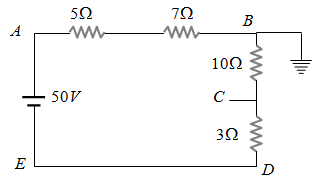
In the circuit shown, the point $‘B\ ’$ is earthed. The potential at the point $‘A\ ’$ is
A piece of copper and the other of germanium are cooled from the room temperature to 80 K, then which of the following would be a correct statement(a) Resistance of each increases(b) Resistance of each decreases(c) Resistance of copper increases while that of germanium decreases (d) Resistance of copper decreases while that of germanium increases


Thermionic emission from a heated filament varies with its temperature $T$ as
Assertion :  In everyday life the Doppler’s effect is observed readily for sound waves than light waves.
Reason     : Velocity of light is greater than that of sound.(a) If both assertion and reason are true and the reason is the correct explanation of the assertion.(b) If both assertion and reason are true but reason is not the correct explanation of the assertion.(c) If assertion is true but reason is false.(d) If the assertion and reason both are false.


The electrostatic force between two point charges $q_1$​ and $q_2​$ at separation $'r\ '$ is given by $\text{F}=\frac{\text{K}_\text{q1q2}}{\text{r}^2}.$​​ The constant $K:$
Which of the following statement is false for the properties of electromagnetic waves?
When a potential difference is applied across the ends of a linear metallic conductor(a) The free electrons are accelerated continuously from the lower potential end to the higher potential end of the conductor(b) The free electrons are accelerated continuously from the higher potential end to the lower potential end of the conductor(c) The free electrons acquire a constant drift velocity from the lower potential end to the higher potential end of the conductor(d) The free electrons are set in motion from their position of rest


One of the following wavelengths is absent and the rest are present in the X-rays coming from a Coolidge tube. Which one is the absent wavelength?
  1. 25pm
  2. 50pm
  3. 75pm
  4. 100pm
Lenz's law is a consequence of the law of conservation of:
A spectrum is formed by a prism of dispersive power ‘ω’. If the angle of deviation is ‘δ’, then the angular dispersion is(a) ω/δ    (b) δ / ω (c) 1/ ωδ (d) ω δ