MCQ
Thermionic emission from a heated filament varies with its temperature $T$ as
  • A
    $\mathrm{T}^{-1}$
  • B
    $T$
  • $\mathrm{T}^2$
  • D
    $\mathrm{T}^{3 / 2}$

Answer

Correct option: C.
$\mathrm{T}^2$
$\mathrm{T}^2$

Need a full question paper?

Generate a complete, print-ready paper with questions like this in minutes — across 16+ boards, with answer keys.
Start Generating Free

Similar questions

A radioactive nucleus undergoes a series of decay according to the scheme $A \xrightarrow{\alpha} A_1 \xrightarrow{\beta} A_2 \xrightarrow{\alpha} A_3 \xrightarrow{\gamma} A_4$ If the mass number and atomic number of $A$ are $180$ and $72$ respectively, then what are these number for $A_4$
The $K_\alpha\ X-$ray emission line of tungsten occurs at $λ = 0.021\ nm.$ The energy difference between $K$ and $L$ levels in this atom is about
Soap bubble appears coloured due to the phenomenon of(a) Interference(b) Diffraction(c) Dispersion(d) Reflection
       
Which of the following properties of light conclusively support wave theory of light?
Work done by a sample of an ideal gas in a process $A$ is double the work done in another process $B$. The temperature rises through the same amount in the two processes. If $C_A$ and $C_B$ be the molar heat capacities for the two processes:
How can we combine three capacitors of $2 \mu F$ each to get $3 \mu F$ capacitance?
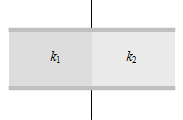
A parallel plate condenser is filled with two dielectrics as shown. Area of each plate is $A$ metre$^2$ and the separation is $t$ metre. The dielectric constants are $k _1$ and $k _2$ respectively. Its capacitance in farad will be
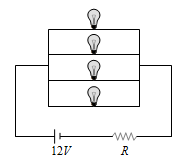
Four identical electrical lamps are labelled $1.5V, 0.5A$ which describes the condition necessary for them to operate at normal brightness. A $12V$ battery of negligible internal resistance is connected to lamps as shown, then
The maximum wavelength of radiation that can produce photoelectric effect in a certain metal is 200 nm. The maximum kinetic energy acquired by electron due to radiation of wavelength 100 nm will be(a) 12.4 eV(b) 6.2 eV(c) 100 eV(d) 200 eV
       
In Young's double slit experiment how many maximas can be obtained on a screen $($including the central maximum$)$ on both sides of the central fringe if $\lambda=2000 \mathring A$ and $d=700 \mathring A$