Question
Assume that each atom in a copper wire contributes one free electron. Estimate the number of free electrons in a copper wire having a mass of 6.4g (take the atomic weight of copper to be 64g mol-1.

Answer

64 grams of copper have 1 mole
6.4 grams of copper have 0.1 mole
1 mole = No atoms
0.1 mole = (no × 0.1) atoms
= 6 × 1023 × 0.1 atoms = 6 × 10²² atoms
1 atom contributes 1 electron
6 × 10²² atoms contributes 6 × 10²² electrons.

Need a full question paper?

Generate a complete, print-ready paper with questions like this in minutes — across 16+ boards, with answer keys.
Start Generating Free

Similar questions

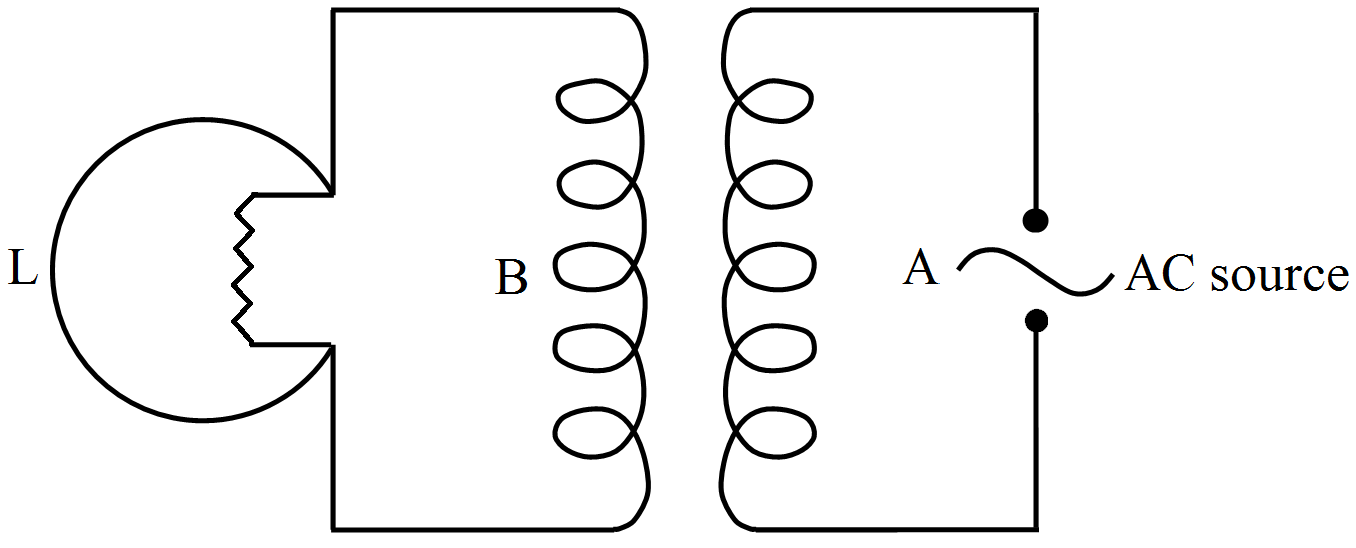
In the given diagram, a coil B is connected to low voltage bulb L and placed parallel to another coil A as shown. Explain the following observations:

  1. Bulb lights.
  2. Bulb gets dimmer if the coil B moves upwards.
Two narrow slits emitting iight in phase are separated by a distance of 1.0cm. The wavelength of the light is 5.0 × 10⁻⁷m. The interference pattern is observed on a screen placed at a distance of 1.0m.
  1. Find the separation between the consecutive maxima. Can you expect to distinguish between these maxima?
  2. Find the separation between the sources which will give a separation of 1.0mm between the consecutive maxima.
Calculate the Q-value of the fusion reaction
4He + 4He = 8Be.
Is such a fusion energetically favourable? Atomic mass of 8Be is 8.0053u and that of 4He is 4.0026u.
A person standing on a platform finds that a train moving with velocity 0.6c takes one second to pass by him. Find:
  1. The length of the train as seen by the person and.
  2. The rest length of the train.
Sketch a graph between frequency of incident radiations and stopping potential for a given photosensitive material. What information can be obtained from the value of the intercept on the potential axis? A source of light of frequency greater than the threshold frequency is placed at a distance of 1 m from the cathode of a photo-cell. The stopping potential is found to be V. If the distance of the light source from the cathode is reduced, explain giving reasons, what change will you observe in the.
  1. photoelectric current,
  2. stopping potential.
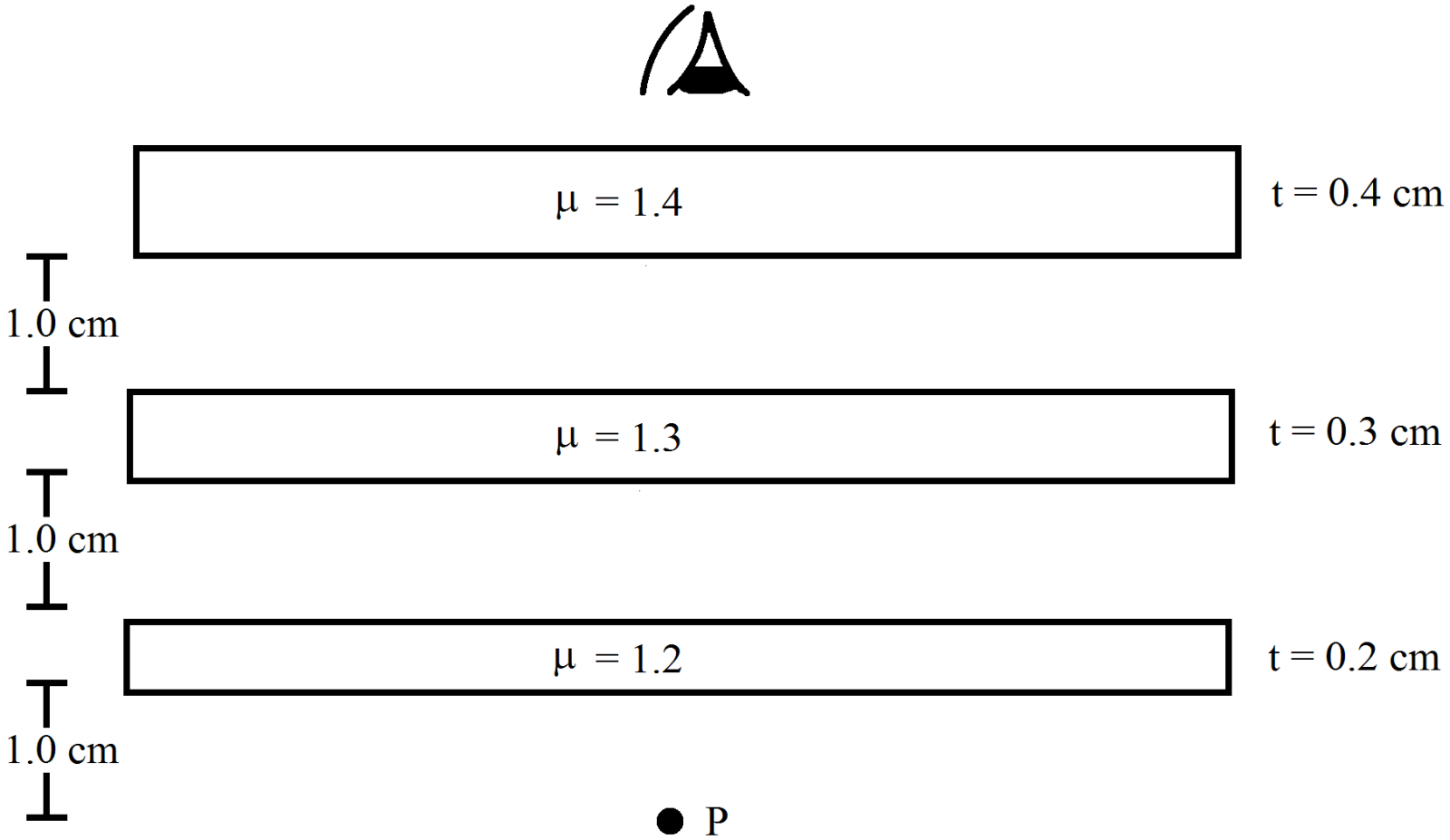
Locate the image of the point P as seen by the eye in the figure.

Calculate the energy that can be obtained from 1kg of water through the fusion reaction
2H + 2H → 3H + p.
Assume that 1.5 × 10⁻²% of natural water is heavy water D2O (by number of molecules) and all the deuterium is used for fusion.
In a typical Indian Bugghi (a luxury cart drawn by horses), a wooden plate is fixed on the rear on which one person can sit. A bugghi of mass 200kg is moving at a speed of 10km/h. As it overtakes a school boy walking at a speed of 4km/h, the boy sits on the wooden plate. If the mass of the boy is 25kg, what will be the new velocity of the bugghi?
Explain with the help of a diagram, how a depletion layer and barrier potential are formed in a junction diode.