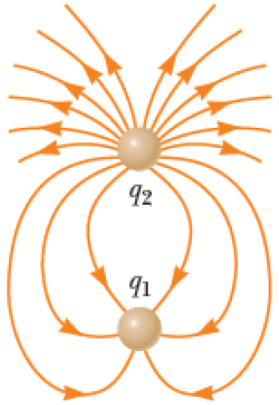
Hence, two equipotential surfaces cannot cut each other.
27 questions · timed · auto-graded
$\text{G}=50\mu\text{C}=50\times10^{-6}\text{C}$
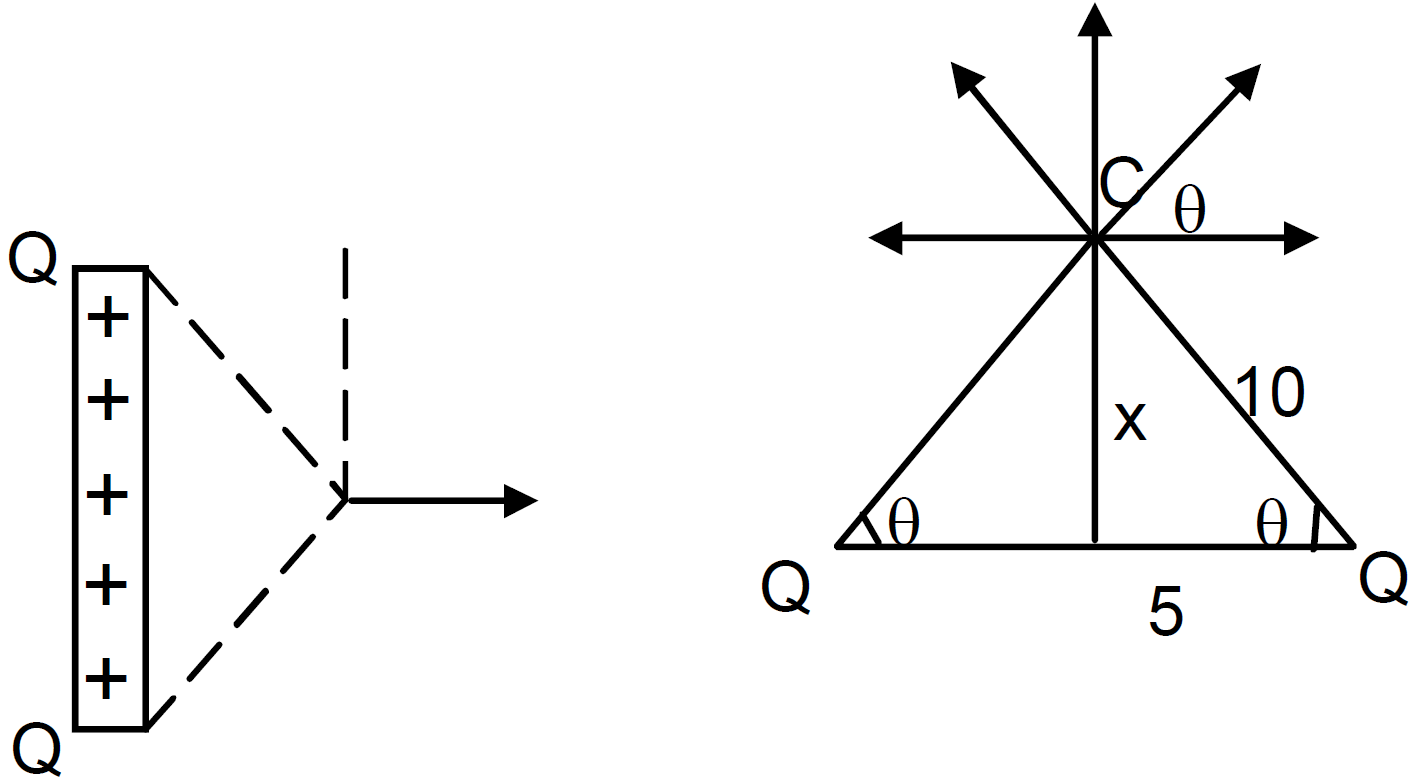
We have, $\text{E}=\frac{2\text{KQ}}{\text{r}}$ for a charged cylinder
$\Rightarrow\text{E}=\frac{2\times9\times10^9\times50\times10^{-6}}{5\sqrt{3}}$
$=\frac{9\times10^{-5}}{5\sqrt{3}}$
$=1.03\times10^{-5}$
Mass of the bob = 100g = 0.1kg
So Tension in the string = 0.1 × 9.8 = 0.98N.
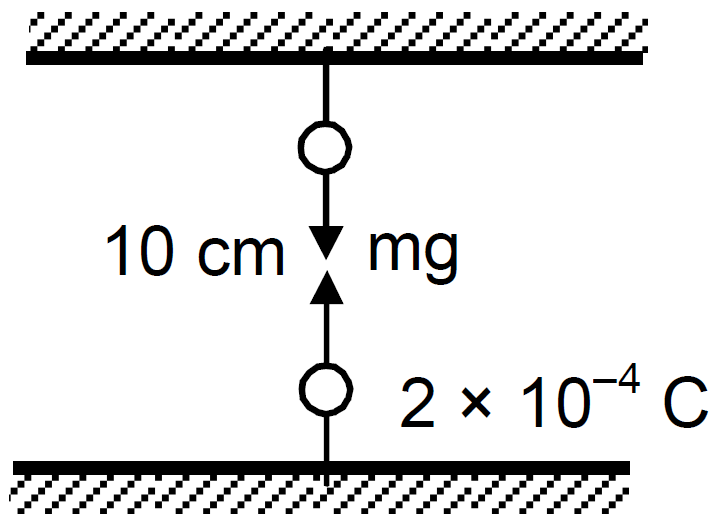
For the Tension to be 0, the charge below should repel the first bob.
$\Rightarrow\text{F}=\frac{\text{kq}_1\text{q}_2}{\text{r}^2}$ $\big[\text{T}-\text{mg}+\text{F}=0\ \Rightarrow\text{T}=\text{mg}-\text{f},\ \text{T}=\text{mg}\big]$
$\Rightarrow0.98=\frac{9\times10^9\times2\times10^{-4}\times\text{q}^2}{(0.01)^2}$
$\Rightarrow\text{q}_2=\frac{0.98\times1\times10^{-2}}{9\times2\times10^5}$
$=0.054\times10^{-9}\text{N}$
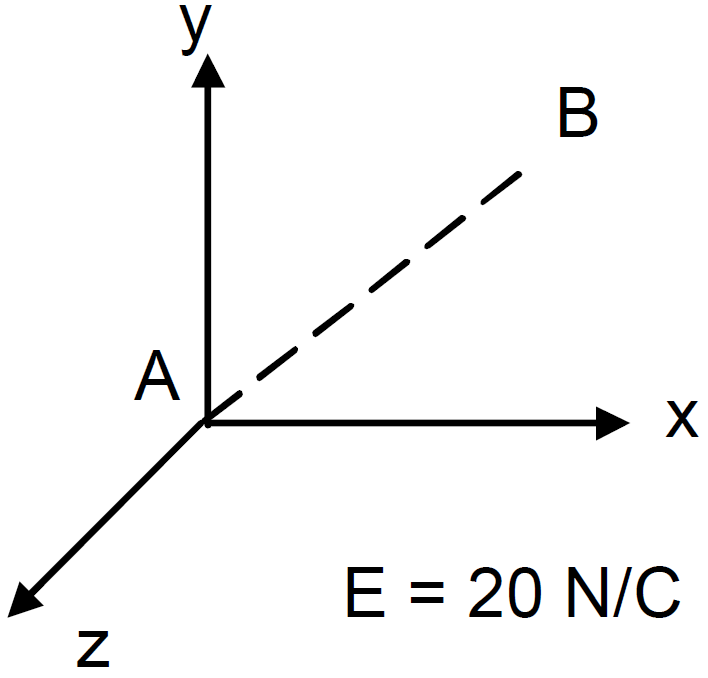
$\Rightarrow\text{V}_\text{B}-\text{V}_\text{A}=\text{E}\times\text{d}$
$=20\times\sqrt{16}$
$=80\text{V}$
$\Rightarrow\text{V}_\text{B}-\text{V}_\text{A}=\text{E}\times\text{d}$
$=20\times\sqrt{(6-4)^2}$
$=20\times2$
$=40\text{V}$
$\Rightarrow\text{V}_\text{B}-\text{V}_\text{A}=\text{E}\times\text{d}$
$=20\times\sqrt{(6-0)^2}$
$=20\times6$
$=120\text{V}.$


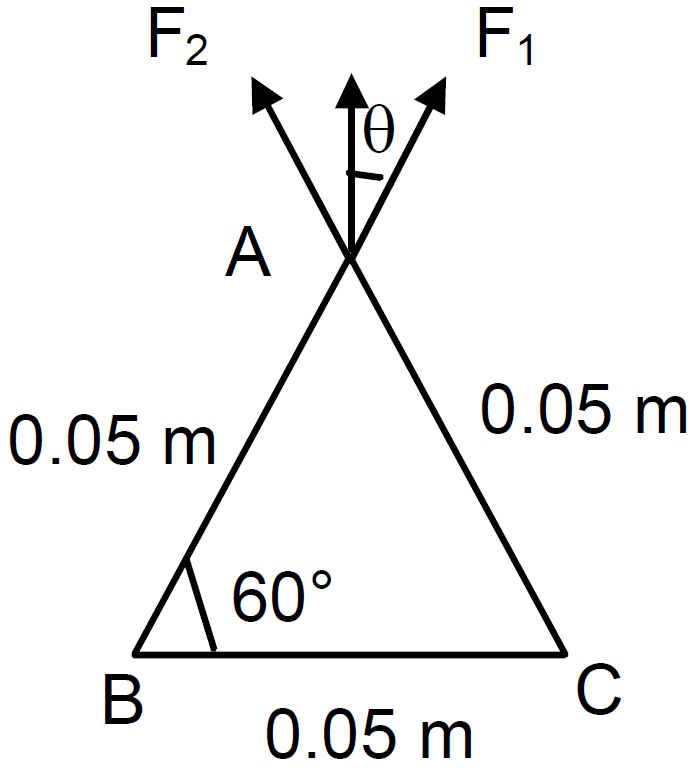
Three charges are held at three corners of a equilateral trangle.
Let the charges be A, B and C.
It is of length 5cm or 0.05m
Force exerted by B on A = F1
Force exerted by C on A = F2
So, force exerted on A = resultant F1 = F2
$\Rightarrow\text{F}=\frac{\text{kq}_2}{\text{r}^2}$
$=\frac{9\times10^9\times2\times2\times2\times10^{-12}}{5\times5\times10^{-4}}$
$=\frac{36}{25}\times10$
$=14.4$
Now, force on A = 2 × F cos 30° since it is equilateral $\triangle.$
⇒ Force on $\text{A}=2\times1.44\times\sqrt{\frac{3}{2}}$
$=24.94\text{N}.$

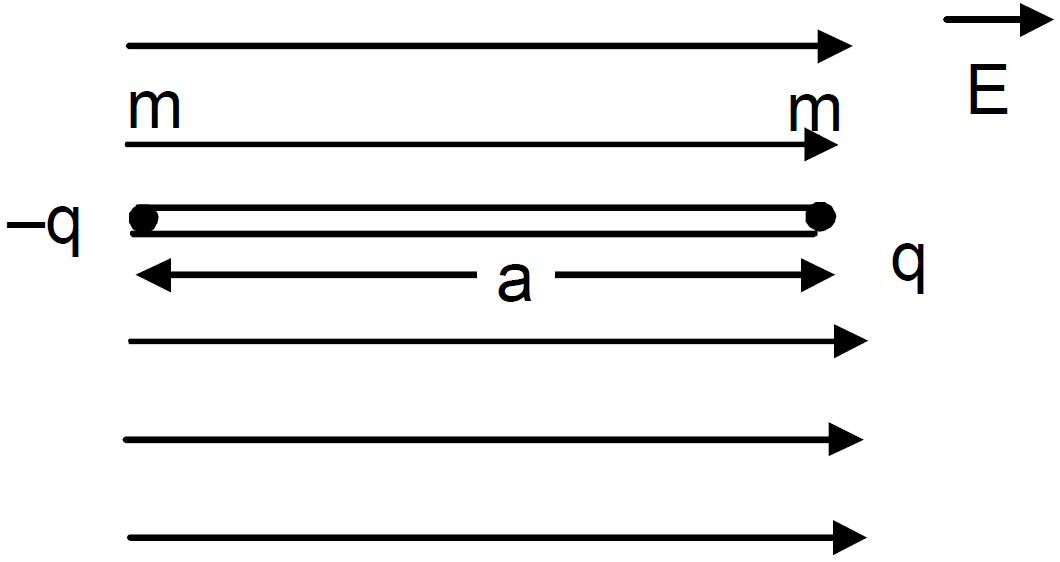
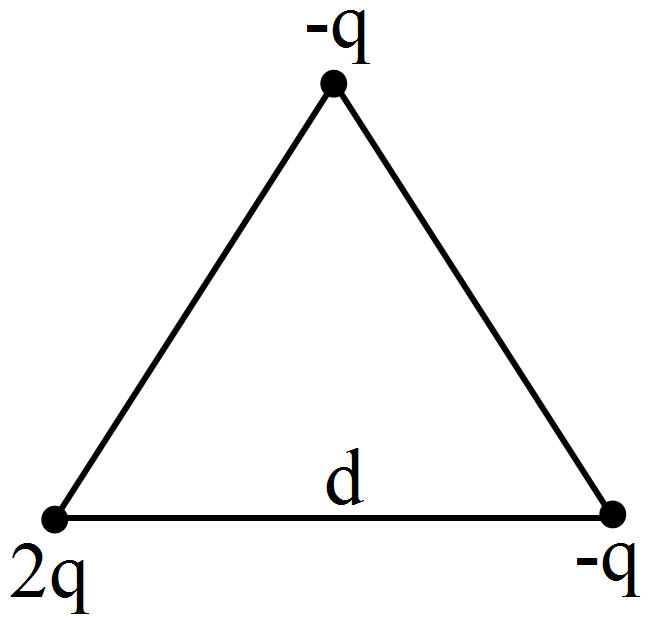
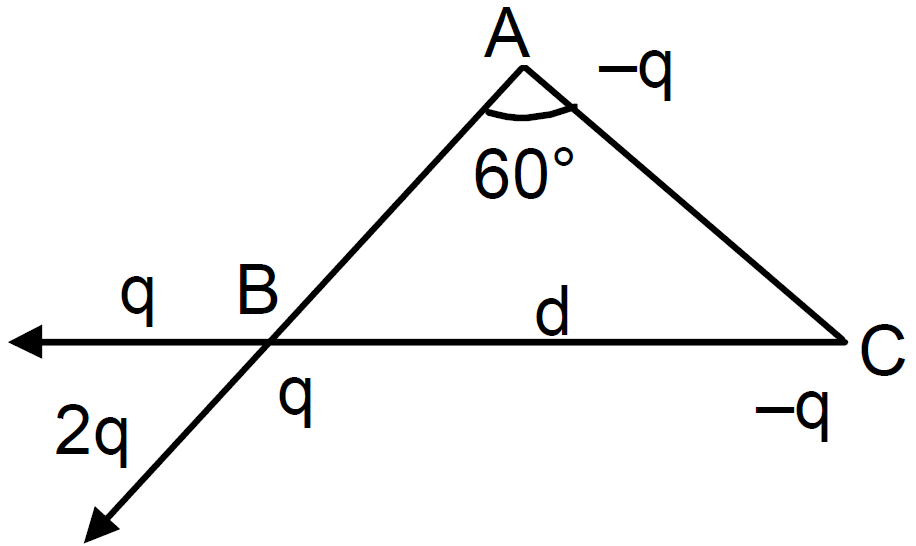
Let -q & -q are placed at A & C
Where 2q on B
So length of A = d
So the dipole moment = (q × d) = P
So, Resultant dipole moment
$\text{P}=\Big[(\text{qd})^2+(\text{qd})^2+2\text{qd}\times\text{qd}\cos60^\circ\Big]^{\frac{1}{2}}$
$=\big[3\text{q}^2\text{d}^2\big]^{\frac{1}{2}}$
$=\sqrt{3}\text{qd}$
$=\sqrt{3}\text{p}$
$\text{m}=10\text{g}$
$\text{F}=\frac{\text{KQ}}{\text{r}}$
$=\frac{9\times10^9\times2\times10^{-4}}{10\times10^{-2}}$
$\text{F}=1.8\times10^{-7}$
$\text{F}=\text{m}\times\text{a}$
$\Rightarrow\text{a}=\frac{1.8\times10^{-7}}{10\times10^{-3}}$
$=1.8\times10^{-3}\text{m/s}^2$
$\text{V}^2-\text{u}^2=2\text{as}$
$\Rightarrow\text{V}^2=\text{u}^2+2\text{as}$
$\text{V}=\sqrt{0+2\times1.8\times10^{-3}\times10\times10^{-2}}$
$=\sqrt{3.6\times10^{-4}}$
$=0.6\times10^{-2}$
$=6\times10^{-3}\text{,m/s}.$
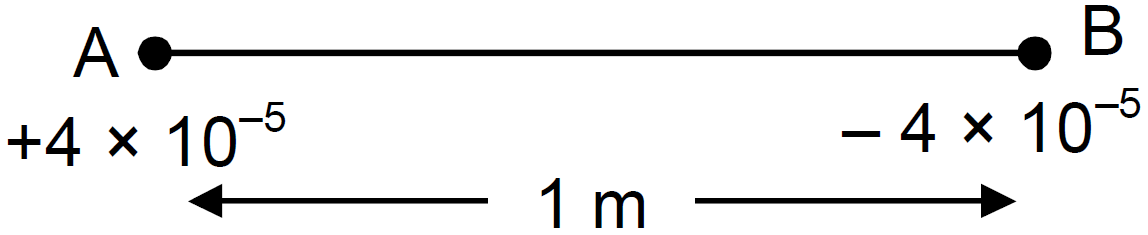
$\text{q}_1=\text{q}_2=4\times10^{-5}$
$\text{s}=1\text{m},\ \text{m}=5\text{g}$
$=0.005\text{kg}$
$\text{F}=\text{K}\frac{\text{q}^2}{\text{r}^2}$
$=\frac{9\times10^9\times\big(4\times10^{-5}\big)^2}{1^2}$
$=14.4\text{N}$
Acceleration ‘a’ $=\frac{\text{F}}{\text{m}}$
$=\frac{14.4}{0.005}$
$=2880\text{m/s}^2$
Now, $\text{u}=0,$
$\text{s}=50\text{cm}=0.5\text{m}$
$\text{a}=2880\text{m/s}^2,\ \text{V}=?$
$\Rightarrow\text{V}=\sqrt{2880}$
$=53.66\text{m/s}\approx54\text{m/s}$ for each particle.

$\text{m}=10,\ \text{mg}=10\times10^{-3}\text{g}\times10^{-3}\text{kg},$
$\text{q}=1.5\times10^{-6}\text{C}$
But $\text{qE}=\text{mg}$
$\Rightarrow(1.5\times10^{-6})\text{E}=10\times10^{-6}\times10$
$\Rightarrow\text{E}=\frac{10\times10^{-4}\times10}{1.5\times10^{-6}}$
$=\frac{100}{1.5}=66.6\text{N/C}$
$=\frac{100\times10^3}{1.5}=\frac{10^{5+1}}{15}$
$=6.6\times10^{3}$