Question
Assume the dipole model for earth's magnetic field B which is given by $B_V =$ vertical component of magnetic field $=\frac{\mu_0}{4\pi}\frac{2\text{m}\cos\theta}{\text{r}^3}$
$B_H =$ Horizontal component of magnetic field $=\frac{\mu_0}{4\pi}\frac{\sin\theta\text{m}}{\text{r}^3}$
θ = 90º - lattitude as measured from magnetic equator. Find loci of points for which,
  1. |B| is minimum,
  2. Dip angle is zero,
  3. Dip angle is ± 45º.

Answer

  1. $\text{B}_\text{V}=\frac{\mu_02\text{m}\cos\theta}{4\pi}$
$\text{B}_\text{H}=\frac{\mu_0}{4\pi}\frac{\text{m}\sin\theta}{\text{r}^3}$
These are the components of B to net magnetic field will be
$\text{B}=\sqrt{\text{B}_\text{v}^2+\text{B}_\text{H}^2}=\frac{\mu_0\text{m}}{4\pi\text{r}^3}\big[3\cos^{2}\theta+1\big]^\frac{1}{2}$
From above equation, the value of B is minimum, if cos $\theta=\frac{\pi}{2}$.
$\theta=\frac{\pi}{2}$. Thus, B is minimum at the magnetic equator.
  1. Angle of dip,
$\tan\delta=\frac{\text{B}_\text{V}}{\text{B}_\text{H}}=\frac{\frac{\mu_0}{4\pi}.\frac{2\text{m}\cos\theta}{\text{r}^3}}{\frac{\mu_0}{4\pi}.\frac{\sin\theta.\text{m}}{\text{r}^3}}=2\cot\theta\ .....(\text{i})$
$\tan\delta=2\cot\theta$
For dip angle is zero i.e., $\delta = 0$
$\cot\theta=0$
$\theta=\frac{\pi}{2}$
For this value of $\theta$ angle fo dip is vanished. It means that locus is again magnetic equator.
  1. $\tan\delta=\frac{\text{B}_\text{V}}{\text{B}_\text{H}}$
Angle of dip i.e., $\delta=\pm45^\circ$
$\frac{\text{B}_\text{V}}{\text{B}_\text{H}}=\tan(\pm45^\circ)$
$\frac{\text{B}_\text{V}}{\text{B}_\text{H}}=1$
$2\cot\theta=1\ \big[\text{From Eq. (i)}\big]$
$\cot\theta=\frac{1}{2}$
$\tan\theta=\frac{1}{2}$
$\Rightarrow\ \theta=\tan^{-1}(2)$
Thus, $\theta=\tan^{-1}(2)$ is the locus.

Need a full question paper?

Generate a complete, print-ready paper with questions like this in minutes — across 16+ boards, with answer keys.

Start Generating Free

Similar questions

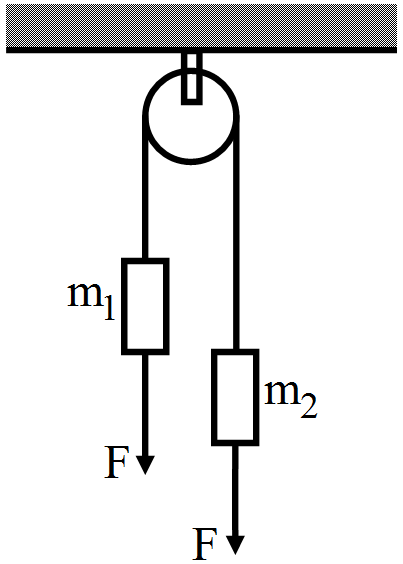
In figure $m_1 = 5kg, m_1 = 2kg$ and F = 1N. Find the acceleration of either block. Describe the motion of $m_1$ if the string breaks but F continues to act.
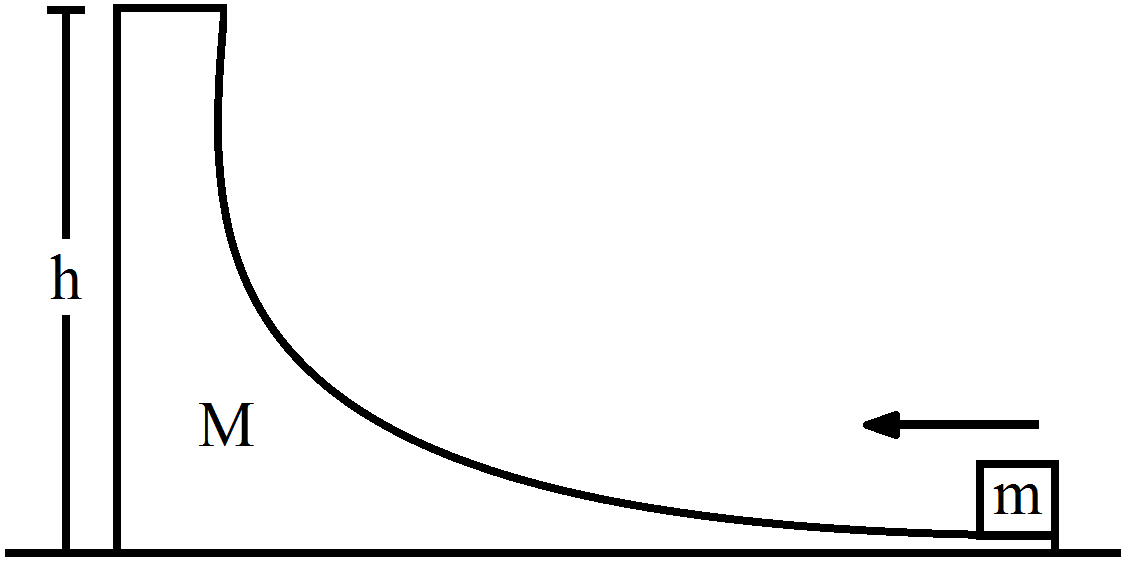
Figure shows a small body of mass m placed over a larger mass M whose surface is horizontal near the smaller mass and gradually curves to become vertical. The smaller mass is pushed on the longer one at a speed v and the system is left to itself. Assume that all the surfaces are frictionless.
  1. Find the speed of the larger block when the smaller block is sliding on the vertical part.
  2. Find the speed of the smaller mass when it breaks off the larger mass at height h.
  3. Find the maximum height (from the ground) that the smaller mass ascends.
  4. Show that the smaller mass will again land on the bigger one. Find the distance traversed by the bigger block during the time when the smaller block was in its flight under gravity.
  1. Write the expression for the force, $\overrightarrow{\text{F}}$, acting on a charged particle of charge 'q', moving with a velocity$\overrightarrow{\text{v}}$ in the presence of both electric field $\overrightarrow{\text{E}}$and magnetic field $\overrightarrow{\text{B}}.$ Obtain the condition under which the particle moves undeflected through the fields.
  2. A rectangular loop of size l x b carrying a steady current I is placed in a uniform magnetic field $\overrightarrow{\text{B}}.$ Prove that the torque$\overrightarrow{\tau}$ acting on the loop is given by $\overrightarrow{\tau} =\overrightarrow{\text{m}}\times\overrightarrow{\text{B},}$were $\overrightarrow{\text{m}}$is the magnetic moment of the loop.
A simple pendulum is constructed by hanging a heavy ball by a 5.0m long string. It undergoes small oscillations.
  1. How many oscillations does it make per second?
  2. What will be the frequency if the system is taken on the moon where acceleration due to gravitation of the moon is $1.67m/s^2.$
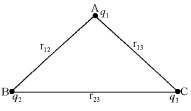
Write the definition of electrostatic at any point. Also write its S.I. units. As shown in the figure, three points charges $q_1$, $q _2$ and $q _3$ are placed at points $A, B$ and $C$ respectively. Drive an expression for the electrostatic potential energy of this system.

Image
Two point charges of magnitude +q and -q are placed at $\Big(-\frac{\text{d}}{2},0,0\Big)$ and $\Big(\frac{\text{d}}{2},0,0\Big)$, respectively. Find the equation of the equipoential surface where the potential is zero.

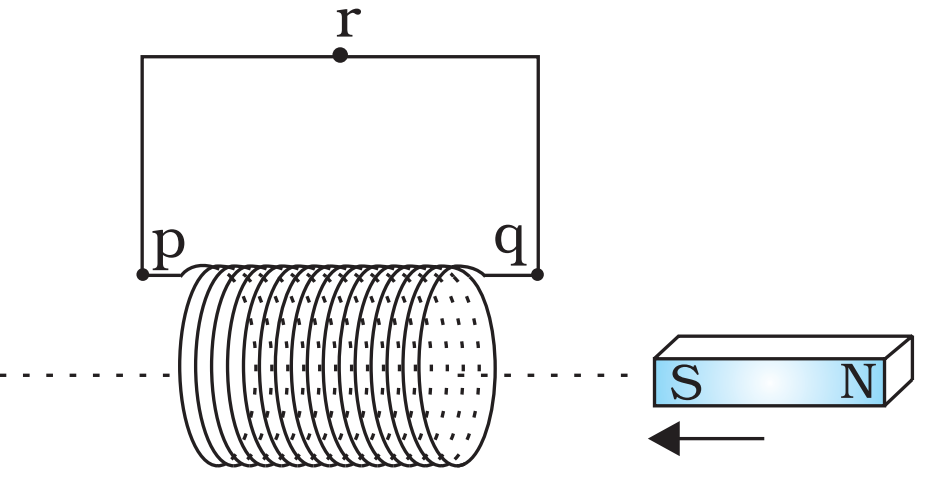
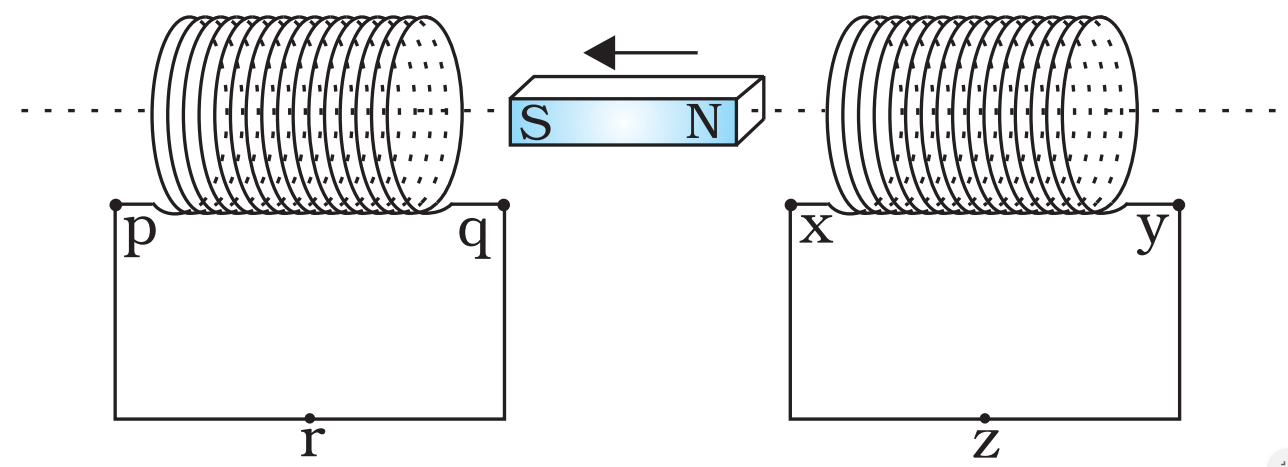
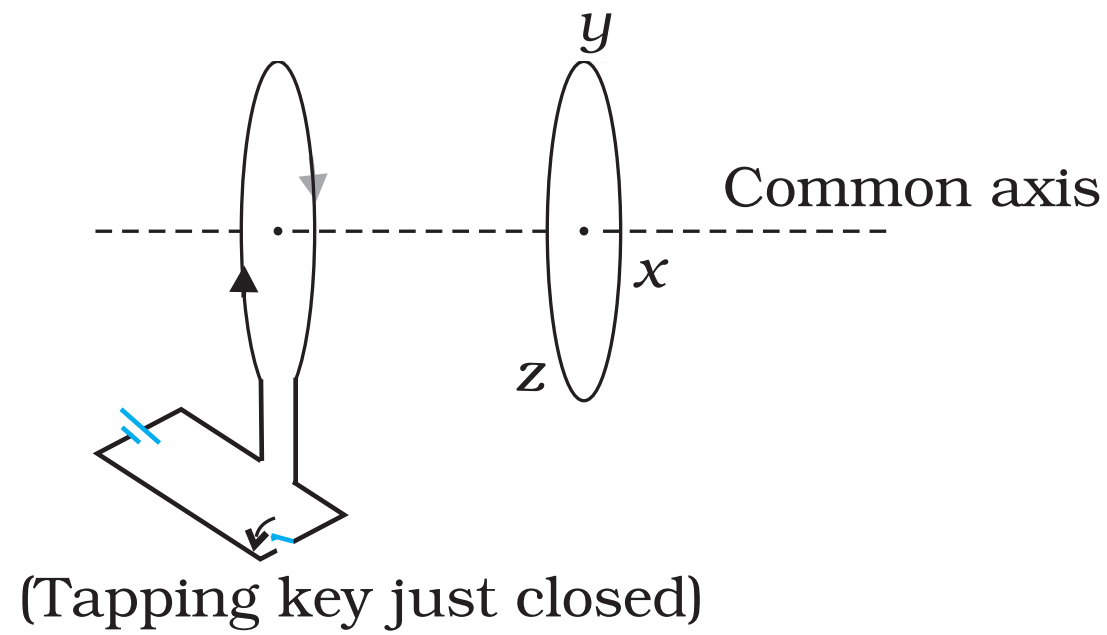
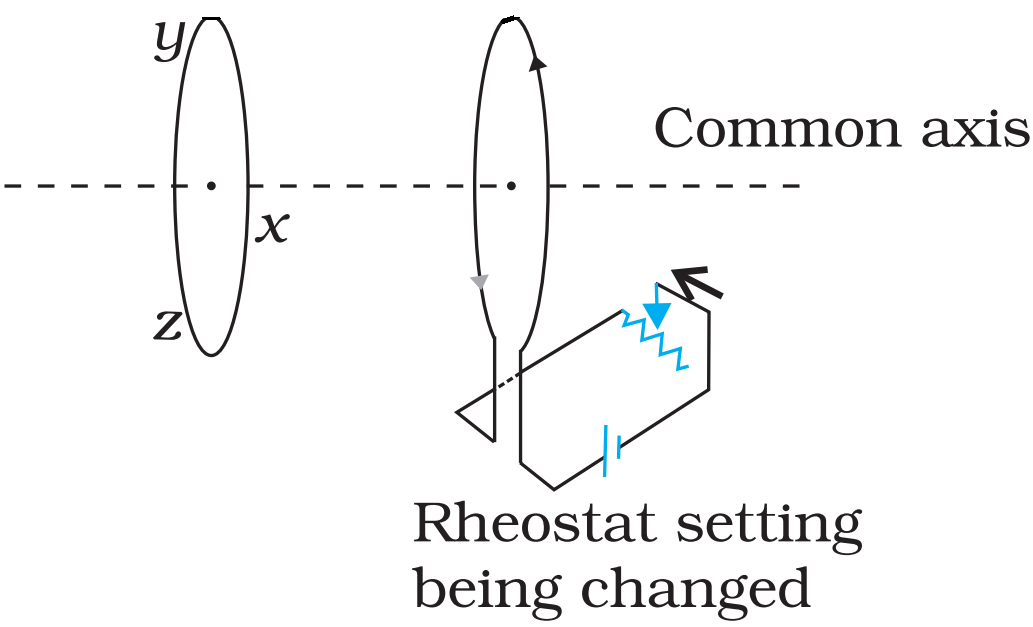
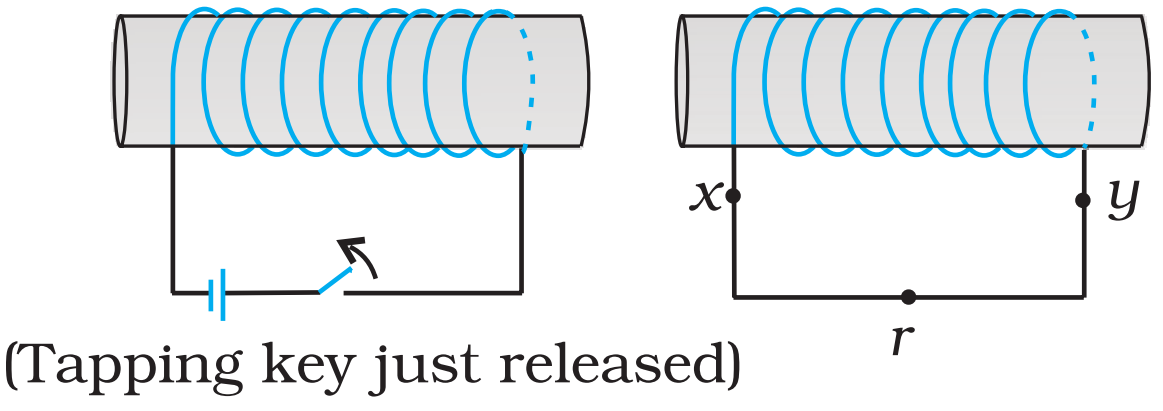
Predict the direction of induced current in the situations described by the following Figs. (a) to (f).
  1.  
  1.  
  1.  
  1.  
  1.  
  1.  
A convex lens of focal length 20cm and a concave lens of focal length 10cm are placed 10cm apart with their principal axes coinciding. A beam of light travelling parallel to the principal axis and having a beam diameter 5.0mm, is incident on the combination. Show that the emergent beam is parallel to the incident one. Find the beam diameter of the emergent beam.
Do magnetic forces obey Newton's third law. Verify for two current elements $\text{dI}_1=\text{dI}\hat{\text{i}}$ located at the origin and $\text{dI}_2=\text{dI}\hat{\text{j}}$ located at (0, R, 0). Both carry current I.
A neutron moving with a speed υ strikes a hydrogen atom in ground state moving towards it with the same speed. Find the minimum speed of the neutron for which inelastic (completely or partially) collision may take place. The mass of neutron = mass of hydrogen $= 1.67 \times 10^{-27}kg.$