Correct option: B.$2{{\tan }^{-1}}\frac{4}{\sqrt{13}}$
B
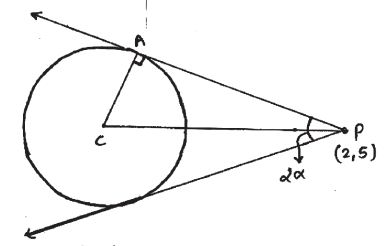
અહી વર્તુળનું કેન્દ્ર $C (0, 0)$ તથા બિંદુ $P (2, 5)$ છે.
$\therefore CP = \sqrt{(2 - 0)^2 + (5 - 0)^2}$
$= \sqrt{29}$
હવે $\triangle \ ACP$ માં $m \angle A= \frac{\pi}{2}$
$\therefore AC^2 + AP^2 = CP^2$
$\therefore AP^2 = CP^2 - AC^2$
$\therefore AP^2 = 29 - 16$
$\therefore AP =\sqrt{13}$
ધારો કે બહારના બિંદુ $P$ આગળ સ્પર્શકોથી બનતા ખૂણાનું માપ $2 \alpha$ છે.
$\therefore$ અર્ધકોણ $\alpha$ થશે.
$\therefore \ \triangle ACP$ માટે , $tan \alpha = \frac{CA}{AP} = \frac{4}{\sqrt{13}}$
$\alpha = tan^{-1} \frac{4}{\sqrt{13}}$
$P$ આગળના ખૂણાનું માપ $= 2 \alpha$
$= 2tan^{-1}\frac{4}{\sqrt{13}}$