MCQ
Bragg’s law for $X-$ rays is
  • A
    $d sin$ $\theta = 2n\lambda $
  • $2d\,\sin \,\theta = n\lambda $
  • C
    $n\sin \theta = 2\lambda d$
  • D
    None of these

Answer

Correct option: B.
$2d\,\sin \,\theta = n\lambda $
b
(b) Suppose, and X-ray bean is incident on a solid, making an angle $\theta$ with the planes of the atoms. These $\mathrm{X}$ -rays are diffracted by different atoms and the diffracted rays interfere. In certain directions, the interference is constructive and we obtain strong reflected $X$ -rays. The analysis shows that there will be a strong reflected $x$ -ray beam only if $2 d \sin \theta=n \lambda$

Need a full question paper?

Generate a complete, print-ready paper with questions like this in minutes — across 16+ boards, with answer keys.
Start Generating Free

Similar questions

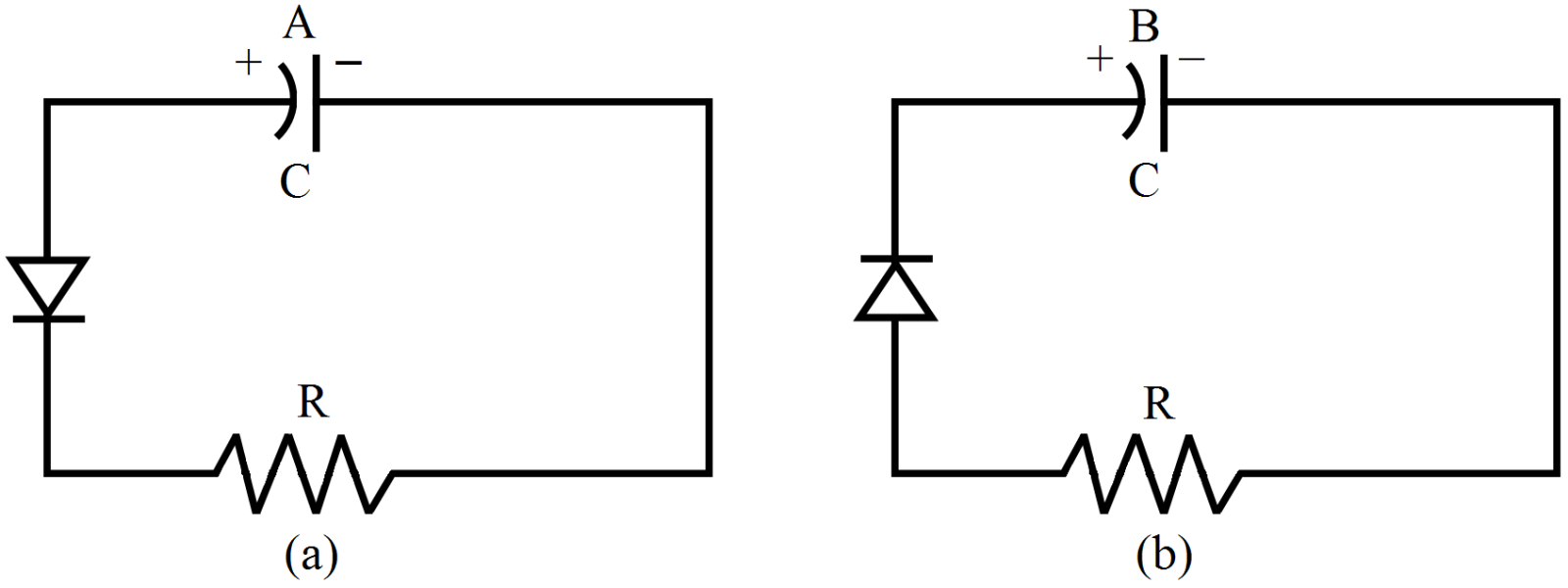
Two identical capacitors $A$ and $B$ are charged to the same potential $V$ and are connected in two circuits at $t = 0$ as shown in figure. The charges on the capahltors at a time $t = CR$ are, respectively:
Find the effective value of current  $i = 2\, sin\, 100\pi t + 2cos\,(100\pi t + 30^o)$
A conducting loop of radius $\frac{10}{\sqrt{\pi}}\,cm$ is placed perpendicular to a uniform magnetic field of $0.5\,T$. The magnetic field is decreased to $zero$ in $0.5\,s$ at a steady rate. The induced emf in the circular loop at $0.25\,s$ is:
Five balls numbered 1 to 5 are suspended using separate threads. Pairs (1, 2), (2, 4) and (4, 1) show electrostatic attraction, while pair (2, 3) and (4, 5) show repulsion. Therefore ball 1 must be
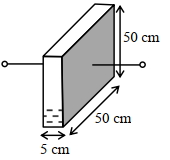
A container has a base of $50 \mathrm{~cm} \times 5 \mathrm{~cm}$ and height $50 \mathrm{~cm}$, as shown in the figure. It has two parallel electrically conducting walls each of area $50 \mathrm{~cm} \times 50 \mathrm{~cm}$. The remaining walls of the container are thin and non-conducting. The container is being filled with a liquid of dielectric constant $3$ at a uniform rate of $250 \mathrm{~cm}^3 \mathrm{~s}^{-1}$. What is the value of the capacitance of the container after $10$ seconds? [Given: Permittivity of free space $\in_0=9 \times 10^{-12} \mathrm{C}^2 \mathrm{~N}^{-1} \mathrm{~m}^{-2}$, the effects of the non-conducting walls on the capacitance are negligible]
When wavelength of incident photon is decreased then
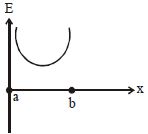
Two point charges $a$ and $b$, whose magnitudes are same are positioned at a certain  distance from each other with a at origin. Graph is drawn between electric field strength at  points between $a$ and $b$ and distance $x$ from a $E$ is taken positive if it is along the line joining from to be. From the graph, it can be decided that 
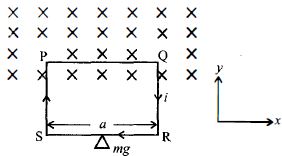
A rectangular loop of wire, supporting a mass $m$, hangs with one end in a uniform magnetic field $\overrightarrow B $ pointing out of the plane of the paper. A clockwise current is set up such that $i > mg/Ba$, where $a$ is the width of the loop. Then
Parallel rays are incident on a transparent sphere along its one diameter. After refrection these rays converge at the other end of this diameter the refractive index of the sphere is
A beaker containing liquid is placed on a table, underneath a microscope which can be moved along a vertical scale. The microscope is focussed, through the liquid onto a mark on the table when the reading on the scale is $a$. It is next focussed on the upper surface of the liquid and the reading is $b.$ More liquid is added and the observations are repeated, the corresponding readings are $c$ and $d.$ The refractive index of the liquid is