Question
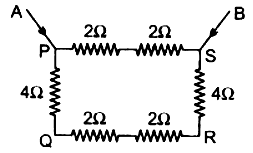
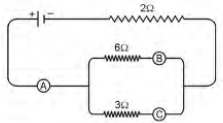
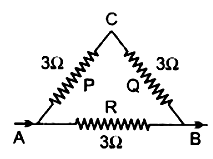
Calculate equivalent resistance in the following cases:

Answer

(i) Resistance P and Q are in series = 3 Ω + 3 Ω = 6 Ω
Resistance of 6 Ω segment and 3 Ω are parallel.
$\therefore \frac{1}{ R }=\frac{1}{6}+\frac{1}{3}=\frac{1+2}{6}=\frac{3}{6}$ or $R =2 \Omega$
(ii) Resistance of the arm PS = 2Ω +2Ω = 4Ω (in series)
Resistance of the arm QR = 2Ω + 2Ω = 4Ω (in series)
Resistance of the arm PQ, QR and RS are in series
= (4 + 4 + 4)Ω = 12Ω
Now resistance of the arm RS and arms (PQ + QR + RS) are in parallel.
$\frac{1}{ R }=\frac{1}{4}+\frac{1}{12}$
$=\frac{3+1}{12}=\frac{4}{12}$
or R = 3Ω

Need a full question paper?

Generate a complete, print-ready paper with questions like this in minutes — across 16+ boards, with answer keys.

Start Generating Free

Similar questions

A fuse is always connected to the live wire of the circuit. Explain the reason.
Describe one experiment to demonstrate the phenomenon of electromagnetic induction.

In the figure:

A house is provided with 15 bulbs of 40W, 5 bulbs of 100W, 5 fans of 80 W, and one heater of 1.0 kW. Each day bulbs are used for 4h, fans for lOh, and heater for 2h. The voltage of mains is 220 V. Calculate:
(i) Maximum power of the circuit in the house,
(ii) maximum current capacity of the main fuse in the house,
(iii) the electrical energy consumed in a week,
(iv) cost of electricity consumed at 1.25 Rs. per kWh.
(i) (a) Define volt.
(b) A wire of uniform thickness with a resistance of $27 \Omega$ is cut into three equal pieces and they are joined in parallel. Find the resistance of the parallel combination.
(ii) (a) What do you understand by the term internal resistance of cell?
(b) Which of the two cables, one of 10 A and other of 20 A will be thicker? Give one reason for your answer.
(iii) In the given figure, $A , B$ and C are three ammeters. The ammeter B reads 0.5 A (All the ammeters have negligible resistance.)
ImageCalculate:
(a) the readings in the ammeters A and C .
(b) the total resistance of the circuit.
What are characteristics of a wave motion?
What should be the characteristic of a source of energy?
State the changes in the position, size and nature of the image of an object when brought from infinity up to a concave lens. Illustrate your answer by drawing ray diagrams.
A radioactive source emits three types of radiations.
(a) Which radiation has zero mass?
(b) Name the radiation which has the lowest ionizing power.
(c) Name the radiation which has the lowest penetrating power.
(d) Give the charge and mass of particles composing the radiation in part $(c).$
(e) When the particle referred to in part $(c)$ becomes neutral, they are found to be the atoms of rare gas. Name this rare gas and draw a model of its neutral atom.
(f) From which part of the atom do these radiations come?
The temperature of 600 g of cold water rises by 15° C when 300 g of hot water at 50° C is added to it. What was the initial temperature of the cold water?
Trace a ray of light incident at $30^{\circ}$ on a surface if travelling from glass to air. What is the angle of refraction in this case? (R.I. for glass $=3 / 2$ ).