Question
What are characteristics of a wave motion?

Answer

Characteristics of wave motion:
1. Wave motion can be produced only in a medium having elasticity and inertia.
2. When energy is given to any part of a medium, disturbance is produced in it by repeated periodic motion of the particles about their equilibrium positions.
3. During wave motion, no matter is transferred. It is only the energy that gets transferred.
4. The velocity of the wave relative to the medium depends only on the nature of the medium and not on the nature or motion of source of disturbance.
5. The velocity of the wave is different from the velocity with which the particles of the medium vibrate about their equilibrium positions.
6. Energy gets transferred from one particle of a medium to the next particle in a fixed interval of time.
7. The energy associated with the wave is the kinetic and potential energy of the matter.

Need a full question paper?

Generate a complete, print-ready paper with questions like this in minutes — across 16+ boards, with answer keys.

Start Generating Free

Similar questions

A current-carrying solenoid is suspended so as to freely rotate in a horizontal plane. State in what direction will it rest. Give a reason for your answer.

or

When a solenoid that is carrying current is freely suspended, it comes to rest in a particular direction. Why does this happen?
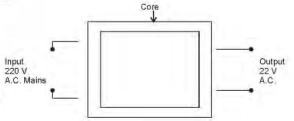
The diagram shows a core of a transformer and its input and output connection.
(a) State the material used for the core and describe its structure.
(b) Use the given data in the diagram to calculate the turn ratio for the transformer.
(c) Complete the diagram of the transformer and connections by labelling all parts added by you.
(d) If a current of $2 A$ is taken from the output, calculate the current in the input circuit. (Assume transformer is ideal).
Image
State the changes in the position, size and nature of the image of an object when brought from infinity up to a concave lens. Illustrate your answer by drawing ray diagrams.

A current of $1.6 mA$ flows through a conductor. If charge on an electron is $-1.6 \times$ $10^{-19}$ coulomb,
find the number of electrons that will pass each second through the cross section of that conductor.
$200 g$ of hot water at $80^{\circ} C$ is added to $300 g$ of cold water at $10^{\circ} C$. Neglecting the heat taken by the container, calculate the final temperature of the mixture of water. Specific heat capacity of water $=4200 Jkg ^{-1} K ^{-1}$
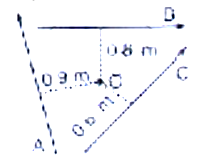
A, B and C are the three forces each of magnitude 4 n acting in the plane of the paper as shown in
Figure. The point O lies in the same plane.

(1) Which force has the least moment about O? Give a reason.
(2) which force has the greatest moment about O? Give a reason.
(3) Name the forces producing (a) Clockwise (b) anticlockwise moments.
(4) what is the resultant torque about the point O?
A battery of e.m.f 15 V and internal resistance 3 Ω is connected to two resistors 3Ω and 6Ω connected in parallel. Find: (a) the current through the battery. (b) p.d. between the terminals of the battery, (c) the current in 3 Ω resistors, (d) the current in 6 Ω resistor.
A man stands in between two parallel cliffs and blows a whistle. He hears first echo after $0.6s$ and second echo after $2.4s$. Calculate the distance between cliffs.
[Speed of sound $= 336 m/s]$
Radioactive substances were found to give off three types of rays. Name them. How do they
(a) React to the magnetic field?
(b) React to the electric field?
(c) Act when different thickness of lead sheets is placed in their path?
At what voltage is the electric power generated at the generating station? Explain the transmission of this power to your house.