MCQ
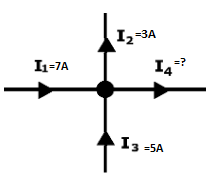
Calculate the value of current I4.
- A-9A
- B9A
- C5A
- D1A
Explanation:
Current I4 can be calculated using Kirchhoff’s first law. The sum of current arriving at a junction is equal to the currents leaving the junction.
Here, Currents arriving at a junction: 7A + 5A = 12A
Currents leaving the junction: 3A + I4
Equating both the currents: 12A = 3A + I4
I4 = 9A
Generate a complete, print-ready paper with questions like this in minutes — across 16+ boards, with answer keys.
64 drops each having the capacity C and potential V are combined to form a big drop. If the charge on the small drop is q, then the charge on the big drop will be
|
(a) 2q |
(b) 4q |
(c) 16q |
(d) 64q |
Complete the equation for the following fission process 
|
(a) |
(b) |
(c) |
(d) |
In NPN transistor, 1010 electrons enters in emitter region in 10–6 sec. If 2% electrons are lost in base region then collector current and current amplification factor (b) respectively are
|
(a) 1.57 mA, 49 |
(b) 1.92 mA, 70 |
(c) 2 mA, 25 |
(d) 2.25 mA, 100 |
A frog can be deviated in a magnetic field produced by a current in a vertical solenoid placed below the frog. This is possible because the body of the frog behaves as
|
(a) Paramagnetic |
(b) Diamagnetic |
(c) Ferromagnetic |
(d) Antiferromagnetic |


