Question
Can the potential function have a maximum or minimum in free space?

Answer

No, the potential function does not have a maximum or minimum in free space, it is because the absence of atmosphere around conductor prevents the phenomenon of electric discharge or potential leakage.

Need a full question paper?

Generate a complete, print-ready paper with questions like this in minutes — across 16+ boards, with answer keys.
Start Generating Free

Similar questions

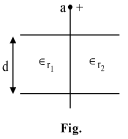
The capacitance of a parallel plate air capacitor is $10 \mu F$. This capacitor is divided into two equal parts as shown in the figure and filled with a medium having dielectric constant $\in_{r_1}=2$ and $\in_{r_2}=4$. Find the value of capacitance of this system.
Image
If the radius of a copper wire is doubled, will its specific resistance increase, decrease or remain same?
A concave lens is placed in water. Will there be any change in focal length? Give reason.
How does the energy stored in a capacitor change if the plates of a charged capacitor are moved farther, the battery remaining connected?
Mention two specific characteristics of nuclear force.
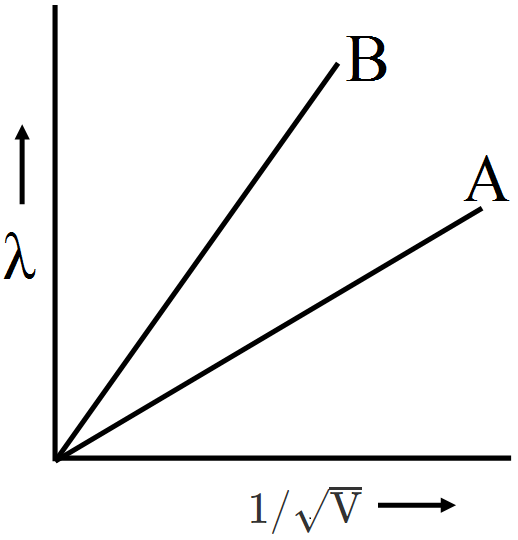
Two lines A and B shown in the graph represent the de Broglie wavelength $(\lambda)$ as a function of $\frac{1}{\sqrt{\text{V}}}$ (V is the accelerating potential) for two particles having the same charge. Which of the two represents the particle of smaller mass?

An electroplating unit plates 3.0g of silver on a brass plate in 3.0 minutes. Find the current used by the unit. The electrochemical equivalent of silver is 1.12 × 10-6 kg C-1.
Draw a circuit diagram of n-p-n transistor amplifier in CE configuration. Under what condition does the transistor act as an amplifier?
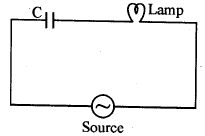
An electric lamp having coil of negligible inductance connected in series with a capacitor and an AC source is glowing with certain brightness. How does the brightness of the lamp change on reducing the (i) capacitance, and (ii) the frequency? Justify your answer.

12J of work has to be done against an existing electric field to take a charge of 0.01C from A to B. How much is the potential difference VB - VA?