Question
Can we conclude from the interference phenomenon whether light is a transverse wave or a longitudinal wave?

Answer

The interference pattern can be produced by any two coherent waves moving in the same direction. It cannot be concluded from the interference phenomenon that light is a transverse wave, as sound waves that are longitudinal in nature also interfere.

Need a full question paper?

Generate a complete, print-ready paper with questions like this in minutes — across 16+ boards, with answer keys.
Start Generating Free

Similar questions

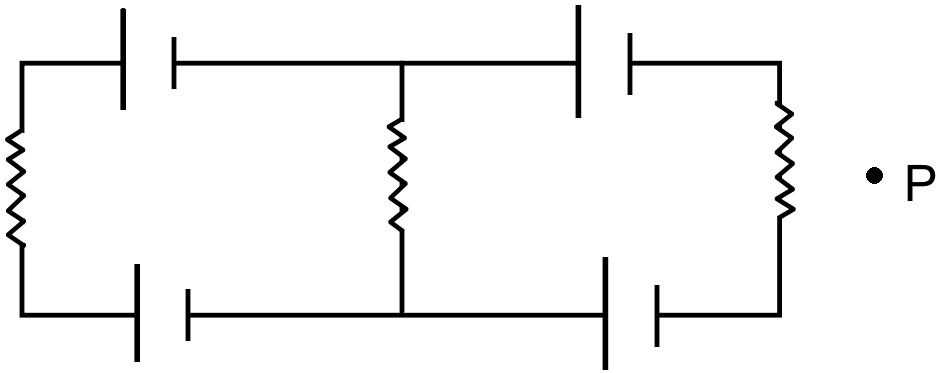
Each of the batteries shown in figure has an emf equal to 5V. Show that the magnetic field B at the point P is zero for any set of values of the resistances.
Two spherical balls of mass 10kg each are placed 10cm apart. Find the gravitational force of attraction between them.
For a photosensitive surface, threshold wavelength is $\lambda_0.$ Does photoemission occur if the wavelength of radiation is (i) more than $\lambda_0$ and (ii) less than $\lambda_0?$ Justify your answer.
A simple microscope is rated 5 for a normal relaxed eye. What will be its magnifying power for a relaxed farsighted eye whose near point is 40cm?
Plot a graph showing variation of de$-$Broglie wavelength $\lambda$ versus $\frac{1}{\sqrt{V}} ,$ where $V$ is accelerating potential for two particles $A$ and $B$ carrying same charge but of masses $m_1, m_2 (m_1 > m_2).$ Which one of the two represents a particle of smaller mass and why?
Answer the following question:
The angle subtended at the eye by an object is equal to the angle subtended at the eye by the virtual image produced by a magnifying glass. In what sense then does a magnifying glass provide angular magnification?
A block of mass m moving at a speed v compresses a spring through a distance x before its speed is halved. Find the spring constant of the spring.
A high jumper successfully clears the bar. Is it possible that his centre of mass crossed the bar from below it? Try it with appropriate figures.
How the photoelectric effect depends on time? Explain.
$a$. Show that the time period $(T)$ of oscillations of a freely suspended magnetic dipole of magnetic moment $(m)$ in a uniform magnetic field $(B)$ is given by $T=2 \pi \sqrt{\frac{I}{m B}},$ where $I$ is a moment of inertia of the magnetic dipole.
$b$. Identify the following magnetic materials:
$i$. A material having susceptibility $\left(\chi_m\right)=-0.00015$.
$ii.$ A material having susceptibility $\left(\chi_m\right)=10^{-5}$.