MCQ
Choke coil works on the principle of
  • A
    Transient current
  • Self induction
  • C
    Mutual induction
  • D
    Wattless current

Answer

Correct option: B.
Self induction
b
The choke coil works because it acts as an inductor. When the current passing through changes, as $AC$ currents do, it typically creates a magnetic field in the coil that works against that current. This property, known as inductance.

Need a full question paper?

Generate a complete, print-ready paper with questions like this in minutes — across 16+ boards, with answer keys.

Start Generating Free

Similar questions

A sample initially contains only $U -238$ isotope of uranium. With time, some of the $U -238$ radioactively decays into $Pb -206$ while the rest of it remains undisintegrated.

When the age of the sample is $P \times 10^8$ years, the ratio of mass of $Pb -206$ to that of $U -238$ in the sample is found to be $7$ . The value of $P$ is. . . . . .

[Given : Half-life of $U-238$ is $4.5 \times 10^9$ years; $\log _e 2=0.693$ ]

Two electric bulbs marked $25\ W - 220\ V$ and $100\ W - 220\ V$ are connected in series to a $440\ V$ supply. Which of the bulbs will fuse?
The shortest wavelength of Lyman series of hydrogen atom is equal to the shortest  wavelength of Balmer series of an hydrogen like atom of atomic number $Z$. The value of $Z$ is equal to :-
Assertion : The number of electrons in a P-type silicon semiconductor is less than the number of electrons in a pure silicon semiconductor at room temperature.
Reason : It is due to law of mass action.
The beam of light has three wavelengths $4144 \,\mathring A$, $4972 \;\mathring A$ and $6216\; \mathring A$ with a total intensity of $3.6 \times$ $10^{-5}\,Wm ^2$ equally distributed amongst the three wavelengths. The beam falls normally on the area $1\,cm ^2$ of a clean metallic surface of work function $2.3\,eV$. Assume that there is no loss of light by reflection and that each energetically capable photon ejects one electron. Calculate the number of photoelectrons liberated in $2\,s$.
Two long and parallel straight wires $A$ and $B$ carrying currents of $8.0\; A$ and $5.0\; A$ in the same direction are separated by a distance of $4.0\; cm$. Estimate the force on a $10\; cm$ section of wire $A.$
Given below are two statements: one is labelled as Assertion $A$ and the other is labelled as Reason $R$.

Assertion $A$: The potential ( $V$ ) at any axial point, at $2 \mathrm{~m}$ distance ( $r$ ) from the centre of the dipole of dipole moment vector $\vec{P}$ of magnitude, $4 \times 10^{-6} \mathrm{C} \mathrm{m}$, is $\pm 9 \times 10^3 \mathrm{~V}$.

(Take $\frac{1}{4 \pi \in_0}=9 \times 10^9 \mathrm{Sl}$ units)

Reason $R$: $V= \pm \frac{2 P}{4 \pi \in_0 r^2}$, where $r$ is the distance of any axial point, situated at $2 \mathrm{~m}$ from the centre of the dipole.

In the light of the above statements, choose the correct answer from the options given below:
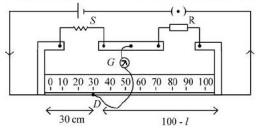
In meter bridge experiment for measuring unknown resistance ' $S$ ', the null point is obtained at a distance $30 cm$ from the left side as shown at point $D$. If $R$ is $5.6 k \Omega$, then the value of unknown resistance ' $S$ ' will be $\Omega .$
A satisfactory photographic print is obtained when the exposure time is $10 \,sec$ at a distance of $2\, m$ from a $60 \,cd$ lamp. The time of exposure required for the same quality print at a distance of $4\, m$ from a $120\, cd$ lamp is.....$sec$
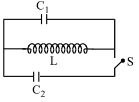
At a moment $(t = 0)$ when charge on capacitor $C_1$ is zero, the switch is closed. If $I_0$ be the current through inductor at that instant, for $t > 0,$