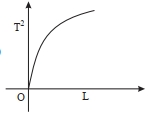
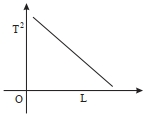
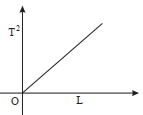
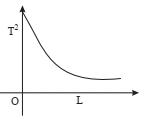
Choose the correct length $( L )$ versus square of time period $\left( T ^2\right)$ graph for a simple pendulum executing simple harmonic motion.
- A
- B
- C
- D
JEE MAIN 2023, Easy


Download our appand get started for free
Experience the future of education. Simply download our apps or reach out to us for more information. Let's shape the future of learning together!No signup needed.*
Similar Questions
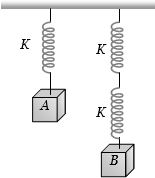
- 1The springs shown are identical. When $A = 4kg$, the elongation of spring is $1\, cm$. If $B = 6\,kg$, the elongation produced by it is ..... $ cm$View Solution
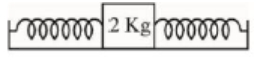
- 2A block of mass $2\,kg$ is attached with two identical springs of spring constant $20\,N / m$ each. The block is placed on a frictionless surface and the ends of the springs are attached to rigid supports (see figure). When the mass is displaced from its equilibrium position, it executes a simple harmonic motion. The time period of oscillation is $\frac{\pi}{\sqrt{x}}$ in SI unit. The value of $x$ is $..........$View Solution
- 3The variation of kinetic energy $(KE)$ of a particle executing simple harmonic motion with the displacement $(x)$ starting from mean position to extreme position $(A)$ is given byView Solution
- 4View SolutionThe total energy of a particle executing simple harmonic motion is
- 5For a particle executing simple harmonic motion, the kinetic energy $K$ is given by $K = {K_o}{\cos ^2}\omega t$. The maximum value of potential energy isView Solution
- 6A particle performs simple harmonic oscillation of period $T$ and the equation of motion is given by;View Solution
$x = a\,\sin \,\left( {\omega t + \pi /6} \right)$
After the elapse of what fraction of the time period the velocity of the particle will be equal to half of its maximum velocity?
- 7The potential energy of a particle of mass $4\,kg$ in motion along the $x$-axis is given by $U =4(1-\cos 4 x )\,J$. The time period of the particle for small oscillation $(\sin \theta \simeq \theta)$ is $\left(\frac{\pi}{ K }\right)\,s$. The value of $K$ is .......View Solution
- 8A mass m oscillates with simple harmonic motion with frequency $f = \frac{\omega }{{2\pi }}$ and amplitude A on a spring with constant $K$ , thereforeView Solution
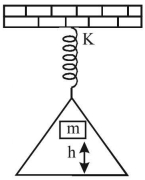
- 9A load of mass $m$ falls from a height $h$ on to the scale pan hung from the spring as shown in the figure. If the spring constant is $k$ and mass of the scale pan is zero and the mass $m$ does not bounce relative to the pan, then the amplitude of vibration isView Solution
- 10The amplitude of the vibrating particle due to superposition of two $SHMs,$View Solution
$y_1 = \sin \left( {\omega t + \frac{\pi }{3}} \right)$ and $y_2 = \sin \omega t$ is :