Question
Column A (Scientist)Column B (Theory)
(1) Dixon and Joly(a) Starch-sugar inter conversion
(2) Steward(b) Osmotic absorption theory
(3) Atkins and Pristley(c) Non-osmotic absorption theory
(4) Kramer and Thimann(d) Cohesion tension theory

Answer

Column A (Scientist)Column B (Theory)
(1) Dixon and Joly(d) Cohesion tension theory
(2) Steward(a) Starch-sugar inter conversion
(3) Atkins and Pristley(b) Osmotic absorption theory
(4) Kramer and Thimann(c) Non-osmotic absorption theory

Need a full question paper?

Generate a complete, print-ready paper with questions like this in minutes — across 16+ boards, with answer keys.

Start Generating Free

Similar questions

Column AColumn B
(1) Auxin(a) Bolting in rosette plants
(2) Cytokinin(b) Stimulate flowering in SDP
(3) Gibberellins(c) Promotion of growth of lateral buds
(4) Abscissic acid(d) Apical dominance
Read the following and answer any four questions from (i) to (v) given below:
A woman unable to conceive after many years of regular unprotected coitus went to specialised infertility clinic. On complete examination, woman was found to be normal, while male partner was diagnosed with infertility. Male partner is unable to copulate the female. Couple was advised to opt for assisted reproductive technology (ART).
  1. Which ART could have been useful for this couple?
  1. ZIFT
  2. IUT
  3. AI
  4. GIFT
  1. In which of the following infertility issues could this technique be used?
  1. Anovulation.
  2. Oligospermia.
  3. Low fructose content in seminal fluid.
  4. All of these.
  1. Which among the following techniques is useful to conceive when there is very low sperm count?
  1. GIFT
  2. Test-tube baby
  3. IUT
  4. JCSI
  1. Assertion: Artificial insemination (AI) is intra-uterine insemination.
Reason: In Al, sperms collected from donor are introduced into the uterus.
  1. Both assertion and reason are true, and reason is the correct explanation of assertion.
  2. Both assertion and reason are true, but reason is not the correct explanation of assertion.
  3. Assertion is true, but reason is false.
  4. Both assertion and reason are false
  1. Success rate of artificial insemination technique is:
  1. 20-40%
  2. 60-70%
  3. 40-50%
  4. 5-7%
Distinguish between : FSH and LH
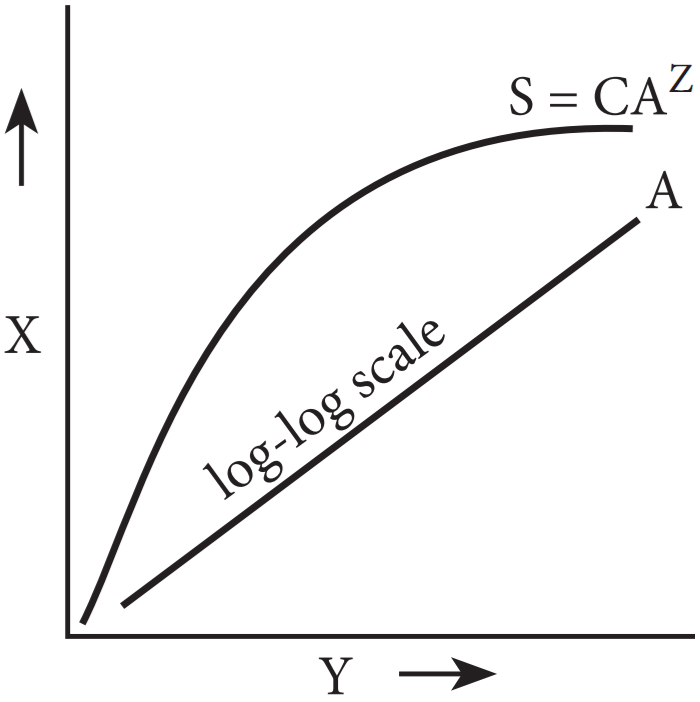
Read the following and answer any four questions from (i) to (v) given below: Within a region, species richness increases with increasing explored area, but only upto a limit. TI1e given graph explains this relationship.
  1. What does the given figure show?
  1. Rivet-popper hypothesis.
  2. Species-area relationship.
  3. Proportionate number of species of major taxa.
  4. $\alpha-\text{ecological diversity }$
  1. Equation for relationship (A) between species richness and area is:
  1. $\log\text{ S}=\log\text{ C}+\text{Z }\log\text{ A}$
  2. $\log\text{ C}=\log\text{ S}+\text{Z }\log\text{ A}$
  3. $\text{Z }\log\text{ A}=\log\text{ S}+\log\text{ C}$
  4. $\log\text{ S}=\log\text{ C}+\log\text{ A}$
  1. What is the value of slope of line or regression coefficient Z for frugivorous birds?
  1. 0.1 - 0.2
  2. 1.15
  3. 0.01 - 0.1
  4. 0.6 - 1.2
  1. The shape of curve for relationship between species richness and areas for wide variety of taxa is:
  1. Straight line.
  2. Parabola.
  3. Rectangular hyperbola.
  4. Bell shaped.
  1. Who gave this concept of increase in species richness with increasing offered area?
  1. Humboldt.
  2. Odum.
  3. Edward Wilson.
  4. Paul Ehrlich.
Why are vectors needed for replication of DNA during rDNA technology?
Read the following and answer any four questions from (i) to (v) given below:
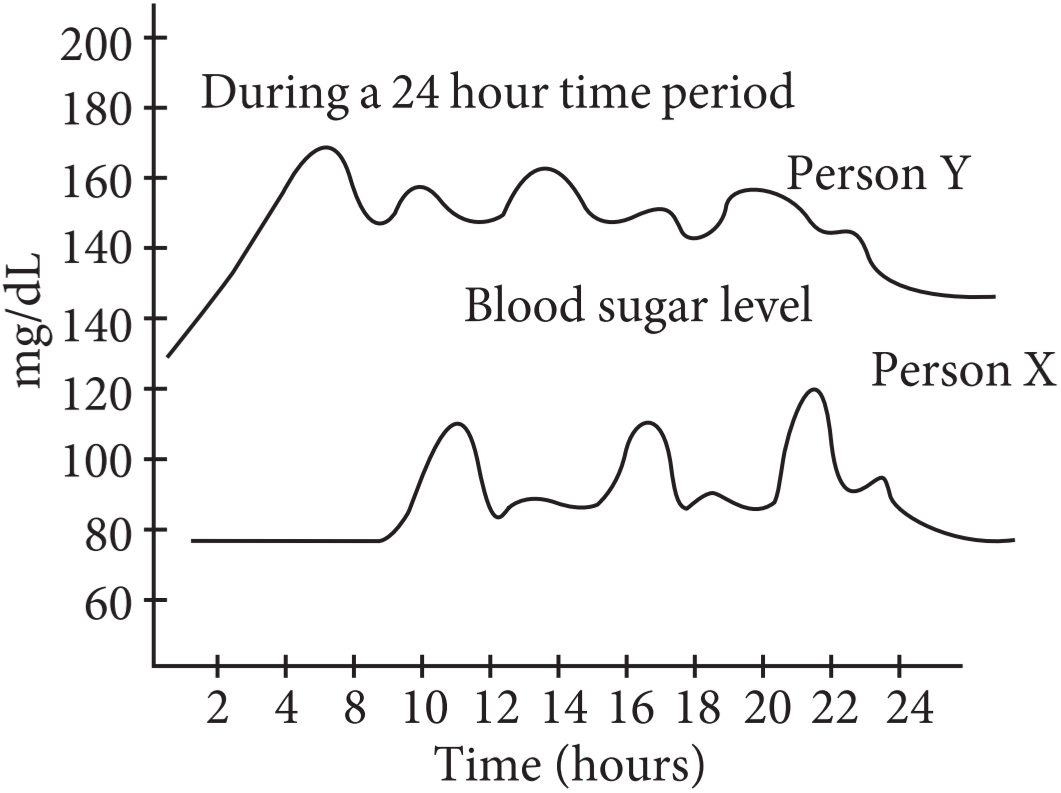
The given graphs show fluctuations in blood sugar of person X and Y during a 24 hour time period.

Based on the above information, answer the following questions.
  1. Which of the following holds true for person X?
  1. Person X is suffering from type I diabetes.
  2. Person X shows severe insulin deficiency and beta cell depletion.
  3. Person X is normal and shows good control of blood sugar level.
  4. Person X is subjected to excessive urination and abnormal thrust.
  1. The given graph indicates that person Y is suffering from.
  1. Diabetes
  2. Hypertension
  3. Atherosclerosis
  4. Rheumatic heart disease.
  1. Which of the following conditions are common in person Y?
  1. Excretion of glucose in urine and excessive urination.
  2. Polydipsia and mild beta cell depletion.
  3. Progressive erosion of articular cartilage at synovial joint.
  4. Both (a) and (b).
  1. A person suffering from diabetes mellitus becomes weak because.
  1. The cells are unable to utilise glucose and other carbohydrates for energy production.
  2. Degradation of fat increases production of toxic ketone bodies.
  3. Cells utilise proteins for obtaining energy
  4. All of these.
  1. Assertion: Type I diabetes involves failure of insulin to facilitate the movement of glucose into cells.
Reason: Type II diabetes is caused by failure of beta cells to produce adequate amount of insulin due to beta cell depletion.
  1. Both assertion and reason are true, and reason is the correct explanation of assertion.
  2. Both assertion and reason are true, but reason is not the correct explanation of assertion.
  3. Assertion is true, but reason is false.
  4. Both assertion and reason are false.
Cuticular transpiration and Stomatal transpiration.
(1) Column A (Asexual)Column B (Examples)
(1) Spore formation(a) Spirogyra
(2) Conidia formation(b) Yeast
(3) Fragmentation(c) Chlamydomonas
(4) Budding(d) Penicillium
Distinguish between : Inborn immunity and acquired immunity.
The bacterium Bacillus thuringiensis is widely used in contemporary biology as:
  1. Agent for production of dairy products.
  2. Source of industrial enzyme.
  3. Indicator of water pollution.
  4. Insecticide.