Question
Distinguish between : Inborn immunity and acquired immunity.

Answer

Inborn ImmunityAcquired Immunity
1. Inborn immunity or innate immunity is also called natural immunity. 1. Acquired immunity is also called adaptive immunity.
2. Innate immunity is present right from the birth.2. Acquired immunity is not present at birth, but is acquired during lifetime of the individual.
3. Inborn immunity does not depend upon the previous exposure to a pathogen or foreign substance.3. Acquired immunity always depends upon the previous exposure to a pathogen or foreign substance.
4. It is non-specific immunity as it can offer resistance to any pathogen.4. It is specific immunity as it can offer resistance only to a particular pathogen.
5. Innate immunity consists of various types of barriers for defence against the pathogens.5. Acquired immunity consists of various types of cells which are able to produce antibodies.
6. Inborn immunity shows immediate effect in the body.6. Acquired immunity requires several days to become activated.
7. Inborn immunity is seen in all animals.7. Acquired immunity is seen only in vertebrates.
8. Inborn immunity is genetic in nature and is heritable.8. Acquired immunity is non-genetic in nature and is non-heritable.

Need a full question paper?

Generate a complete, print-ready paper with questions like this in minutes — across 16+ boards, with answer keys.

Start Generating Free

Similar questions

Respiratory organsAlternative name
(1) Larynx(a) Lid of larynx
(2) Trachea(b) Air sacs
(3) Alveoli(c) Sound box
(4) Epiglottis(d) Windpipe
Distinguish between : Single circulation and Double circulation.
Read the following and answer any four questions from (i) to (v) given below:
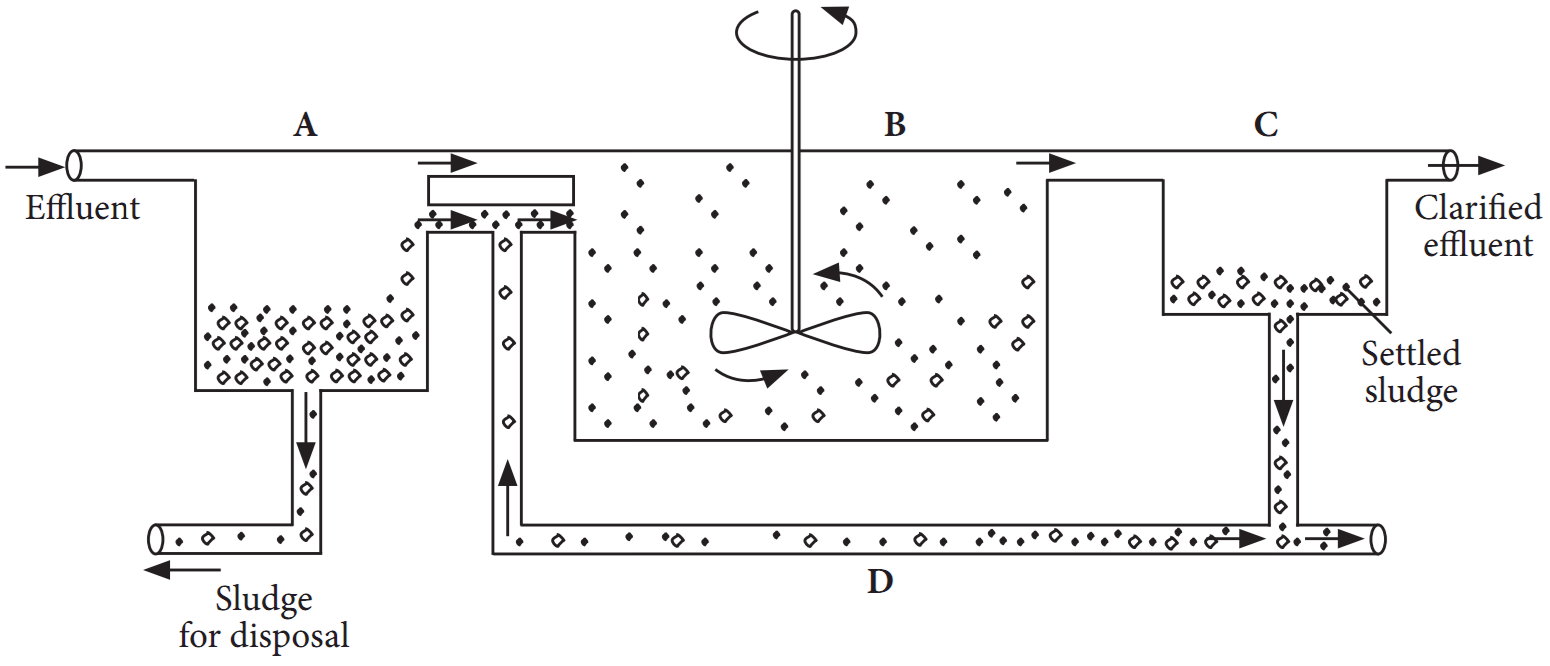
Saurin, a M.Sc student, get an assignment on sewage treatment plant (STP) to study the microbial load. After visiting such plant in his locality, he makes a simplified diagram of the STP for his project. Study the diagram given below and answer the following questions.
  1. In the diagram 'A' denotes:
  1. Aeration tank.
  2. Primary settling tank.
  3. Secondary settling tank.
  4. Sludge digester.
  1. Which of the following is incorrect regarding the sludge released from A?
  1. It is formed after primary treatment.
  2. It does not require aeration.
  3. It possesses floes of decomposer microbes.
  4. It is used in landfills.
  1. A large number of aerobic heterotrophic microbes grow in:
  1. A
  2. B
  3. C
  4. Both (a) and (b).
  1. What is denoted by 'D' in the given diagram?
  1. Primary sludge.
  2. Primary effluent.
  3. Activated sludge.
  4. Secondary effluent.
  1. Assertion: The colloided and finely suspended matter of sewage form aggregates which are called floes.
Reason: Floes contain masses of bacteria, slime and fungal filaments.
  1. Both assertion and reason are true and reason is the correct explanation of assertion.
  2. Both assertion and reason are true but reason is not the correct explanation of assertion.
  3. Assertion is true but reason is false.
  4. Both assertion and reason are false.
Distinguish between : Inspiratory Reserve Volume (IRV) and Expiratory Reserve Volume (ERV).
Distinguish between : T. S. of artery and T.S. of vein.
Read the following and answer any four questions from (i) to (v) given below:
Alcohols are important industrial solvents. Ethanol, methanol, propanol and butanol are produced commercially by fermentation activity of some fungi, majorly yeasts. During fermentation, yeast cells convert cereal derived sugars into ethanol and $CO_2$ At the same time hundreds of secondary metabolites that influence the aroma and taste of alcohol are produced. Sugar concentration affects the rate of fermentation reactions. Yeast cannot grow in very strong sugar solution. In case of complex carbohydrate containing nutrient media, 1% malt or Rhizopus is used along with yeasts. Hydrolysis of starch is carried out at high temperature for 30 ruins. 'Tile crushed food mixed with hot water for obtaining malt in called mash. 'Tile nutrient medium prior to fermentation in called wort. Wort is cooled down to appropriate temperature and inoculated with strain of yeast.
  1. Tile rate of alcohol production is measured on the basis of:
  1. Amount of sugar present in the medium.
  2. Amount of $CO_2$ produced per unit time.
  3. Amount of yeast added in the medium.
  4. All of these.
  1. A number of chemicals are produced at the time of alcoholic fermentation with the change of nutrient media, pH and aeration. Select such by-product from the following.
  1. Phenylethanol.
  2. Amyl alcohol.
  3. Glycerol.
  4. All of these.
  1. During alcoholic fermentation of cereals and potato, the crushed food mixed with hot water for obtaining malt is called:
  1. Juice.
  2. Mash.
  3. Wort.
  4. None of these.
  1. Distilled alcohol with 95% ethanol content is called:
  1. Absolute alcohol.
  2. Rectified spirit.
  3. Gin.
  4. Brandy.
  1. Assertion: Rhizopus or 1% malt is used in the nutrient medium when it contains complex carbohydrates.
Reason: Yeast does not possess sufficient diastase or amylase.
  1. Both assertion and reason are true and reason is the correct explanation of assertion.
  2. Both assertion and reason are true but reason is not the correct explanation of assertion.
  3. Assertion is true but reason is false.
  4. Both assertion and reason are false.
Read the following and answer any four questions from (i) to (v) given below:
According to Mendel, one gene control the expression of one character only. The ability of a gene to have multiple phenotypic effect because it influences a number of characters is an exception. The gene having a multiple phenotypic effect because of its ability to control of two or more characters can be seen in cotton. In cotton, a gene for the lint also influences the height of plant, size of the ball, number of ovules and viability of seeds.
  1. Genes with multiple phenotypic effects are known as?
  1. Hydrostatic genes.
  2. Duplicate genes.
  3. Pleiotropic genes.
  4. Complimentary genes.
  1. Which of the following disorder is an example of genes with multiple phenotypic effects?
  1. Phenylketonuria.
  2. Haemophilia.
  3. Sickle cell anaemia.
  4. Both (a) and (c)
  1. Which of the following is an example of gene with multiple phenotypic effect?
  1. Drosophila white eye mutation.
  2. Kernel colour in wheat.
  3. Height in human beings.
  4. Skin colour in human beings.
  1. Which of the following statements is not correct regarding genes with multiple phenotypic effect?
  1. It is not essential that all the traits are equally influenced.
  2. Occasionally a number of related changes are caused by a gene.
  3. It occurs due to effect of the gene on two or more inter-related metabolic pathways.
  4. None of these.
  1. Assertion: ln garden pea, the gene which controls the flower colour also controls the colour of the seed coat and presence of red spots in the leaf axils.
Reason: A pleiotropic gene influences more than one trait.
  1. Both assertion and reason are true and reason is the correct explanation of assertion.
  2. Both assertion and reason are true but reason is not the correct explanation of assertion.
  3. Assertion is true but reason is false.
  4. Both assertion and reason are false.
Distinguish between : Vital Capacity of Lung and Total Lung Capacity.
Distinguish between: DNA in prokaryotic and eukaryotic cells.
Distinguish between: m-RNA, t-RNA and r-RNA.