Question
Why are vectors needed for replication of DNA during rDNA technology?

Answer

The vector provides the origin of replication.

Need a full question paper?

Generate a complete, print-ready paper with questions like this in minutes — across 16+ boards, with answer keys.

Start Generating Free

Similar questions

Read the following and answer any four questions from (i) to (v) given below:
Wetlands are called Ramsar sites because the first international convention on their conservation was held in Ramsar in Iran in 1971. Wetlands or Ramsar sites are low lying marshy areas which get filled up during rains due to runoff and overflow from other water bodies. They are often considered to be waste lands which are used as dumping areas and filled up to recover land for various constructions activities. As a result, a large number of wetlands have disappeared.
  1. Select the incorrect match of wetland and its location.
 
Wetland
Location
(a)
Harike
Punjab
(b)
Chandra Tai
H.P.
(c)
Bhoj
M.P.
(d)
Ashtamudi
Odisha
  1. Migratory bird flamingo breeds in which of the following wetlands?
  1. Bhitarkanika Mangroves.
  2. Rann of Kutch.
  3. Harike.
  4. Chandra Tal.
  1. Which of the following is not an importance of wetlands?
  1. They are an important source of recharging groundwater.
  2. They provide protection from floods.
  3. They are good source of siltation and purification of water.
  4. None of these.
  1. Which of the following wetland ecosystem is highly acidic and has a accumulation of decomposed plants known as peat?
  1. Bog
  2. Mangrove
  3. Estuary
  4. Watershed
  1. The mangroves of Bhitarkanika are famous for:
  1. Rare migratory waterbirds.
  2. Nesting sites for endangered olive ridley turtles.
  3. Prawn cultivation.
  4. All of these.
Read the following and answer any four questions from (i) to (v) given below:
The first menstruation is called menarche, that usually occurs between 12 and 15 years. In human females, menstruation is repeated at an average interval of about 28/29 days and is called menstrual cycle. It is regulated by certain hormones, as pituitary gland is stimulated by releasing factors produced in the hypothalamus. The hormones produced by pituitary gland influence the ovaries. The hormones secreted by the ovaries affect the walls of the uterus.
  1. The breakdown of endometrium is characteristic of:
  1. Proliferative phase.
  2. Luteal phase.
  3. Ovulatory phase.
  4. Menstrual phase.
  1. Which days of the menstrual cycle marks the proliferative phase?
  1. 1-5
  2. 15-28
  3. 6-13
  4. 10-14
  1. Which of the following occurs during secretory phase?
  1. Empty Graafian follicle changes into corpus luteum.
  2. Primary follicle changes into Graafian follicle.
  3. Endometrium rebuilds and estrogen secretion increases.
  4. LH surge, inducing release of an ovum.
  1. Identify the hormones that attain peak level during ovulatory phase.
  1. FSH.
  2. Progesterone.
  3. LH.
  4. Both (a) and (c).
  1. Withdrawal of which hormone causes degeneration of corpus luteum?
  1. FSH.
  2. LH.
  3. Progesterone.
  4. Estrogen.
Column I [Contraceptive method]Column II [Mode of action]
(1) Pill(a) Prevents sperms reaching cervix
(2) Condom(b) Prevents implantation
(3) Vasectomy(c) Prevents ovulation
(4) Copper T(d) Semen contains no sperms
A patient is suffering from ADA deficiency. Can he be cured? How?
Genomic library and c-DNA library.
Distinguish between : Extero and entero receptors.
Read the following and answer any four questions from (i) to (v) given below:
The pollen grains or microspores are the male reproductive bodies of a flower and are contained in the pollen sac or microsporangia. Each pollen grain consists of a single microscopic cell, possessing two coats: the exine and the in tine. The exine of a pollen grain is made of chemically stable material. Because of this, pollen grains are often very well preserved for thousands of years in soil and sediments.
  1. One of the most resistant biological material present in the exine of pollen grain is:
  1. Pectocellulose.
  2. Sporopollenin.
  3. Suberin.
  4. Cellulose.
  1. The exine possesses one or more thin places known as:
  1. Raphe.
  2. Germ pores.
  3. Hilum.
  4. Endothecium.
  1. What is the function of germ pore?
  1. Emergence of radicle.
  2. Absorption of water for seed germination.
  3. Initiation of pollen tube.
  4. All of these.
  1. What is the key advantage to the plant for having such strong pollen grain walls?
  1. It protects the vital genetic material in the pollen grain.
  2. It allows pollen to serve as a valuable fossil record for the study of ancient plants.
  3. It prevents the pollen tube from growing out before the pollen grain reaches the stigma of a compatible species.
  4. It gives weight to the pollen grain, allowing it to cling better to the body surfaces of insect pollinators.
  1. The number of germ pores in dicots and monocots respectively are:
  1. One and three.
  2. Three and two.
  3. Two and three.
  4. Three and one.
Read the following and answer any four questions from (i) to (v) given below:
A typical angiospermic ovule is a small structure attached to the placenta by means of a stalk called funicle. The body of the ovule fuses with funicle in the region called hilum. Each ovule has one or two protective envelopes called integuments. Integuments encircle the nucellus except at the tip where a small opening called the micropyle is formed. Mature ovules are classified on the basis of funiculus. It can be orthotropous, anadromous, hernitropous, campylotropous, etc.
  1. The body of the ovule consists of a mass of parenchymatous cells called:
  1. Integuments.
  2. Nucellus.
  3. Hilum.
  4. Funiculus.
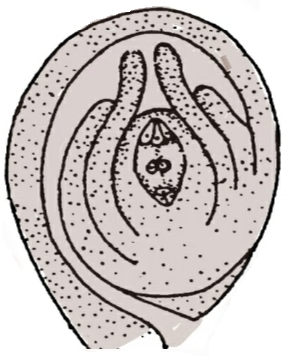
  1. Refer to the given figure and select the correct statement regarding it.
  1. This type of ovule is found in cactus.
  2. The micropyle comes to lie close to the funiculus due to unilateral growth of ovule.
  3. It is most common type of ovule found in the members of Chenopodiaceae.
  4. It is half inverted ovule.
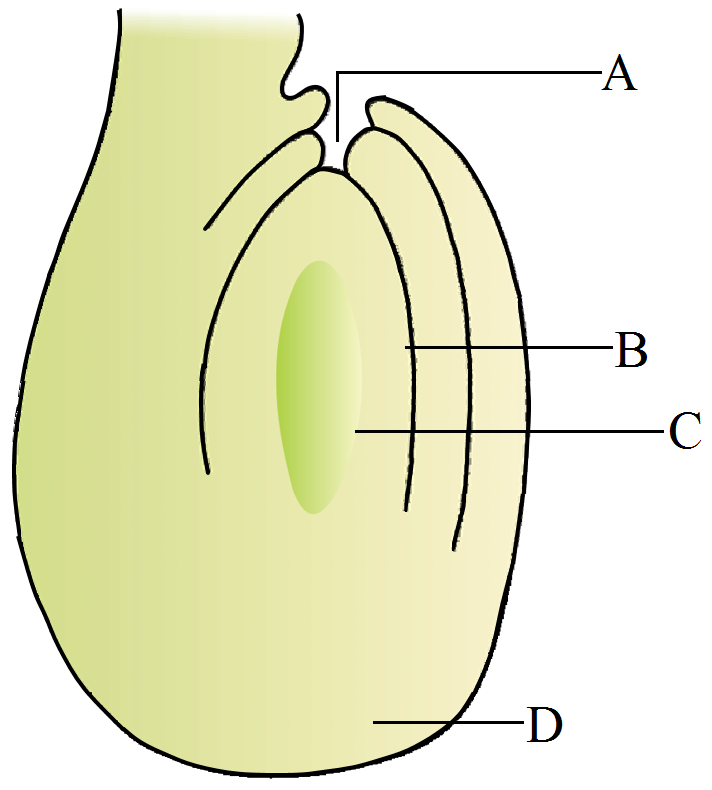
  1. Identify the parts labelled as A, B, C and D in the given figure and select the correct option.
S. No A B C D
(a) Chalaza Female gametophyte Embryo sac Micropyle
(b) Chalaza NuceIIus Embryo sac Micropyle
(c) Micropyle Egg Embryo sac Chalaza
(d) Micropyle Nucellus Embryo sac Chalaza
  1. Mature ovules are classified on the basis of funiculus. If micropyle lie close to the funiculus, the ovule is termed as:
  1. Orthotropous.
  2. Anatropous.
  3. Hemitropous.
  4. Campylotropous.
  1. In Asphodel us, ovule is:
  1. Unitegmic.
  2. Tritegmic.
  3. Bitegmic.
  4. Ategmic.
Waves recorded in ECGHeart activity
(1) P wave(a) Ventricular repolarization
(2) QRS complex(b) Atrial depolarization
(3) T wave(c) Isoelectric segment
(4) ST segment(d) Ventricular depolarization
Polymerase chain reaction:
  1. Is a method of synthesising human protein from human DNA
  2. Uses restriction enzymes
  3. Can produce billions of copies of a DNA fragment
  4. Takes place naturally in bacteria