Question
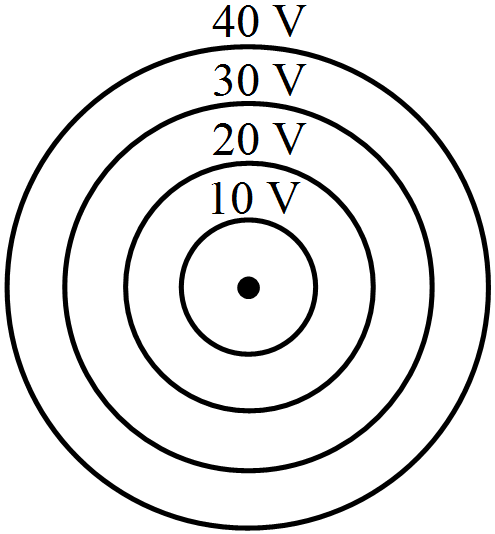
Concentric equipotential surfaces due to a charged body placed at the centre are shown. Identify the polarity of the charge and draw the electric field lines due to it.
Answer


For a single charge the potential is given by $\text{V}=\frac{1}{4\pi\varepsilon_0}\frac{\text{q}}{\text{r}}$
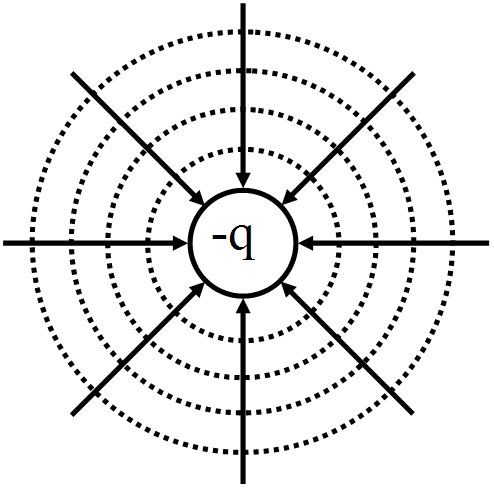
 
This shows that V is constant if r is constant. Greater the radius smaller will be the potential. In the given figure, potential is increasing. This shows that the polarity of charge is negative (-q). The direction of electric field will be radially inward. The field lines are directed from higher to lower potential.

Need a full question paper?

Generate a complete, print-ready paper with questions like this in minutes — across 16+ boards, with answer keys.

Start Generating Free

Similar questions

A charged capacitor of capacitance C is discharged through a resistance R. A radioactive sample decays with an average-life $\tau.$ Find the value of R for which the ratio of the electrostatic field energy stored in the capacitor to the activity of the radioactive sample remains constant in time.
Give brief explanation of a semi-conductor diode.
A thin prism is made of a material having refractive indices 1.61 and 1.65 for red and violet light. The dispersive power of the material is 0.07. It is found that a beam of yellow light passing through the prism suffers a minimum deviation of 4.0° in favourable conditions. Calculate the angle of the prism.
Describe principle and construction of AC generator with figure and discuss its working.
(i) Obtain an expression of average power in AC circuit.
(ii) In an alternating circuit, if alternating current $I=4 \sin \omega t$ and voltage V-200sin $(\omega t+\pi / 3)$ then calculate the average power dissipated in the circuit.
Find the energy liberated in the reaction:
$^{223}Ra \rightarrow \ ^{209}Pb +\ ^{14}C.$
The atomic masses needed are as follows.
$^{223}Ra$ $^{209}Pb$ $^{14}C$
$22.018u$ $208.981u$ $14.003u$
A charge of $3.14 \times 10^{-6}C$ is distributed uniformly over a circular ring of radius $20.0\ cm$. The ring rotates about its axis with an angular velocity of $60.0\ rad/s$. Find the ratio of the electric field to the magnetic field at a point on the axis at a distance of $5.00\ cm$ from the centre.
Suppose an attractive nuclear force acts between two protons which may be written as $\text{F}=\text{Ce}^{-\text{kr}}/\text{r}^2.$
  1. Write down the dimensional formulae and appropriate $SI$ units of $C$ and $k.$
  2. Suppose that $k = 1 fermi^{-1}$ and that the repulsive electric force between the protons is just balanced by the attractive nuclear force when the separation is $5$ fermi. Find the value of $C.$
A jet plane is travelling towards west at a speed of $1800\ km/h.$ What is the voltage difference developed between the ends of the wing having a span of $25m,$ if the Earth’s magnetic field at the location has a magnitude of $5 \times 10^{–4}T$ and the dip angle is $30^\circ .$
Using Gauss’s theorem, show mathematically that for any point outside the shell, the field due to a uniformly charged thin spherical shell is the same as if the entire charge of the shell is concentrated at the centre. Why do you expect the electric field inside the shell to be zero according to this theorem?