Question
Consider a particle moving in simple harmonic motion according to the equation $\text{x}=2.0\cos(50\pi\text{t}+\tan^{-1}0.75)$ where x is in centimetre and t in second. The motion is started at $t = 0.$
  1. When does the particle come to rest for the first time?
  2. When does the acceleration have its maximum magnitude for the first time?
  3. When does the particle come to rest for the second time?
Answer

  1. $\text{x}=2.0\cos(50\pi\text{t}+\tan^{-1}0.75)$
$=2.0\cos(50\pi\text{t}+0.643)$
$\text{v}=\frac{\text{dx}}{\text{dt}}=-100\sin(50\pi\text{t}+0.643)$
$\Rightarrow\sin(50\pi\text{t}+0.643)=0$
As the particle comes to rest for the $1^{st}$ time
$\Rightarrow50\pi\text{t}+0.643=\pi$
$\Rightarrow\text{t}=1.6\times10^{-2}\sec.$
  1. Acceleration $\text{a}=\frac{\text{dv}}{\text{dt}}=-100\pi\times50\pi\cos(50\pi\text{t}+0.643)$
For maximum acceleration $\cos(50\pi\text{t}+0.643)=-1\cos\pi$ (max) (so a is max)
$\Rightarrow\text{t}=1.6\times10^{-2}\sec.$
  1. When the particle comes to rest for second time,
$50\pi\text{t}+0.643=2\pi$
$\Rightarrow\text{t}=3.6\times10^{-2}\text{s}.$

Need a full question paper?

Generate a complete, print-ready paper with questions like this in minutes — across 16+ boards, with answer keys.

Start Generating Free

Similar questions

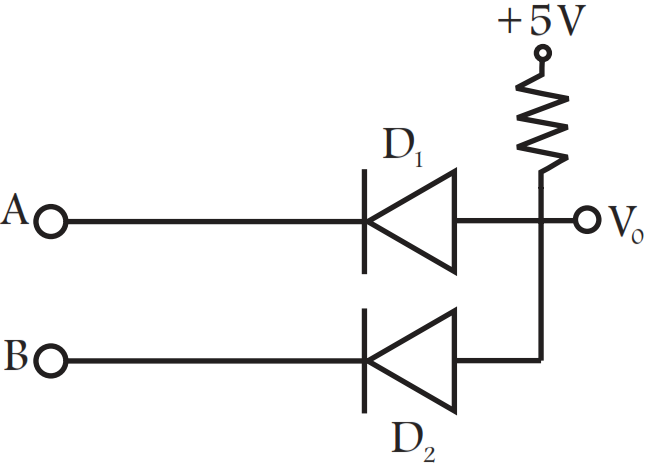
Write the truth table for the circuit shown in Fig. Name the gate that the circuit resembles.
On the basis of Bohr's postulates, derive the expression for orbital speed of electron for $n ^{\text {th }}$ stable orbit in hydrogen atom. Energy in ground state of hydrogen atom is $(-) XeV$. What will be the kinetic energy in this state?
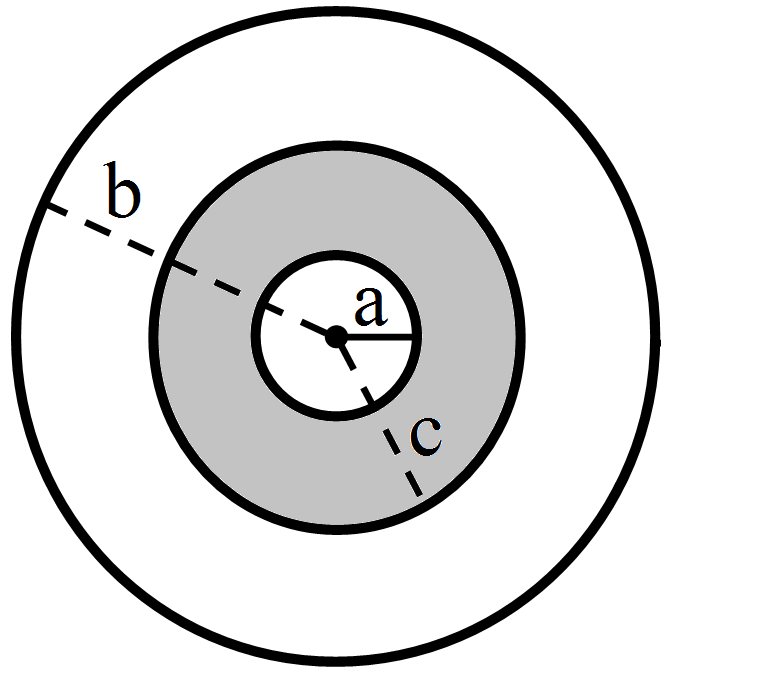
A sphercial capacitor is made of two conducting spherical shells of radii a and b. The space between the shells is filled with a dielectric of dielectric constant K up to a radius c as shown in figure. Calculate the capacitance.
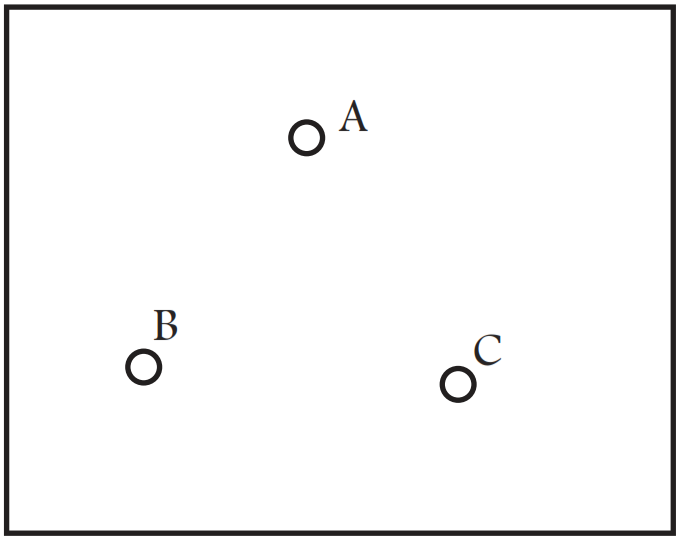
Consider a box with three terminals on top of it as shown in Fig (a):

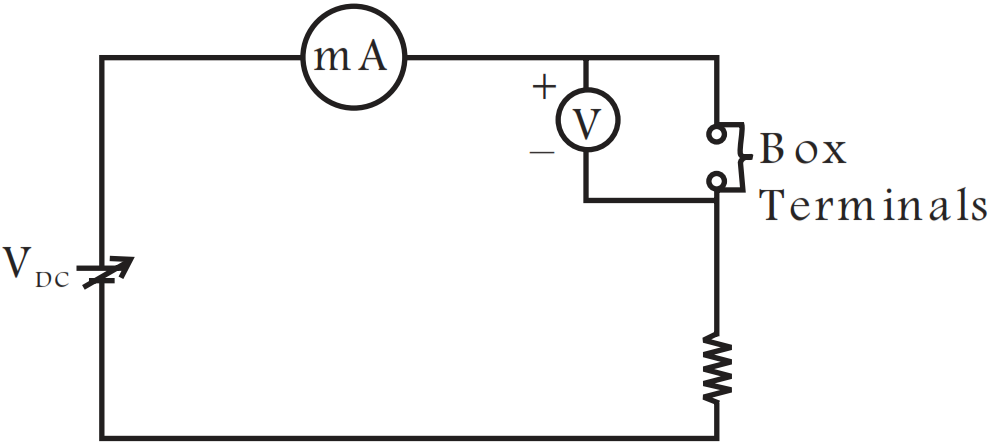
Three components namely, two germanium diodes and one resistor are connected across these three terminals in some arrangement. A student performs an experiment in which any two of these three terminals are connected in the circuit shown in Fig. (b).

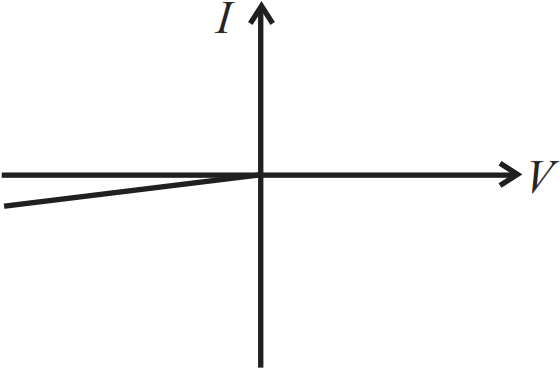
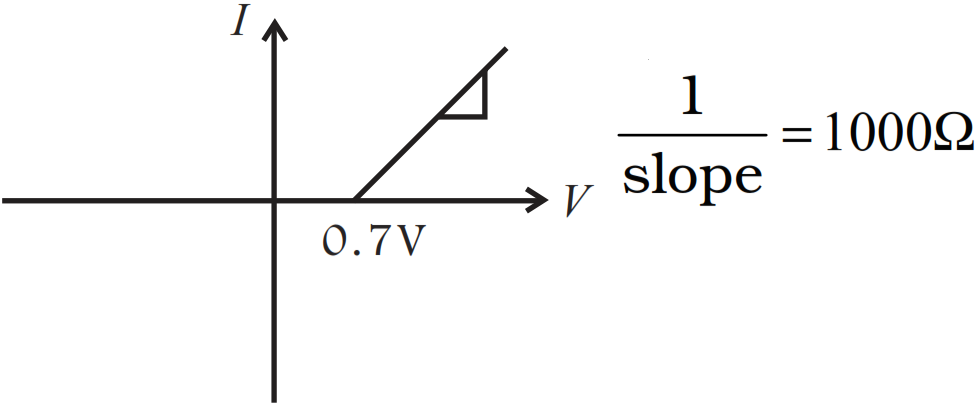
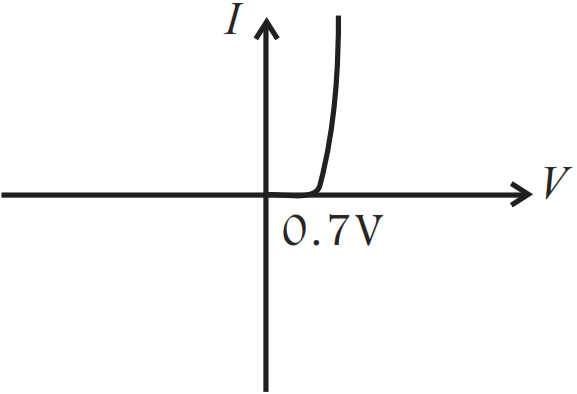
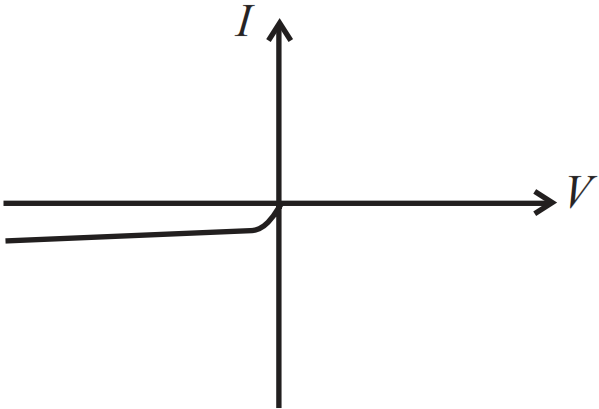
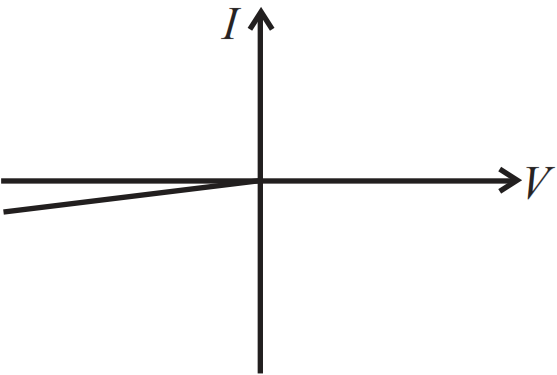
The student obtains graphs of current-voltage characteristics for unknown combination of components between the two terminals connected in the circuit. The graphs are
  1. When A is positive and B is negative,
  1. When A is negative and B is positive,
  1. When B is negative and C is positive,
  1. When B is positive and C is negative,
  1. When A is positive and C is negative,
  1. When A is negative and C is positive,

From these graphs of current - voltage characteristic shown in Fig. (c) to (h), determine the arrangement of components between A, B and C.
The two blocks in an Atwood machine have masses 2.0kg and 3.0kg. Find the work done by gravity during the fourth second after the system is released from rest.
A charge of 8 mC is located at the origin. Calculate the work done in taking a small charge of $–2 \times 10^{–9}$ C from a point P (0, 0, 3 cm) to a point Q (0, 4 cm, 0), via a point R (0, 6 cm, 9 cm).
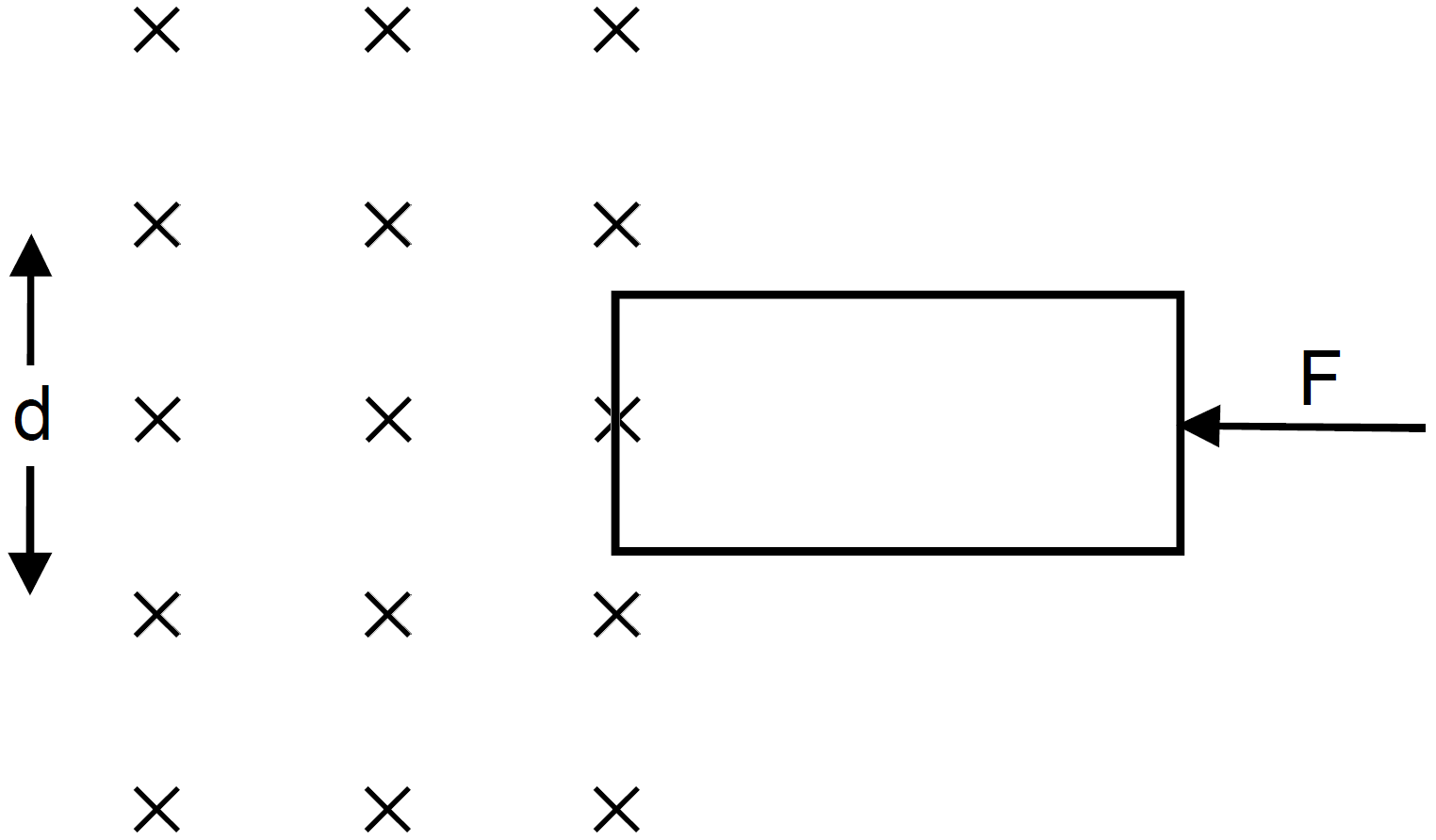
The rectangular wire-frame, shown in figure, has a width d, mass m, resistance R and a large length. A uniform magnetic field B exists to the left of the frame. A constant force F starts pushing the frame into the magnetic field at t = 0.
  1. Find the acceleration of the frame when its speed has increased to v.
  2. Show that after some time the frame will move with a constant velocity till the whole frame enters into the magnetic field. Find this velocity $v_0.$
  3. Show that the velocity at time t is given by $\text{v}=\text{v}_0\Big(1-\text{e}^{-\frac{\text{ft}}{\text{mv}_0}}\Big)$
A particle executes a simple harmonic motion of amplitude 1.0cm along the principal axis of a convex lens of focal length 12cm. The mean position of oscillation is at 20cm from the lens. Find the amplitude of oscillation of the image of the particle.

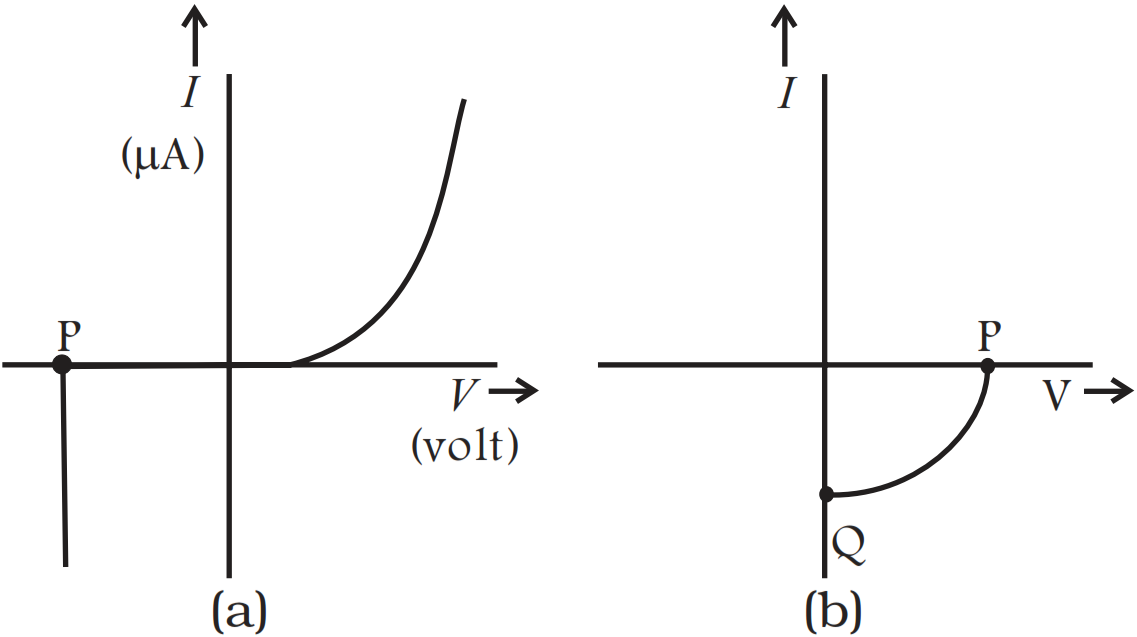
  1. Name the type of a diode whose characteristics are shown in Fig. (A) and Fig. (B).
  2. What does the point P in Fig. (A) represent?
  3. What does the points P and Q in Fig. (B) represent?
Show that the first few frequencies of light that is emitted when electrons fall to the $n^{th}$ level from levels higher than n, are approximate harmonics (i.e. in the ratio 1 : 2: 3...) when n > > 1.