Question
Consider earth satellites in circular orbits. A geostationary satellite must be at a height of about 36000km from the earth's surface. Will any satellite moving at this height be a geostationary satellite? Will any satellite moving at this height have a time period of 24 hours?
Answer

$\text{T}=\Big(\frac{\text{g}\text{R}^2\text{T}^2}{4\pi^2}\Big)^{\frac{1}{3}}-\text{R}$$\text{T}=\frac{4\pi^2(\text{h}+\text{R})^3}{\text{g}\text{R}^2}$
$=\frac{4\times3.14^2\times(36000+6400)^3\times10^9}{9.8\times(6400\times10^3)^2}$
$=24.097\text{Hr}$
Which implies that it is a geostationary sattelite with time period = 24Hrs.

Need a full question paper?

Generate a complete, print-ready paper with questions like this in minutes — across 16+ boards, with answer keys.

Start Generating Free

Similar questions

A wire carries an alternating current $\text{i}=\text{i}_0\sin\omega\text{t}.$ Is there an electric field in the vicinity of the wire?
  1. Mention two properties of soft iron due to which it is preferred for making an electromagnet.
  2. State Gauss's law in magnetism. How is it different from Gauss's law in electrostatics and why?
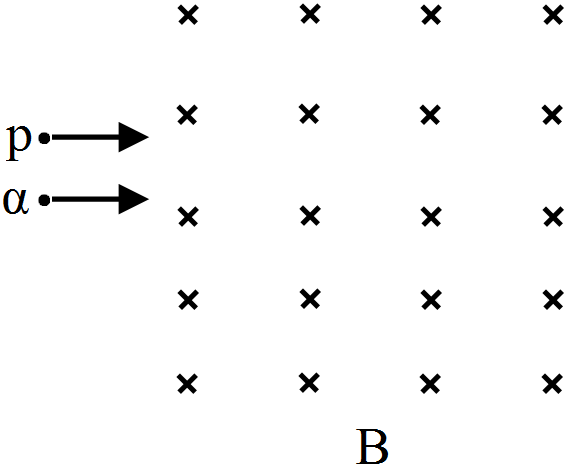
An $\alpha$-particle and a proton moving with the same speed enter the same magnetic field region at right angles to the direction of the field. Show the trajectories followed by the two particles in the region of the magnetic field. Find the ratio of the radii of the circular paths which the two particles may describe.
An ac circuit is made from series combination of components of circuits X and Y . Current is ahead of voltage by $\frac{\pi}{4}$. If component $X$ is pure resistor whose value is $100 \Omega$ then (i) what is the name of component $Y$ ? (ii) If root mean square value of voltage is 141 V , then find the root mean square value of the current.
Define the term wavefront. State Huygen's principle. Consider a plane wavefront incident on a thin convex lens. Draw a proper diagram to show how the incident wavefront traverses through the lens and after refraction focusses on the focal point of the lens, giving the shape of the emergent wavefront.
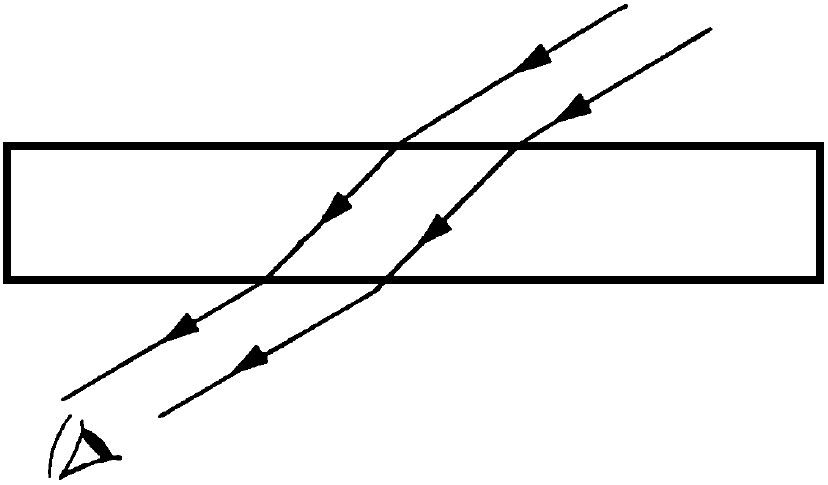
A narrow beam of light passes through a slab obliquely and is then received by an eye. The index of refraction of the material in the slab fluctuates slowly with time. How will it appear to the eye? The twinkling of stars has a similar explanation.
Define an equipotential surface. Draw equipotential surface:
  1. In the case of a single point charge and,
  2. In a constant electric field in Z-direction.
Why the equipotential surfaces about a single charge are not equidistant?
  1. Can electric field exist tangential to an equipotential surface? Give reason.
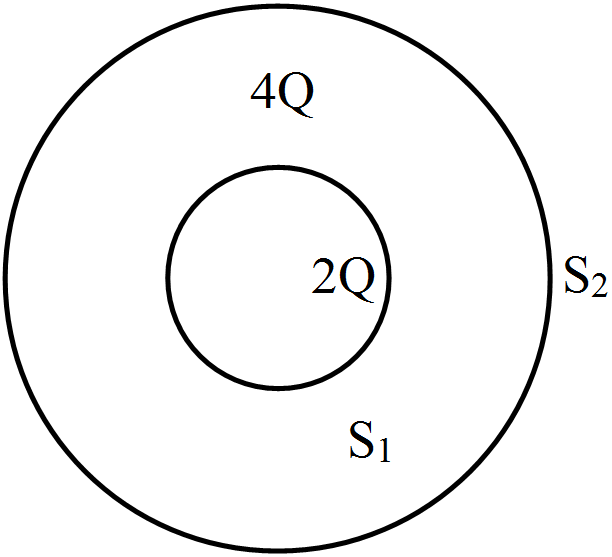
Consider two hollow concentric spheres, $S_1$ and $S_2$, enclosing charges 2Q and 4Q respectively as shown in the figure.
  1. Find out the ratio of the electric flux through them.
  2. How will the electric flux through the sphere $S_1$ change if a medium of dielectric constant $'\in_\text{r}'$ is introduced in the space inside $S_1$ in place of air? Deduce the necessary expression.
Explain how the groups of different energy levels can be made in -semi-conductors like Si and Ge crystals with band diagram
Derive the formula of electric field for a point on the axis of electric dipole.