Question
Consider the and answer the following questions.
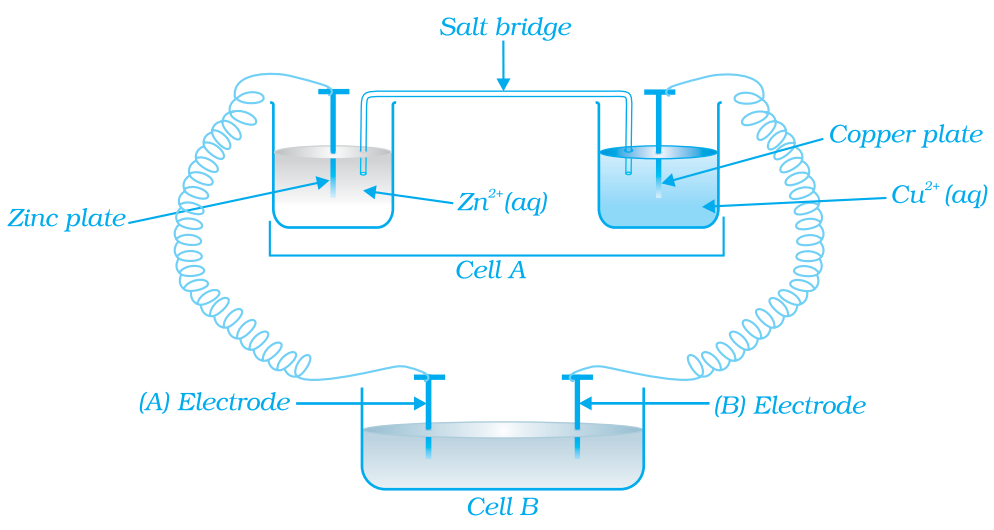
  1. Cell $'A\ ’$ has $E_{Cell}= 2V$ and Cell $'B\ ’$ has $E_{Cell} = 1.1V$ which of the two cells $'A\ ’$ or $'B\ ’$ will act as an electrolytic cell. Which electrode reactions will occur in this cell?
  2. If cell $'A\ ’$ has $E_{Cell}= 0.5V$ and cell $'B\ ’$ has $E_{Cell}= 1.1V$ then what will be the reactions at anode and cathode?
Answer

  1. Cell ‘B’ will act as electrolytic cell as it has lower emf
$\therefore$ The electrode reactions will be:
$\text{zn}^{2+}+2\text{e}^{-}\xrightarrow{\ \ \ \ \ \ \ \ \ \ \ }\text{zn}\ \ \text{ at cathode}$
$\text{Cu}\xrightarrow{\ \ \ \ \ \ \ \ \ \ \ }\text{Cu}^{2+}+2\text{e}^-\ \ \text{ at anode}$
  1. Now cell $'B\ ’$ acts as galvanic cell as it has higher emf and will push electrons into cell $‘A’.$
The electrode reaction will be:
$\text{at cathode}\ \ \text{ zn}\xrightarrow{\ \ \ \ \ \ \ \ \ \ \ }\text{zn}^{2+}+2\text{e}^{-}$
$\text{ at anode}\ \ \ \text{Cu}^{2+}+2\text{e}^-\xrightarrow{\ \ \ \ \ \ \ \ \ \ \ }\text{Cu}$

Need a full question paper?

Generate a complete, print-ready paper with questions like this in minutes — across 16+ boards, with answer keys.

Start Generating Free

Similar questions

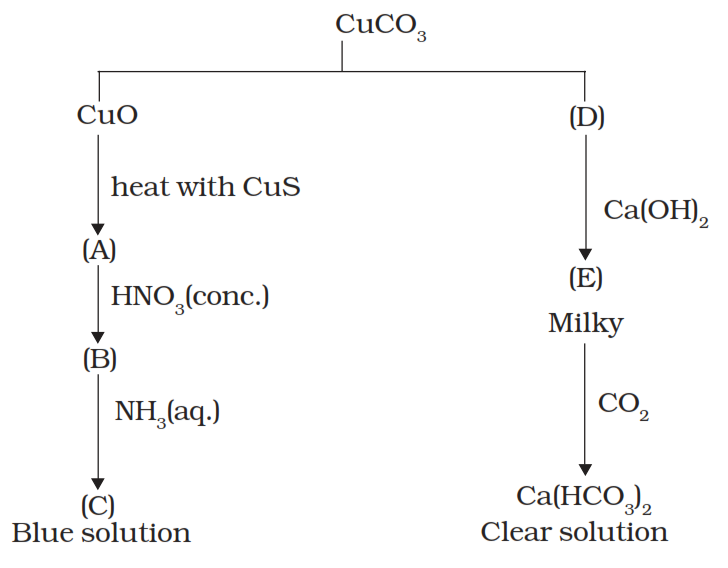
Identify $A$ to $E$ and also explain the reactions involved.
Derive the integral rate equation for the first order reaction and prove that the graph of $\ln k$ and $t$ a straight line.
  1. State two main differences between globular proteins and fibrous proteins.
  2. Based on their chemical composition, state how are lipids classified Give one example of each class.
Answer the following questions:Account for the following$:$
  1. Methylamine in water reacts with ferric chloride to precipitate hydrated ferric oxide.
  2. Diazonium salts of aromatic amines are more stable than those of aliphatic amines.
Attempt any five of the following:
(a) Name the enzyme which convert surcrose into glucose and fructose.
(b) i. Name any two bases which are common to both DNA and RNA.
     ii. Which vitamin deficiency causes:
1. Bone deformities in children?
2. Pernicious anaemia?
(c) What are heterocyclic bases?
(d) Write the name of linkage joining two monosaccharides.
(e) Name the purines present in DNA.
(f) Give an example of fibrous protein.
(g) Of the two bases named below, which one is present in RNA and which one is present in DNA?
i. Thymine
ii. Uracil
Match the terms given in Column I with expressions given in Column II.
  Column I   Column II
i. Mass percentage a. $\frac{\text{Number of moles of the solute component}}{\text{Volume of solution in litres}}$
ii. Volume percentage b. $\frac{\text{Number of moles of a component}}{\text{Total number of moles of all the components}}$
iii. Mole fraction c. $\frac{\text{Volume of the solute component in solution}}{\text{Total volume of solution}}\times100$
iv. Molality d. $\frac{\text{Mass of the solute component in solution}}{\text{Total mass of the solution}}\times100$
v. Molarity e. $\frac{\text{Number of moles of the solute components}}{\text{Mass of solvent in kilograms}}$
Explain the methods of preparation alcohol from the following compounds:
(a) From carbonyl compound
(b) From carboxylic acid
(c) From esters
(d) From Grignard reagent
Describe the standard hydrogen electrode with diagram.
What is the difference between osmosis and diffusion?
At $291K$, the molar conductivities at infinite dilution of $NH_4Cl, NaOH$ and $NaCl$ are $129.8, 217.4$ and $108.9S \ cm^2 mol^{-1}$ respectively. If the molar conductivity of a centinormal solution of $NH_4OH$ is $9.33S \ cm^2 mol^{-1},$ what is the percentage dissociation of $NH_4OH$ at this dilution? Also calculate the dissociation constant of $NH_4OH.$