MCQ
Conventional flow of current will always be from:
  • $p$ type $\rightarrow n$ type
  • B
    $n$ type $\rightarrow p$ type
  • C
    $n$ Type $\rightarrow n$ type
  • D
    None of these

Answer

Correct option: A.
$p$ type $\rightarrow n$ type
The holes in the covalent bonds of $p-$type semiconductor. They appear to move towards $n-$type semiconductor. Because the electrons in the covalent bonds of $n-$type semiconductor $($not free electrons$)$ jump towards $p-$type semiconductor due to plenty of holes available in the covalent bonds at $p-$side.
Hence, conventional current flow from $p-$type to $n-$type.

Need a full question paper?

Generate a complete, print-ready paper with questions like this in minutes — across 16+ boards, with answer keys.
Start Generating Free

Similar questions

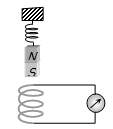
A magnet NS is suspended from a spring and while it oscillates, the magnet moves in and out of the coil C. The coil is connected to a galvanometer G. Then as the magnet oscillates,
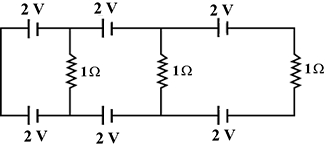
In the below circuit the current in each resistance is
The process by which a heavy nucleus splits into light nuclei is known as
In Young's double slit interference experiment, the slit separation is made $3$ folds. The fringe width becomes ......... times
The refractive indices of violet and red light are $1.54$ and $1.52$ respectively. If the angle of prism is $10^o $, then the angular dispersion is
Two point charges +9e and +e are at 16 cm away from each other. Where should another charge q be placed between them so that the system remains in equilibrium
If the refractive indices of crown glass for red, yellow and violet colours are 1.5140, 1.5170 and 1.5318 respectively and for flint glass these are 1.6434, 1.6499 and 1.6852 respectively, then the dispersive powers for crown and flint glass are respectively
If the forward voltage in a semiconductor diode is doubled, the width of the depletion layer will
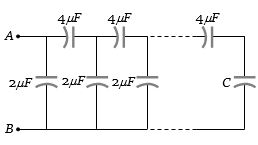
A finite ladder is constructed by connecting several sections of $2\,\mu F,\;4\,\mu F$ capacitor combinations as shown in the figure. It is terminated by a capacitor of capacitance $C$. What value should be chosen for $C$ such that the equivalent capacitance of the ladder between the points $A$ and $B$ becomes independent of the number of sections in between......$\mu F$
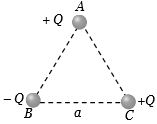
Three charges are placed at the vertices of an equilateral triangle of side ‘$a$’ as shown in the following figure. The force experienced by the charge placed at the vertex $A$ in a direction normal to $BC$ is