MCQ
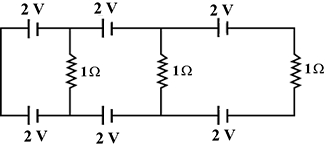
In the below circuit the current in each resistance is
  • A
    $1$ $A$ 
  • B
    $0.25$ $ A$
  • C
    $0.5$ $ A$
  • $0$ $ A$

Answer

Correct option: D.
$0$ $ A$
d
The potential difference in each loop is zero.

$\therefore $ No current will flow or current in each resistance is Zero.

Need a full question paper?

Generate a complete, print-ready paper with questions like this in minutes — across 16+ boards, with answer keys.

Start Generating Free

Similar questions

An electric wire of length ‘$I$’ and area of cross-section $a$ has a resistance $R\, ohms$. Another wire of the same material having same length and area of cross-section $4a$ has a resistance of
A capacitor is charged to 200 volt it has 0.1 coulomb charge. When it is discharged, energy will be
The circular boundary of the concave mirror subtends a cone of half angle $\theta$ at its centre of curvature. The minimum value of $\theta$ for which ray incident on this mirror parallel to the principle axis suffers reflection more than one is......$^o$
For the nuclear fusion reaction ${ }_1^2 H +{ }_1^3 H \rightarrow{ }_2^4 He +{ }_0^1 n$ temperature to which gases must be heated is $3.7 \times 10^9 \,K$. Potential energy between two nuclei is closest to ........ $J$ (Boltzmann's constant $k=1.38 \times 10^{-23} \,J / K$ )
After losing two electrons, an atom of Helium becomes equivalent to:
The phenomenon of light passing through the object is called:
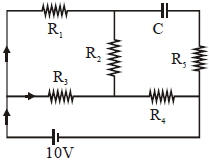
An ideal cell of emf $10\, V$ is connected in circuit shown in figure. Each resistance is $2\, \Omega .$ The potential difference (in $V$) across the capacitor when it is fully charged is
In Young's double slit experiment the intensity of the maxima is $I$. If the width of each slit is doubled, the intensity of the maxima will be:
The field of view is maximum for
A straight conductor carries a current. Assume that all free electrons in the conductor move with the same drift velocity v. $A$ and $B$ are two observers on a straight line $XY$ parallel to the conductor. A is stationary. $B$ moves along $XY$ with a velocity $v$ in the direction of the free electrons.