MCQ
The process by which a heavy nucleus splits into light nuclei is known as
  • Fission
  • B
    $\alpha - $decay
  • C
    Fusion
  • D
    Chain reaction

Answer

Correct option: A.
Fission
a
(a)

Need a full question paper?

Generate a complete, print-ready paper with questions like this in minutes — across 16+ boards, with answer keys.

Start Generating Free

Similar questions

A star emitting light of wavelength 5896 Å is moving away from the earth with a speed of 3600 km /sec. The wavelength of light observed on earth will ($\mathrm{c}=3\times 10^8\mathrm{~m} / \mathrm{sec}$ is the speed of light)
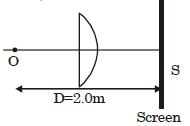
A plano-convex thin lens is used to obtain the image of a point object $O$ on the screen $S$ as shown in figure. The thickness of the lens in the middle is $0.5\ cm$ and refractive index of the material of the lens is $1.5$ . If the separation $D$ between the object and the screen is to be minimum, then the aperture diameter of the lens should be.....$cm$ (consider lens as thin)
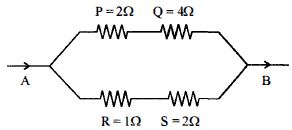
Which of the four resistances $P, Q, R$ and $S$ generate the greatest amount of heat when a current flows from $A$ to $B$ ?
A deviation of $2^{\circ}$ is produced in the yellow ray when prism of crown and flint glass are achromatically combined. Taking dispersive powers of crown and flint glass are $0.02$ and $0.03$ respectively and refractive index for yellow light for these glasses are $1.5$ and $1.6$ respectively. The refracting angles for crown glass prism will be $........\,^{\circ}$ (in degree) (Round off to the Nearest Integer)
For transistor action, which of the following statements is correct$?$
Two parallel plates have equal and opposite charge. When the space between them is evacuated, the electric field between the plates is $2 \times10^5 V/m$. When the space is filled with dielectric, the electric field becomes $1 \times10^5 V/m$. The dielectric constant of the dielectric material
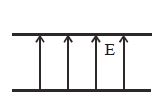
An electron falls through a distance of $1.5\, cm$ in a uniform electric field of magnitude $2.0\times10^4\, N/C$ as shown in the figure. The time taken by electron to fall through this distance is ($m_e = 9.1\times10^{-31}\,kg$, Neglect gravity)
$A$ ray of light moving along the unit vector $(- i - 2j)$ undergoes refraction at an interface of two media, which is the $x-z$ plane. The refractive index for $y > 0$ is $2$ while for $y < 0$, it is $ \sqrt 5 / 2$ . The unit vector along which the refracted ray moves is : 
Which of the following (referred to a spherical mirror) do (does) not depend on whether the rays are paraxial or not?
Two coherent plane light waves of equal amplitude makes a small angle $\alpha ( < < 1)$ with each other . They fall almost normally on a screen. If $\lambda $ is the wavelength of light waves, the fringe width $\Delta x$ of interference patterns of the two sets of waves on the screen is