MCQ
Correct match is :
  • A
    Ordinary form of borax   $:$        $Na_2B_4O_7 · 5H_2O$
  • Colemanite                       $:$        $Ca_2B_6O_{11}·5H_2O$
  • C
    Boronatrocalcite              $:$        $2Mg_3B_8O_{15}·MgCl_2$
  • D
    Octahedral form of borac        $:$        $Na_2B_4O_7·10H_2O$

Answer

Correct option: B.
Colemanite                       $:$        $Ca_2B_6O_{11}·5H_2O$
b
(A) Incorrect. Ordinary form of Borax $= Na _2 B _4 O _7 \cdot 10 H _2 O$

(B) Correct: Colemanite $= Ca _2 B _6 O _{11} \cdot 5 H _2 O$

(c) Incorrect: Bernarocalcite $= CaB _4 O _7 \cdot NaBO _2 \cdot 8 H _2 O$

(D) Correct: Octahedral form of borax $= Na _2\left[ B _4 O _5( OH )_4\right] \cdot 8 H _2 O$

Need a full question paper?

Generate a complete, print-ready paper with questions like this in minutes — across 16+ boards, with answer keys.
Start Generating Free

Similar questions

The heat liberated when $ 1.89 \,g$  of benzoic acid is burnt in a bomb calorimeter at ${25\,^o}C$ increases the temperature of $ 18.94\, kg $ of water by ${0.632\,^o}C$.If the specific heat of water at ${25\,^o}C$ is $0.998\, cal/g-deg$, the value of the heat combustion of benzoic acid is ....$kcal$
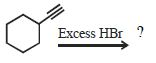
Identify the major product of the following reaction
Assuming fully decomposed, the volume of $C{O_2}$ released at $STP$ on heating $9.85\,g$ of $BaC{O_3}$ (Atomic mass of $Ba=137$) will be ................ $\mathrm{L}$
The $IUPAC$ name of is

$C{H_3} - \mathop {\mathop {C = }\limits_{|\,\,\,\,} }\limits_{C{l_{}}\,} \mathop {\mathop {C\, - }\limits_{|\,\,\,\,\,\,} }\limits_{C{H_3}\,} \mathop {\mathop {CH - \,}\limits_{|\,\,\,\,\,\,\,\,\,} }\limits_{{C_2}{H_5}\,} C{H_2} - C \equiv CH$

$\begin{array}{*{20}{c}}
  {C{H_3} - CH - CH = C{H_2}} \\ 
  {|\,\,\,\,\,\,\,\,\,\,\,\,\,\,\,\,\,\,\,\,} \\ 
  {C{H_3}\,\,\,\,\,\,\,\,\,\,\,\,\,\,} 
\end{array}$ $\xrightarrow{{{\text{D}}Br}}\,Product \,\left( {Major} \right)$ Product will be
$O_2 F_2$ is an unstable yellow orange solid and $H_2O_2$ is a colourless  liquid, both have $O-O$ bond and $O-O$ bond length in $H_2O_2$ and $O_2F_2$ respectively is
If enthalpies of formation of ${C_2}{H_4}(g),\,C{O_2}(g)$ and ${H_2}O(l)$ at ${25\,^o}C$ and $1\,atm$ pressure be $ 52, -394 $ and $ - 286\,kJ\,mo{l^{ - 1}}$ respectively, the enthalpy of combustion of ${C_2}{H_4}(g)$ will be.....$kJ\,mo{l^{ - 1}}$
Which isomer of xylene can give three different monochloroderivatives ?
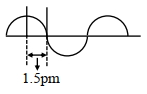
A hypothetical electromagnetic wave is show below.

(Image)

The frequency of the wave is $\mathrm{x} \times 10^{19} \mathrm{~Hz}$. $x=$ . . . .  (nearest integer)
On the basis of the following thermochemical data : $(\Delta _fG^oH^+_{(aq)} = 0)$

$H_2O(l) \rightarrow H^+(aq) + OH^-(aq)\,;\,\,\Delta H = 57.32\,kJ$

$H_2(g)+ \frac{1}{2} O_2(g)  \rightarrow H_2O(l)\,;\,\, \Delta H=-286.20\,kJ$

The value of enthalpy of formation of $OH^-$ ion at $25\,^oC$ is : .............. $\mathrm{kJ}$