Question
Define electronegativity. How does it differ from electron gain enthalpy?

Answer

The relative tendency of a bonded atom to attract the shared electron pair towards itself is called electronegativity while electron gain enthalpy is the energy change that occurs for the process of adding an electron to a gaseous isolated atom to convert it into a negative ion i.e., to form, a monovalent anion. Electron gain enthalpy and electronegativity both measure the power of attracting electrons, but electron gain enthalpy is concerned with an isolated gaseous atom while electronegativity is concerned with the atom in combination.

Need a full question paper?

Generate a complete, print-ready paper with questions like this in minutes — across 16+ boards, with answer keys.

Start Generating Free

Similar questions

A sample of HI(g) is placed in flask at a pressure of 0.2 atm. At equilibrium the
partial pressure of HI(g) is 0.04 atm.
What is $\text{K}_\text{p}$ for the given equilibrium?
$\text{2HI (g)}\rightleftharpoons\text{H}_2\text{ (g) + I}_2\text{ (g)}$
Urine has a pH of 6.0. If a patient eliminates 1300mL of urine per day, how many gram equivalents of the acid he eliminates per day?
Which one of the following alkali metals gives hydrated salts?
Dual behaviour of matter proposed by de Broglie led to the discovery of electron microscope often used for the highly magnified images of biological molecules and other type of material. If the velocity of the electron in this microscope is $1.6 \times 10^6 \mathrm{~ms}^{-1}$, calculate de Broglie wavelength associated with this electron.
The first (IE) and second (IER) ionization enthalpy: $\left( KJ mol ^{-1}\right)$ of three elements $A , B$ and C are given below:
 ABC
$IE _1$4035491142
$IE _2$264010602080
Identify the element which is likely to be
i. a non-metal
ii. an alkali metal
iii. an alkaline earth metal
Calculate the number of atoms in each of the following
1. 52 mole of Ar
2. 52 u of He
3. 52 g of He .
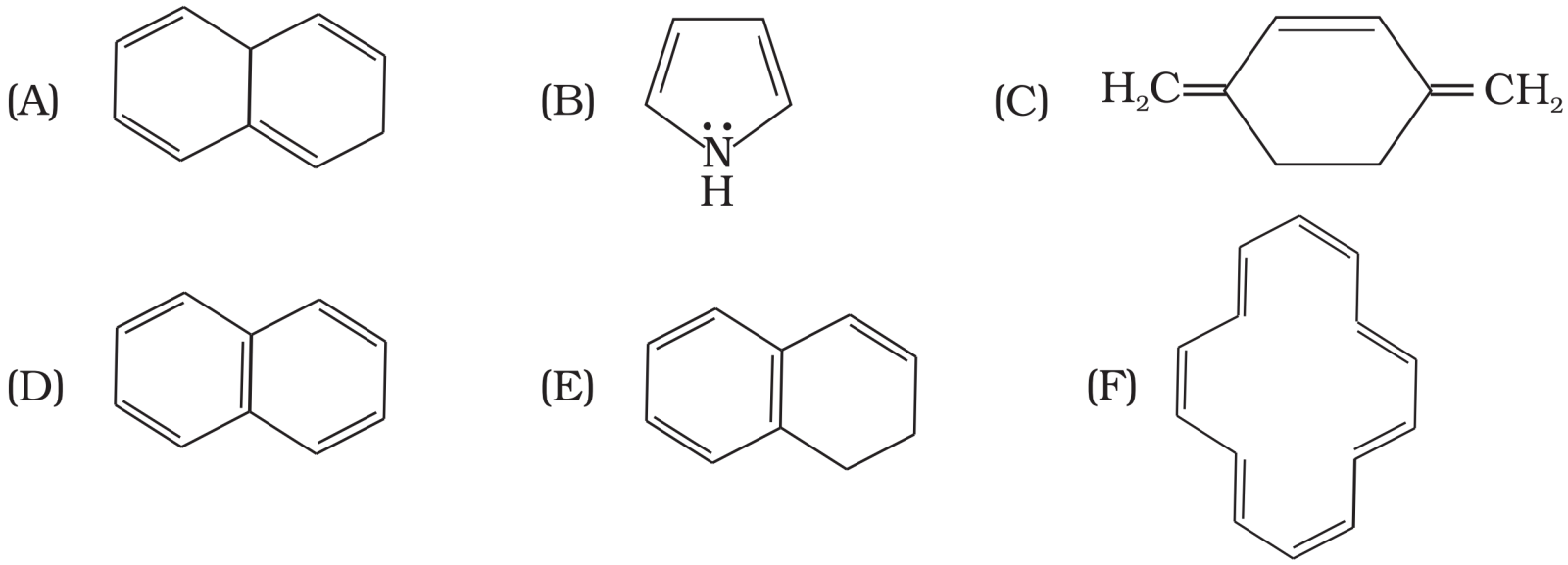
Which of the following compounds are aromatic according to Huckel’s rule?
  1. Write IUPAC name of the following:
  1. $\text{CH}_2\text{CH}_2\text{CHO}\text{ and }\text{CH}_3\text{C}-\text{CH}_3\\ \ \ \ \ \ \ \ \ \ \ \ \ \ \ \ \ \ \ \ \ \ \ \ \ \ \ \ \ \ \ \ \ \ \ \ \ \ \ \ \ \ ||\\ \ \ \ \ \ \ \ \ \ \ \ \ \ \ \ \ \ \ \ \ \ \ \ \ \ \ \ \ \ \ \ \ \ \ \ \ \ \ \ \ \ \text{O}$
  2. Draw the structure of 3-oxopentanal.
Write four characteristic properties of p-block elements.
  1. Which orbital is non-directional?
  2. What are the frequency and wavelength of a photon emitted during a transition from n = 5 state to n = 2 state in the hydrogen atom?
($h = 6.626 \times 10^{-34}Js$)