Question
Define the different terms used for the composition of a nucleus.

Answer

• The Composition of nucleus :
(i) Atomic number $( Z )$ :
The number of electrons in the neutral atom is called the atomic number.
OR
The number of protons in the neutral atom is called the atomic number.
(ii) Mass number (A) :
The sum of the number of protons and neutrons in the nucleus of the atom is called the atomic mass number A .
Both protons and neutrons are present in the nucleus hence it is known by the common name of nucleon.
The total number of nucleons in the nucleus of an atom is called atomic mass number A .
$\therefore A = Z + N$
(iii) Neutron number ( N $)$ :
The number of neutrons present in the nucleus of an atom is called the neutron number N .
(iv) Nuclide :
The type of nucleus is called nuclide and is represented by symbol ${ }_Z X^A$.
Where X is the chemical symbol of element, $Z =$ atomic number and A is atomic mass number.
For example :
Nuclide of gold ${ }_{79} A u^{197}$
in which 197 nucleons, 79 protons and 118 neutrons are there.

Need a full question paper?

Generate a complete, print-ready paper with questions like this in minutes — across 16+ boards, with answer keys.
Start Generating Free

Similar questions

Radiation from hydrogen discharge tube falls on a cesium plate. Find the maximum possible kinetic energy of the photoelectrons. Work function of cesium is 1.9eV.
  1. Draw a neat labelled ray diagram of a compound microscope. Explain briefly its working.
  2. Why must both the objective and the eye-piece of a compound microscope have short focal lengths?
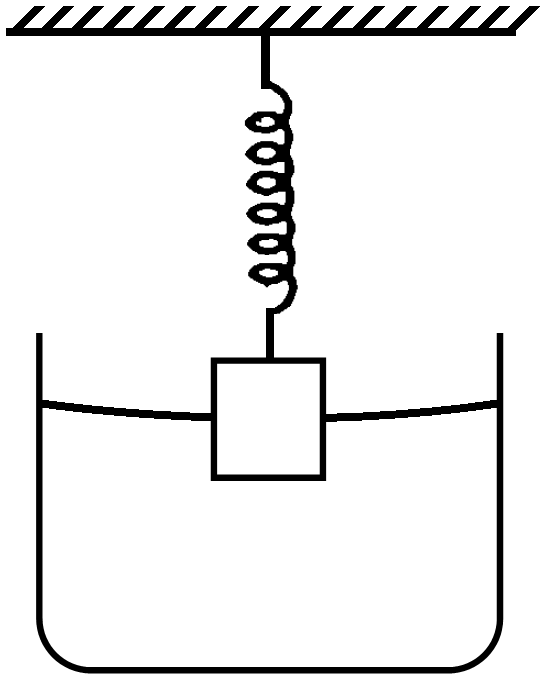
A cylindrical object of outer diameter $10\ cm,$ height $20\ cm$ and density $8000\ kg/m^3$ is supported by a vertical spring and is half dipped in water as shown in.
  1. Find the elongation of the spring in equilibrium condition.
  2. If the object is slightly depressed and released, find the time period of resulting oscillations of the object. The spring constant $= 500N/m.$
An infinite line charge produces a field of 9 x10⁴ N C-1at a distance of 2 cm. Calculate the linear charge density.
  1. Define self $-$ inductance. Write its $SI$ units.
  2. A long solenoid with $15$ turns per $\ cm$ has a small loop of area $2.0 \ cm^2$ placed inside the solenoid normal to its axis. If the current carried by the solenoid changes steadily from $ 2.0 A$ to $4.0 A$ in $0.1 s,$ what is the induced emf in the loop while the current is changing?
Two electric bulbs have the following specifications.
  1. 100W at 220V.
  2. 1000W at 220V.
Which bulb has higher resistance? What is the ratio of their resistances?
Using Bohr's postulates, obtain the expression for the total energy of the electron in the stationary states of the hydrogen atom. Hence draw the energy level diagram showing how the line spectra corresponding to Balmer series occur due to transition between energy levels.
A long, vertical wire carrying a current of $10A$ in the upward direction is placed in a region where a horizontal magnetic field of magnitude $2·0 \times 10^{-3}T $
exists from south to north. Find the point where the resultant magnetic field is zero.
The diameter of the sun is $1.4 \times 10^9m$ and its distance from the earth is $1.5 \times 10^{11}m.$ Find the radius of the image of the sun formed by a lens of focal length $20\ cm.$
Consider a radioactive nucleus $A$ which decays to a stable nucleus $C$ through the following sequence$: A \rightarrow B \rightarrow C$
Here $B$ is an intermediate nuclei which is also radioactive. Considering that there are $N_0$ atoms of $A$ initially, plot the graph showing the variation of number of atoms of $A$ and $B$ versus time.