Question
Define the term magnetic moment of a current loop. Write the expression for the magnetic moment when an electron revolves at a speed v around an orbit of radius ‘r’ in hydrogen atom.

Answer

Magnetic moment of a current loop:

The torque on current loop is $\tau=\text{MB}\sin\theta$, where $\theta$ is angle between magnetic moment and magnetic field.

$\Rightarrow\text{M}=\frac{\tau}{\text{B}\sin\theta}$

If B or 1 T, $\sin\theta=1$ or $\theta=90^\circ$ then $\text{M}=\tau$.

That is the magnetic moment of a current loop is defined as the torque acting on the loop when placed in a magnetic field of 1 T such that the loop is oriented with its area vector normal to the magnetic field.

Also, M = IA

i.e., magnetic moment of a current loop is the product of current flowing in the loop and area of loop. Its direction is perpendicular to the plane of the loop and determined by using right hand thumb rule.

Magnetic moment of revolving electron,

$\text{M}=\frac{\text{evr}}{2}$

Need a full question paper?

Generate a complete, print-ready paper with questions like this in minutes — across 16+ boards, with answer keys.
Start Generating Free

Similar questions

  1. Two insulated charged copper spheres A and B have their centres separated by a distance of 50 cm. What is the mutual force of electrostatic repulsion if the charge on each is 6.5 × 10⁻⁷ C? The radii of A and B are negligible compared to the distance of separation.
  2. What is the force of repulsion if each sphere is charged double the above amount, and the distance between them is halved?
Explain with a neat diagram construction and working of a compound microscope. Obtain an expression for its magnifying power.
A horizontal cesium plate ($\phi$ = l.9 eV) is moved vertically downward at a constant speed u in a room full of radiation of wavelength 250 run and above. What should be the minimum value of u so that the vertically upward component of velocity is nonpositive for each photoelectron?
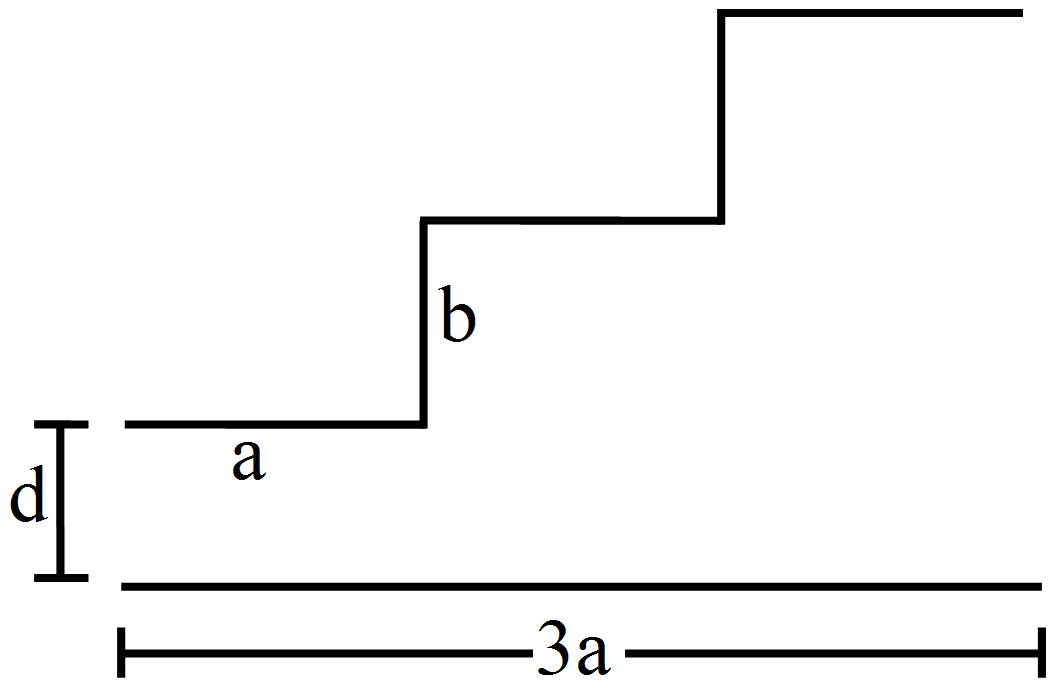
A capacitor is made of a flat plate of area A and a second plate having a stair-like structure as shown in figure. The width of each stair is a and the height is b. Find the capacitance of the assembly.

A capacitor of capacitance $C_1$ is charged to a potential $V_1$ while another capacitor of capacitance $C_2$ is charged to a potential difference $V_2$. The capacitors are now disconnected from their respective charging batteries and connected in parallel to each other.
i. Find the total energy stored in the two capacitors before they are connected.
ii. Find the total energy stored in the parallel combination of two capacitors.
iii. Explain the reason for the difference of energy in parallel combination in comparison to the total energy before they are connected
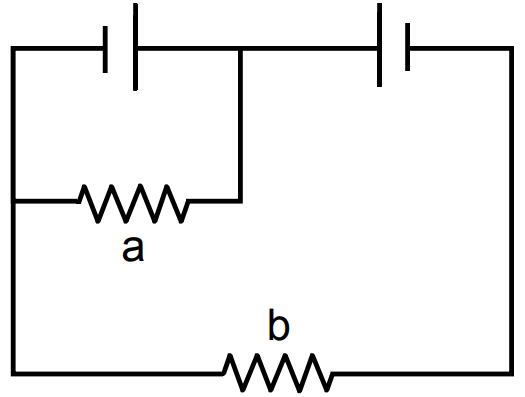
Each of the resistors shown in figure. has a resistance of $10\Omega$ and each of the batteries has an emf of 10V. Find the currents through the resistors a and b in the two circuits.


a. Derive an expression for the impedance of a series L-C-R circuit connected to an AC supply of variable frequency.
b. Explain briefly how the phenomenon of resonance in the circuit can be used in the tuning mechanism of a radio or a TV set?
A capacitor stores $50\mu\text{C}$ charge when connected across a battery. When the gap between the plates is filled with a dielectric, a charge of $100\mu\text{C}$ flows through the battery. Find the dielectric constant of the material inserted.
Suppose a 'n' - type wafer is created by doping Si crystal having 5 × 1028 atoms/m3 with 1ppm concentration of As. On the surface 200 ppm Boron is added to create ‘P’ region in this wafer. Considering ni = 1.5 × 1016m-3.
  1. Calculate the densities of the charge carriers in the n & p regions.
  2. Comment which charge carriers would contribute largely for the reverse saturation current when diode is reverse biased.
In an agricultural experiment, a solution containing 1 mole of a radioactive material $\Big(\text{t}_{\frac{1}{2}}=14.3\text{ days}\Big)$ was injected into the roots of a plant. The plant was allowed 70 hours to settle down and then activity was measured in its fruit. If the activity measured was $1\mu\text{Ci},$ what per cent of activity is transmitted from the root to the fruit in steady state?