Question
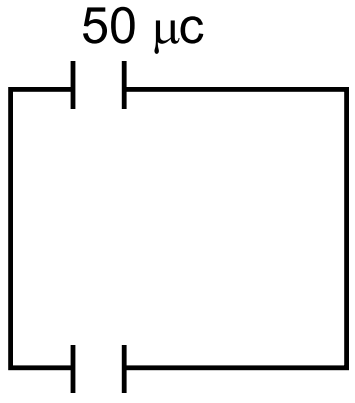
A capacitor stores $50\mu\text{C}$ charge when connected across a battery. When the gap between the plates is filled with a dielectric, a charge of $100\mu\text{C}$ flows through the battery. Find the dielectric constant of the material inserted.

Answer


Initial charge stored $=50\mu\text{c}$

Let the dielectric constant of the material induced be ‘k’.

Now, when the extra charge flown through battery is 100.

So, net charge stored in capacitor $=150\mu\text{c}$

Now, $\text{C}_1=\frac{\in_0\text{A}}{\text{d}}$ or $\frac{\text{q}_1}{\text{V}}=\frac{\in_0\text{A}}{\text{d}}\ \dots(1)$

$\text{C}_2=\frac{\in_0\text{Ak}}{\text{d}}$ or $\frac{\text{q}_2}{\text{V}}=\frac{\in_0\text{Ak}}{\text{d}}\ \dots(2)$

Dividing (1) and (2) we get $\frac{\text{q}_1}{\text{q}_2}=\frac{1}{\text{k}}$

$\Rightarrow\frac{50}{150}=\frac{1}{\text{k}}$

$\Rightarrow\text{k}=3$
Need a full question paper?

Generate a complete, print-ready paper with questions like this in minutes — across 16+ boards, with answer keys.

Start Generating Free

Similar questions

A 100kg block is started with a speed of 2.0ms-1 on a long, rough belt kept fixed in a horizontal position. The coefficient of kinetic friction between the block and the belt is 0.20.
  1. Calculate the change in the internal energy of the block-belt system as the block comes to a stop on the belt.
  2. Consider the situation from a frame of reference moving at 2.0ms-1 along the initial velocity of the block. As seen from this frame, the block is gently put on a moving belt and in due time the block starts moving with the belt at 2.0ms-1 Calculate the increase in the kinetic energy of the block as it stops slipping past the belt.
  3. Find the work done in this frame by the external force holding the belt.
A voltmeter coil has resistance $50.0\Omega$ and a resistor of $1.15\text{k}\Omega$ is connected in series. It can read potential differences up to 12 volts. If this same coil is used to construct an ammeter that can measure currents up to 2.0A, what should be the resistance of the shunt used?
Find out magnetic force on parallel current carrying conductors and also state their special conditions.
$\text{ }^{212}_{33}\text{Bi}$ can disintegrate either by emitting an $\alpha$-particle of by emitting a $\beta^-$-particle.
  1. Write the two equations showing the products of the decays.
  2. The probabilities of disintegration $\alpha$ and $\beta$ -decays are in the ratio $\frac{7}{13}.$ The overall half-life of 212Bi is one hour. If 1g of pure 212Bi is taken at 12.00 noon, what will be the composition of this sample at 1P.m. the same day?
The friction coefficient between a road and the tyre of a vehicle is $\frac{4}{3}.$ Find the maximum incline the road may have so that once hard brakes are applied and the wheel starts skidding, the vehicle going down at a speed of 36km/hr is stopped within 5m.
  1. Using Gauss Theorem show mathematically that for any point outside the shell, the field due to a uniformly charged spherical shell is same as the entire charge on the shell, is concentrated at the centre.
  2. Why do you expect the electric field inside the shell to be zero according to this theorem?

OR

A thin conducting spherical shell of radius R has charge Q spread uniformly over its surface. Using Gauss’s theorem, derive an expression for the electric field at a point outside the shell.

Draw a graph of electric field E(r) with distance r from the centre of the shell for $0\leq\text{r}\le\infty.$

OR

Find the electric field intensity due to a uniformly charged spherical shell at a point (i) outside the shell and (ii) inside the shell. Plot the graph of electric field with distance from the centre of the shell.

OR

Using Gauss’s law obtain the expression for the electric field due to a uniformly charged thin spherical shell of radius R at a point outside the shell. Draw a graph showing the variation of electric field with r, for r > R and r < R.

Define mean value and root mean square value of alternating current.
Figure shows a cylindrical tube with adiabatic walls and fitted with an adiabatic separator. The separator can be slid into the tube by an external mechanism. An ideal gas $(\gamma=1.5)$ is injected in the two sides at equal pressures and temperatures. The separator remains in equilibrium at the middle. It is now slid to a position where it divides the tube in the ratio 1 : 3. Find the ratio of the temperatures in the two parts of the vessel.

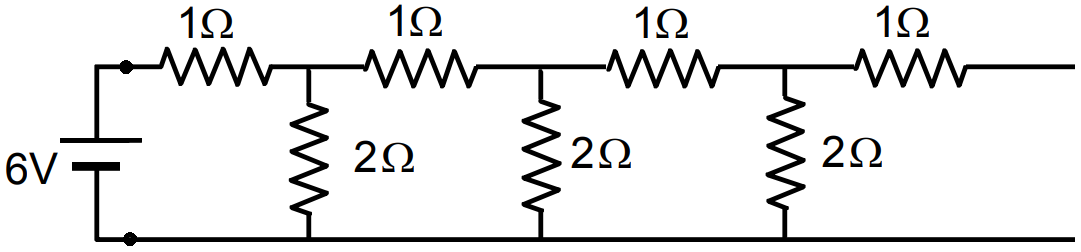
An infinite ladder is constructed with $1\Omega$ and $2\Omega$ resistors, as shown in the figure.

(a) Find the effective resistance between the points A and B. (b) Find the current that passes through the $2\Omega$ resistor nearest to the battery.

i. Prove that an ideal capacitor in an ac circuit does not dissipate power.
ii. An inductor of 200 mH, a capacitor of $400 \mu f$, and a resistor of $10 \Omega$ are connected in series to ac source of 50 V of variable frequency. Calculate the
a. the angular frequency at which maximum power dissipation occurs in the circuit and the corresponding value of the effective current and
b. value of Q-factor in the circuit.