Question
Derive Einstein’s photoelectric equation $\frac{1}{2}\text{m}\text{v}^2=\text{h}\nu-\text{h}\nu_0.$

Answer

Einstein’s Explanation of Photoelectric Effect:Einstein’s Photoelectric Equation:
Einstein explained photoelectric effect on the basis of quantum theory. The main points are,
  1. Light is propagated in the form of bundles of energy. Each bundle of energy is called a quantum or photon and has energy hν where h = Planck’s constant and ν = frequency of light.
  2. The photoelectric effect is due to collision of a photon of incident light and a bound electron of the metallic cathode.
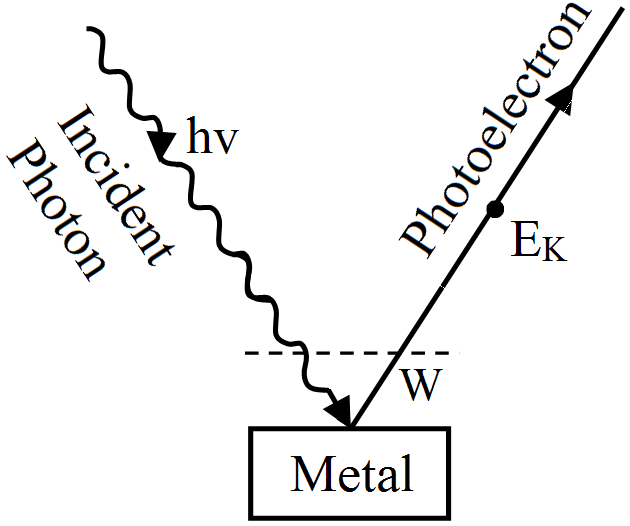
  3. When a photon of incident light falls on the metallic surface, it is completely absorbed. Before being absorbed it penetrates through a distance of nearly 10-8m (or $100\mathring{\text{A}}$). The absorbed photon transfers its whole energy to a single electron. The energy of photon goes in two parts: a part of energy is used in releasing the electron from the metal surface (i.e., in overcoming work function) and the remaining part appears in the form of kinetic energy of the same electron.
If ν be the frequency of incident light, the energy of photon = hν. If W be the work function of metal and $E_K$ the maximum kinetic energy of photoelectron, then according to Einstein’s explanation. $\text{h}\nu=\text{W}+\text{E}_\text{K}$ or $\text{E}_\text{K}=\text{h}\nu-\text{W}\dots(\text{i})$ This is called Einstein’s photoelectric equation. If $\nu_0$ be the threshold frequency, then if frequency of incident light is less then $\nu_0$ no electron will be emitted and if the frequency of incident light be $\nu_0$ then $E_K = 0$; so from equation (i) $0=\text{h}\nu_0-\text{W}$ or $\text{W}=\text{h}\nu_0$ If $\lambda_0$ be the threshold wavelength, then $\nu_0=\frac{\text{c}}{\lambda_0},$ where c is the speed of light in vacuum $\therefore$ Work function $\text{W}=\text{h}\nu_0=\frac{\text{hc}}{\lambda_0}\dots(\text{ii})$Substituting this value in equation (i), we get
$\text{E}_\text{K}=\text{h}\nu-\text{h}\nu_0$ $\Rightarrow\ \frac{1}{2}\text{mv}^2=\text{h}\nu-\text{h}\nu_0\dots(\text{iii})$This is another form of Einstein's photoelectric equation.

Need a full question paper?

Generate a complete, print-ready paper with questions like this in minutes — across 16+ boards, with answer keys.
Start Generating Free

Similar questions

There are two coils A and B seperated by some distance. If a current of 2A flows through A, a magnetic flux of $10^{-2}$Wb passes through B (no current through B). If no current passes through A and a current of 1A passes through B, what is the flux through A?
Calculate the electric field in a copper wire of cross-sectional area $2.0mm^2$ carrying a current of 1A.
The resistivity of copper $=1.7\times10^{-8}\Omega\text{-m}.$
Consider the Atwood machine of the previous problem. The larger mass is stopped for a moment 2.0s after the system is set into motion. Find the time elapsed before the string is tight again.

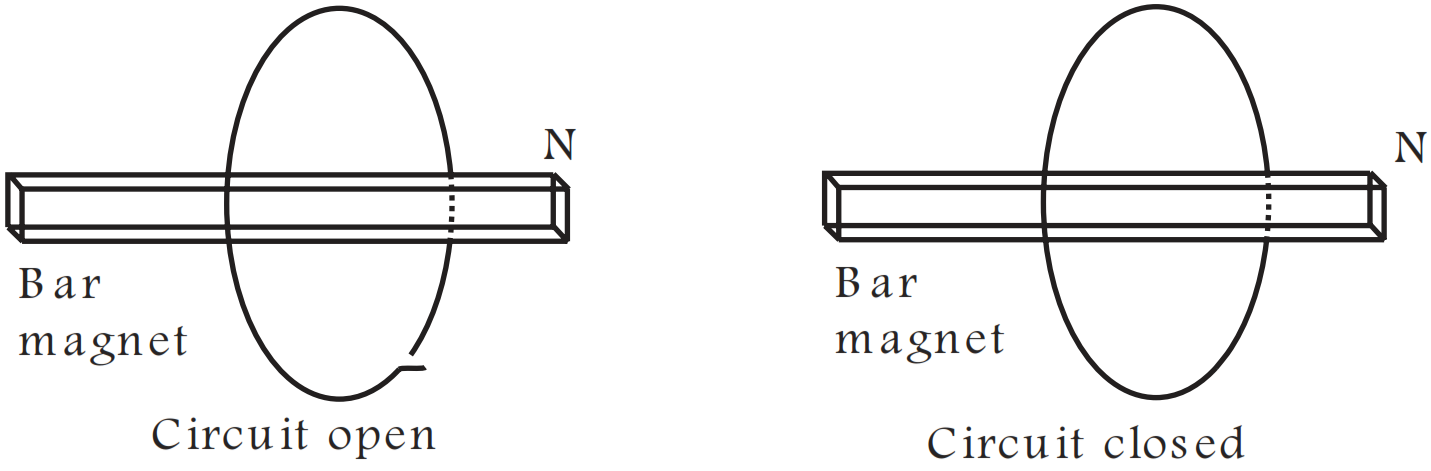
Consider a magnet surrounded by a wire with an on/off switch S (Fig). If the switch is thrown from the off position (open circuit) to the on position (closed circuit), will a current flow in the circuit? Explain.
Obtain an expression for induced electromotive force due to rotational motion of a disc in a uniform magnetic field.
Calculate potential on the axis of a ring due to charge Q uniformly distributed along the ring of radius R.
A block of mass m is kept on a horizontal ruler. The friction coefficient between the ruler and the block is g. The ruler is fixed at one end and the block is at a distance L from the fixed end. The ruler is rotated about the fixed end in the horizontal plane through the fixed end.
  1. What can the maximum angular speed be for which the block does not slip?
  2. If the angular speed of the ruler is uniformly increased from zero at an angular acceleration $\alpha,$ at what angular speed will the block slip?
  1. State Kirchhoff’s rules for an electric network. Using Kirchhoff’s rules, obtain the balance condition in terms of the resistances of four arms of Wheat sone bridge.
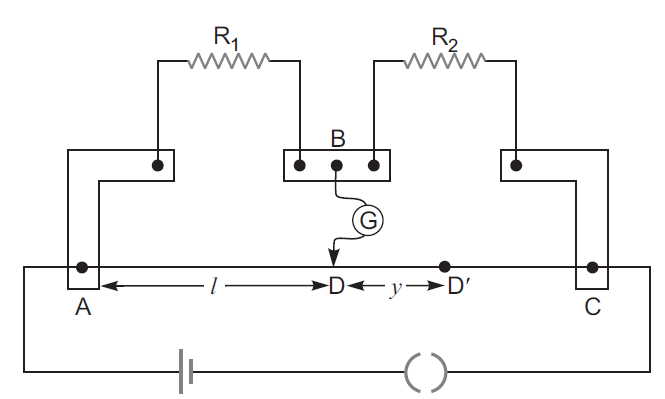
  2. In the meter bridge experimental set up, shown in the figure, the null point ‘D’ is obtained at a distance of 40 cm from end A ofthe meter bridge wire. If a resistance of 10 Ω is connected in series with $R_1$, null point is obtained at AD = 60 cm. Calculate the value of $R_1$ and $R_2.$
Derive the electric field generated due to the dipole at any point located on the equatorial plane of the electric dipole. Draw the necessary diagram.
An electrical device draws 2kW power from AC mains $(\text{voltage }223\text{V}\text{(rms)}=\sqrt{50.000}\text{V})$. The current differs (lags) in phase by $\phi\Big(\tan\phi=\frac{-3}{4}\Big)$ as compared to voltage. Find,
  1. R,
  2. $X_C - X_L,$
  3. $I_M$. Another device has twice the values for $R, X_C$ and $X_L$. How are the answers affected?