Question
An electrical device draws 2kW power from AC mains $(\text{voltage }223\text{V}\text{(rms)}=\sqrt{50.000}\text{V})$. The current differs (lags) in phase by $\phi\Big(\tan\phi=\frac{-3}{4}\Big)$ as compared to voltage. Find,
  1. R,
  2. $X_C - X_L,$
  3. $I_M$. Another device has twice the values for $R, X_C$ and $X_L$. How are the answers affected?
Answer

Power $\text{P}=\frac{\text{V}^2}{\text{Z}}$Given, P = 2kW = 2000W,$ V_{rms} = V = 223V$
$\text{Z}=\frac{\text{V}^2}{\text{P}}=\frac{223\times223}{2\times10^3}=25$
Now, impedance $\text{Z}=25\Omega$
Impedance $\text{Z}=\sqrt{\text{R}^2+(\text{X}_\text{C}-\text{X}_\text{L})^2}$
$\Rightarrow\ \sqrt{\text{R}^2+(\text{X}_\text{C}-\text{X}_\text{L})^2}=25$
$\Rightarrow\ \text{R}^2+(\text{X}_\text{C}-\text{X}_\text{L})^2=625$
As, $\tan\phi=\frac{\text{X}_\text{C}-\text{X}_\text{L}}{\text{R}}=-\frac{3}{4}$
$\therefore\ 625=\text{R}^2+\Big(-\frac{3}{4}\text{R}\Big)^2=\frac{25}{16}$
$\text{R}^2=400$
$\Rightarrow\ \text{R}=20\Omega$
  1. Resistance $\text{R}=200\Omega.$
  2. $\text{X}_\text{L}-\text{X}_\text{C}=\frac{3\text{R}}{4}=\frac{3}{4}\times20=15\Omega.$
  3. Main current $\text{I}_\text{M}=\text{I}\sqrt{2}=\frac{\text{V}}{\text{Z}}\sqrt{2}=\frac{223}{25}\times\sqrt{2}=12.6\text{A}$.

Need a full question paper?

Generate a complete, print-ready paper with questions like this in minutes — across 16+ boards, with answer keys.

Start Generating Free

Similar questions

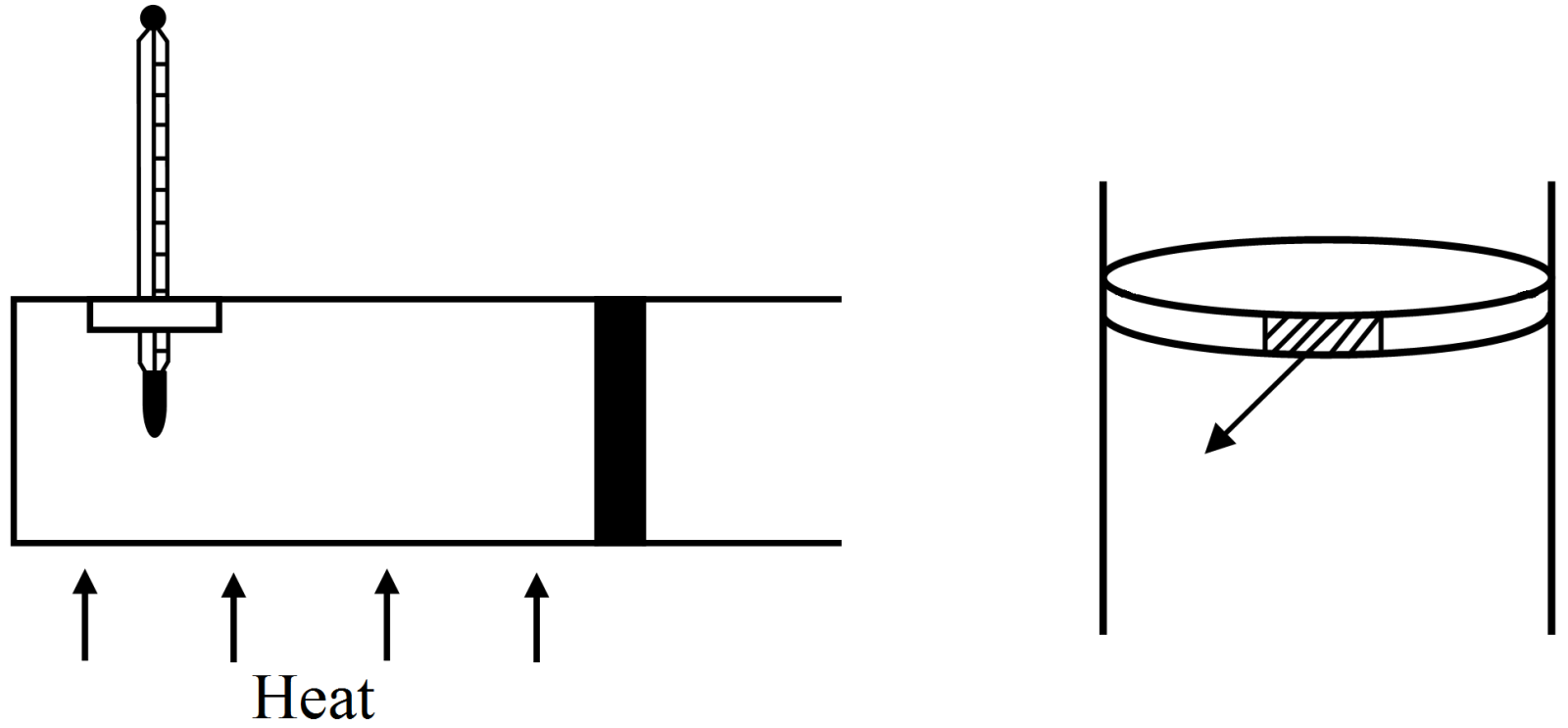
Figure. shows a cylindrical tube of radius 5cm and length 20cm. It is closed by a tight-fitting cork. The friction coefficient between the cork and the tube is 0.20. The tube contains an ideal gas at a pressure of 1 atm and a temperature of 300K. The tube is slowly heated and it is found that the cork pops out when the temperature reaches 600K Let dN denote the magnitude of the normal contact force exerted by a small length dl of the cork along the periphery (see the figure). Assuming that the temperature of the gas is uniform at any instant, calculate $\frac{\text{dN}}{\text{dl}}.$
A series LCR circuit with L = 0.12H, C = 480nF, R = 23Ω is connected to a 230V variable frequency supply.
  1. What is the source frequency for which current amplitude is maximum. Obtain this maximum value.
  2. What is the source frequency for which average power absorbed by the circuit is maximum. Obtain the value of this maximum power.
  3. For which frequencies of the source is the power transferred to the circuit half the power at resonant frequency? What is the current amplitude at these frequencies?
  4. What is the Q-factor of the given circuit?
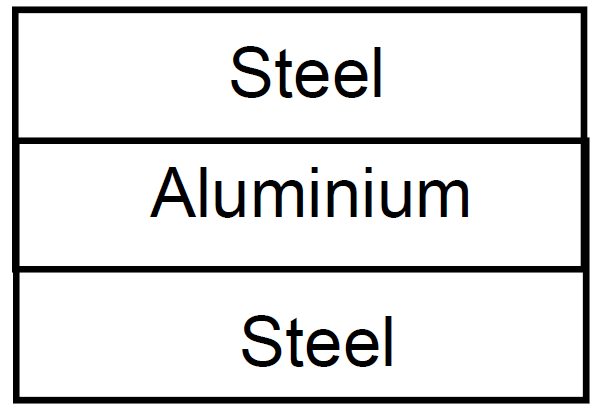
Two steel rods and an aluminium rod of equal length $l_0$ and equal cross section are joined rigidly at their ends as shown in the figure below. All the rods are in a state of zero tension at $0^\circ C$. Find the length of the system when the temperature is raised to $\theta$. Coefficient of linear expanaion of aluminium and steel are $\alpha_\text{a}$ and $\alpha_\text{s}$respectively. Young's modulus of aluminium is $Y_a$ and of steel is $Y_s.$​​​​​​​
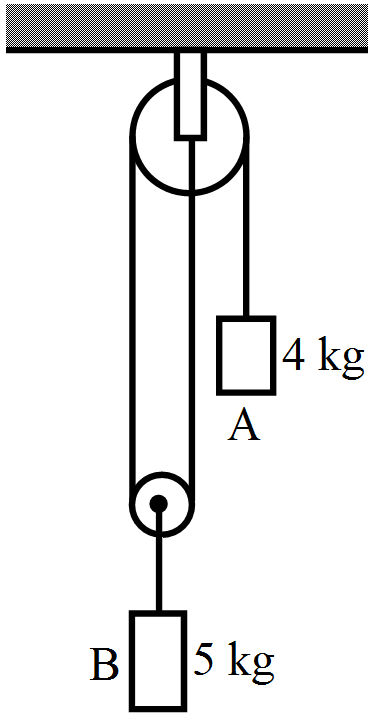
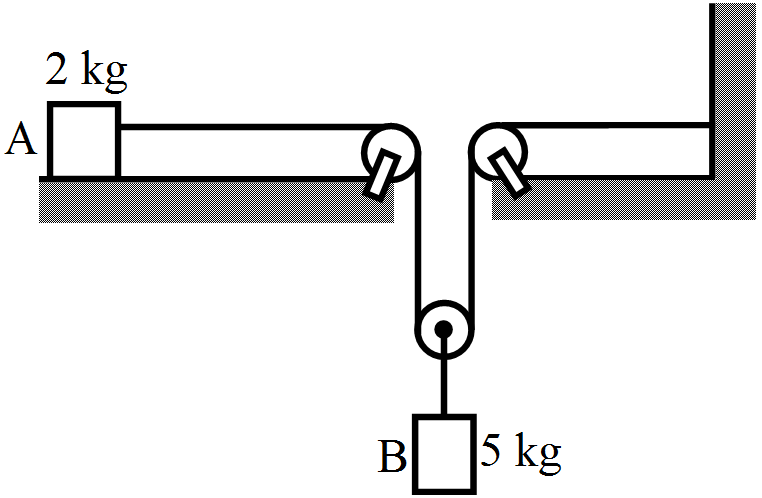
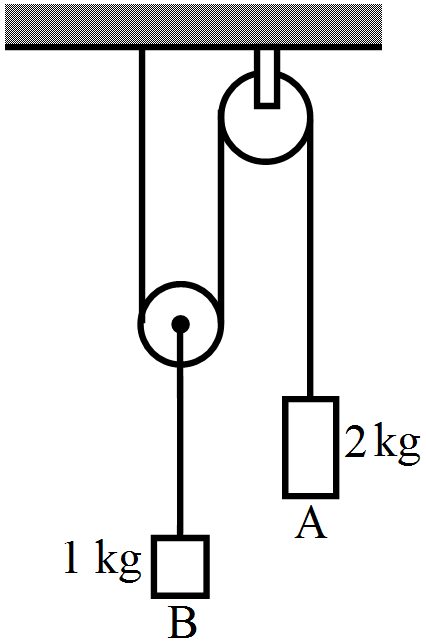
Find the acceleration of the blocks A and B in the three situations shown in figure.


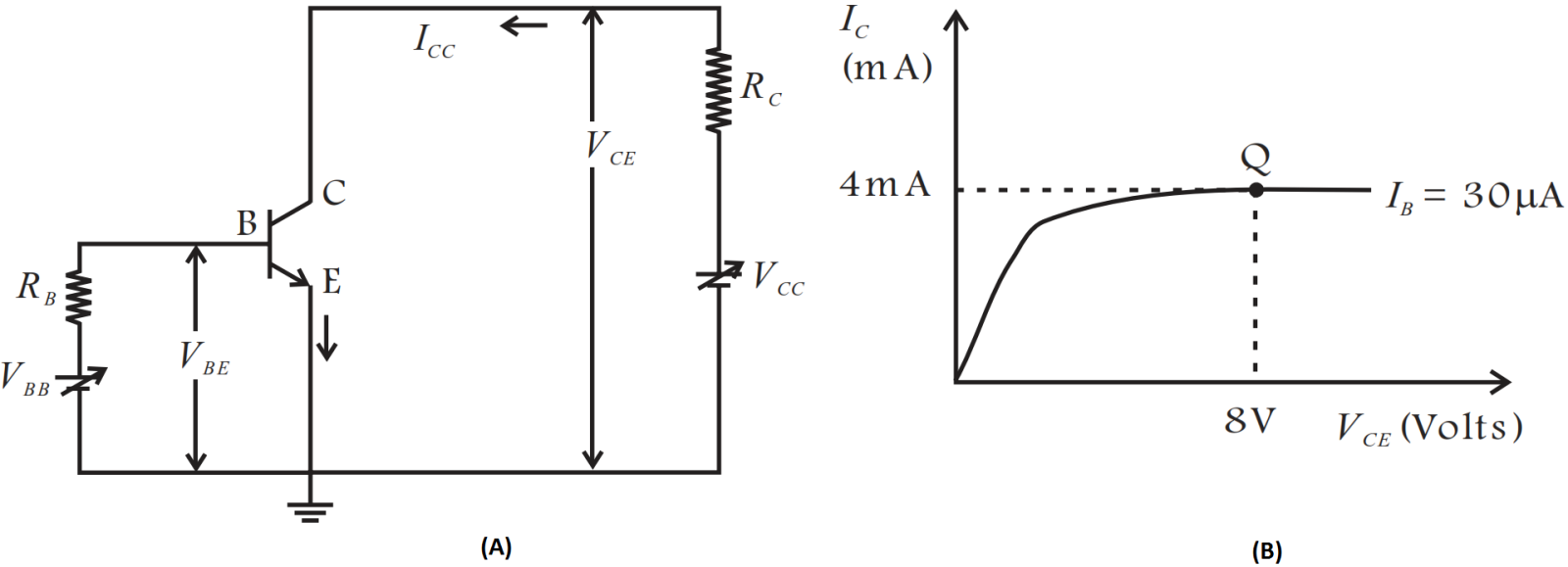
Consider the circuit arrangement shown in Fig (a) for studying input and output characteristics of npn transistor in CE configuration.

Select the values of $R_B$ and $R_C$ for a transistor whose $V_{BE} = 0.7V,$ so that the transistor is operating at point Q as shown in the characteristics shown in Fig. (b).
Given that the input impedance of the transistor is very small and $V_{CC} = V_{BB} = 16V,$ also find the voltage gain and power gain of circuit making appropriate assumptions.
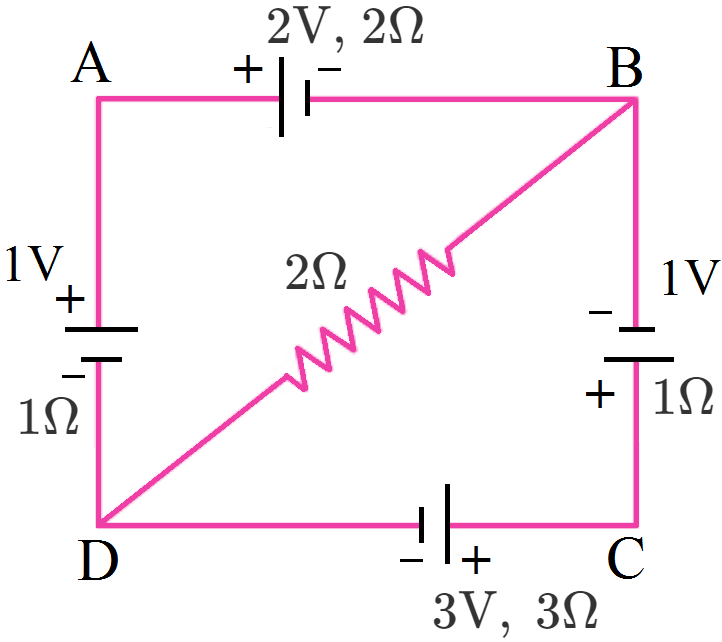
For the circuit shown here, calculate the potential difference between points B and D.
  1. Using Biot-Savart’s law, derive the expression for the magnetic field in the vector form at a point on the axis of a circular current loop.
  2. What does a toroid consist of ? Find out the expression for the magnetic field inside a toroid for N turns of the coil having the average radius r and carrying a current I. Show that the magnetic field in the open space inside and exterior to the toroid is zero.
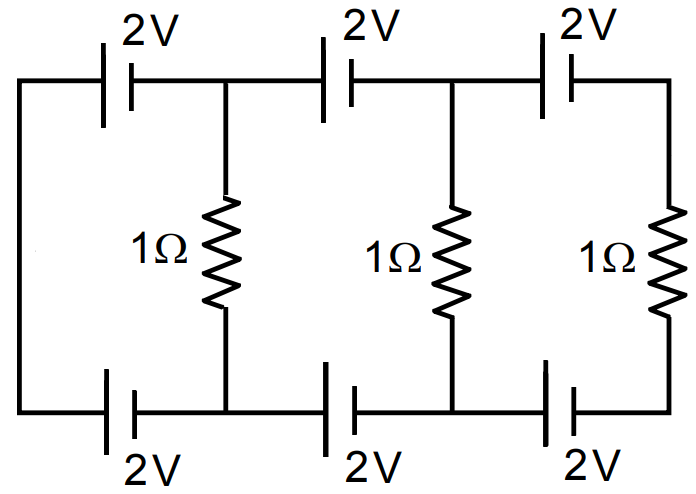
Find the circuit in the three resistors shown in the figure.
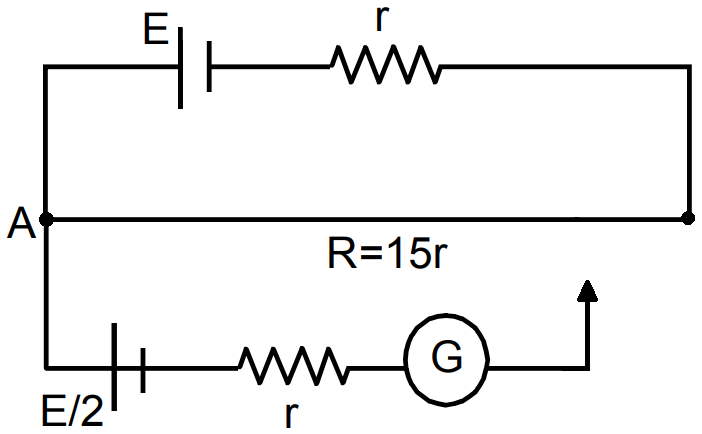
Consider the potentiometer circuit as arranged in the figure. The potentiometer wire is 600cm long. (a) At what distance from the point A should the jockey touch the wire to get zero deflection in the galvanometer? (b) If the jockey touches the wire at a distance of 560cm from A, what will be the current in the galvanometer?
A tightly-wound, long solenoid is kept with its axis parallel to a large metal sheet carrying a surface current. The surface current through a width dl of the sheet is Kdl and the number of turns per unit length of the solenoid is n. The magnetic field near the centre of the solenoid is found to be zero.
  1. Find the current in the solenoid.
  2. If the solenoid is rotated to make its axis perpendicular to the metal sheet, what would be the magnitude of the magnetic field near its centre ?