Question
Derive the expression for force per unit length between two long straight parallel current carrying conductors. Hence define one ampere.

Answer

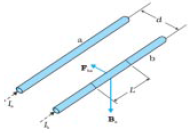
Figure shows two long parallel conductors a and b separated by a distance d and carrying (parallel) currents Ia and I b, respectively. The conductor ‘a’ produces, the same magnetic field Ba at all points along the conductor ‘b’. The right-hand rule tells us that the direction of this field is downwards (when the conductors are placed horizontally). Its magnitude is given by

$\text{B}_{\alpha} = \frac{\mu_\circ\text{I}_{\alpha}}{2\pi\text{d}}$

The conductor ‘b’ carrying a current I b will experience a sideways force due to the field Ba. The direction of this force is towards the conductor ‘a’. We label this force as Fba, the force on a segment L of ‘b’ due to ‘a’. The magnitude of this force is given by

$\int_{ba} = \text{I}_{b}\text{LB}_{a}$ $ = \frac{\mu_\circ\text{I}_{a}\text{I}_{b}}{2\pi\text{d}}\text{L}$

Let $\int_{ba}$ represent the magnitude of the force $\text{F}_{ba}$ per unit length.

$\int_{ba} = \frac{\mu_\circ\text{I}_{a}\text{I}_{b}}{2\pi\text{d}}$

One ampere: The ampere is the value of that steady current which, when maintained in each of the two very long, straight, parallel conductors of negligible cross-section, and placed one metre apart in vacuum, would produce on each of these conductors a force equal to 2 × 10⁻⁷ newton per metre of  their length.

Need a full question paper?

Generate a complete, print-ready paper with questions like this in minutes — across 16+ boards, with answer keys.
Start Generating Free

Similar questions

Find the total energy stored in the capacitors in the given network.

For a given position of an object, an equiconvex lens forms its real image at a distance of 60cm from the lens. A convex mirror is now kept in between this image position and the convex lens. The final image formed by this combination coincides with the object when the distance between the convex lens and the convex mirror equals 25cm. Calculate the radius of curvature of the convex mirror.
An ideal gas $\Big(\frac{\text{C}_\text{P}}{\text{C}_\text{V}}=\gamma\Big)$ is taken through a process in which the pressure and the volume vary as p = aVb. Find the value of b for which the specific heat capacity in the process is zero.
A ball is dropped from a balloon going up at a speed of 7m/s. If the balloon was at a height 60m at the time of dropping the ball, how long will the ball take in reaching the ground?
  1. Define self inductance. Write its S.I. units.
  2. Derive an expression for self inductance of a long, solenoid of length l, cross sectional area A having N number of turns.
In a photoelectric experiment, the collector plate is at 2.0V with respect to the emitter plate made of copper ($\phi$ - 4.5eV). The emitter is illuminated by a source of monochromatic light of wavelength 200 run. Find the minimum and maximum kinetic energy of the photoelectrons reaching the collector.
Radiation of wavelength 5000 Å falls on a metal of work function 1.9 eV. Calculate the energy of emitted photoelectrons and stopping potential.
A spherical capacitor consists of two concentric spherical conductors, held in position by suitable insulating supports (2.36). Show

that the capacitance of a spherical capacitor is given by $\text{C}=\frac{{4}\pi\in_{0}\text{r}_1\text{r}_2}{\text{r}_1-\text{r}_2}$

where r1 and r2 are the radii of outer and inner spheres, respectively.

Define the term ‘mutual inductance’ between the two coils.
Obtain the expression for mutual inductance of a pair of long coaxial solenoids each of length l and radii r1 and r2 (r2 >> r1). Total number of turns in the two solenoids are N1 and N2 respectively.
A straight wire of length l can slide on two parallel plastic rails kept in a horizontal plane with a separation d. The coefficient of friction between the wire and the rails is $\mu.$ If the wire carries a current i, what minimum magnetic field should exist in the space in order to slide the wire on the rails?