Question
Describe the structure and functions of epithelium.

Answer

Epithelium is the simplest tissue. It is the protective tissue of the animal body in which the cells are tightly packed having no intercellular matrix. Epithelial cells lie on a delicate non-cellular basement membrane which contains a special form of matrix protein, called collagen. These tissues perform the function of excretion, secretion and absorption. Depending upon the shape and functions of the cells.
The epithelial tissue is of various types:
  1. Squamous: The cells are flat and polygonal and are arranged as tiles. These tissues occur in skin, lining of alveoli of lungs, blood vessels etc. Its function includes protection, diffusion and osmosis.
  2. Cuboidal: The cells are cube like. These occur in glands, germinal layer of ovary, kidney tubules etc. Its function is secretion and absorption.
  3. Columnar: The cells are pillar or column like resting on a thin membrane. Such tissues occur in the lining of stomach, intestine etc. Its function includes protection, absorption and secretion.
  4. Ciliated: It has cuboidal, columnar cells with fine hair like structures called cilia. It is present in the lining of respiratory tract, fallopian tube, nephron etc. Its function is protection, spreading of mucus and motion of gases and liquids by cilia.
  5. Glandular: The cells are cubical. These can be branched or unbranched. Such tissues are present in glands. Its main function is secretion.

Need a full question paper?

Generate a complete, print-ready paper with questions like this in minutes — across 16+ boards, with answer keys.

Start Generating Free

Similar questions

What are meristematic tissues? Explain with the help of suitable diagram. Give their classification on the basis of their position in the plant body.
What are the different tissues in alimals.
Draw a labelled diagram of the fractional distillation apparatus used for separating a mixture of alcohol and water.
There is a water reservoir (river) near a village. Due to insufficient rain, farmers are worried about their crops. Suggest and explain the irrigation practice that can be adopted to supply water to the entire agricultural land in the village.

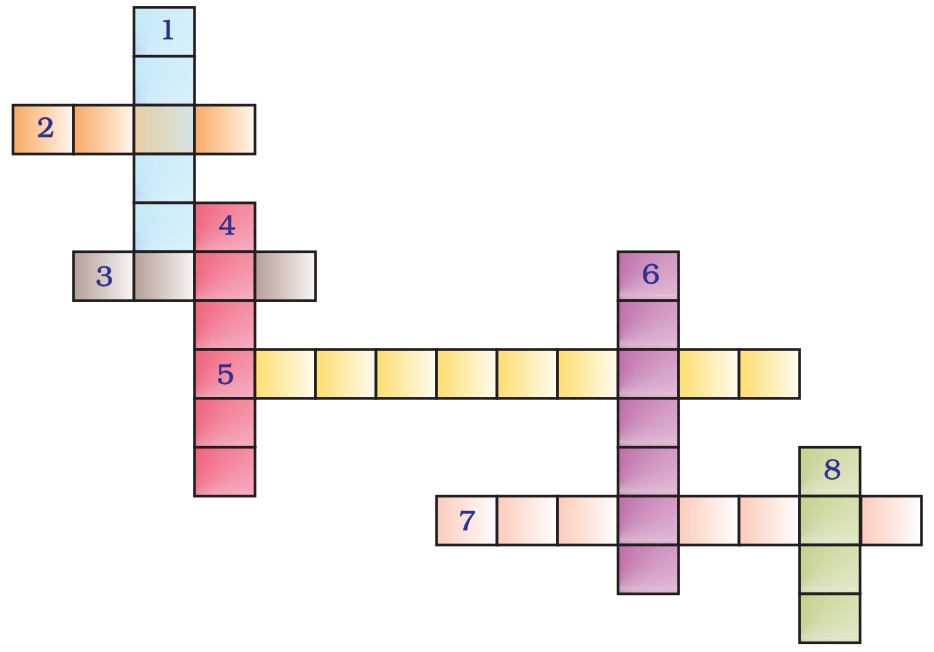
Complete the following crossword puzzle (Figure) by using the name of the chemical elements. Use the data given in the table following.
Across
Down
2.
The element used by Rutherford during his $\alpha$–scattering experiment.
1.
A white lustrous metal used for making ornaments and which tends to get tarnished black in the presence of moist air.
3.
An element which forms rust on exposure to moist air.
4.
Both brass and bronze are alloys of the element.
5.
A very reactive non–metal stored under water.
6.
The metal which exists in the liquid state at room temperature.
7.
Zinc metal when treated with dilute hydrochloric acid produces a gas of this element which when tested with burning splinter produces a pop sound.
8.
An element with symbol Pb.
$A, B$ and $C$ are all liquids. Liquid $A$ has a comparatively low boiling point. On heating, liquid a vaporizes completely without leaving behind any residue. Liquid $A$ is being used increasingly as a fuel in motor vehicles either alone or by mixing with petrol. Liquid $B$ has a very high boiling point. It also vaporizes completely on heating, without leaving any residue. Liquid $B$ is a conductor of electricity and used in making thermometers. Liquid $c$ has a moderate boiling point. On heating, liquid $C$ vaporises leaving behind a white solid $D$ which is used in cooking vegetables. The condensation of vapours from $C$ give a liquid $E$ which turns anhydrous $CuSO_4$ to blue.
  1. Which liquid could be an element? Name this element.
  2. Which liquid could be a mixture? Name this mixture.
  3. Which liquid could be a compound? Name this compound.
  4. What could the solid $D$ be?
  5. What do you think is liquid $E$?
Draw a flow sheet diagram showing the separation of various components of a mixture containing camphor, sand and iron filings.
A car is travelling at $20m/s$ along a road. A child runs out into the road $50m$ ahead and the car driver steps on the brake pedal. What must the car's deceleration be if the car is to stop just before it reaches the child?
Define muscular tissue, Classify and explain different types of muscles with the help of suitable diagrams.
State and explain Newton’s second law of motion.