Question
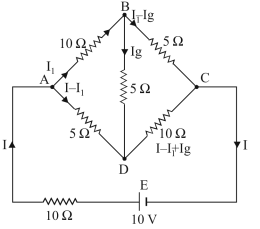
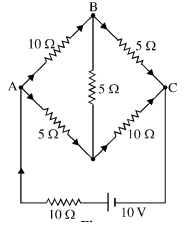
Determine the current in each branch of the network shown in Fig.:
Image

Answer

Applying Kirchoff's second law in the branch ABCD
$\Rightarrow \quad-10 I _1-5 Ig +\left( I - I _1\right) 5=0$
$\Rightarrow \quad-10 I _1-5 Ig +5 I -5 I _1=0$
$\Rightarrow \quad-15 I _1-5 I g+5 I =0$
$3 I _1- I + I g=0$$\quad$.....(1)
Again, applying Kirchoff's second rule in the branch BDCB
$-5 Ig -10\left( I - I _1+ Ig \right)+5\left( I _1- Ig \right)=0$
$\Rightarrow \quad-5 Ig -10 I +10 I _1-10 Ig +5 I _1-5 Ig =0$
$\Rightarrow \quad 15 I _1-10 I -20 Ig =0$
or $\quad 3 I _1-2 I -4 Ig =0$$\quad$.....(2)
Image
Applying Kirchhoff"s second rule in branch ABCEA
$-10 I _1-5\left( I _1- Ig \right)-10 I +10=0$
$\Rightarrow \quad-10 I _1-5 I _1+5 Ig -10 I +10=0$
$\Rightarrow \quad-15 I_1-10 I+5 \lg =-10$
$\Rightarrow \quad 3 I _1+2 I - Ig =2$.....(3)
Adding equations (1) and (3).
$6 I_1+I=2$....(4)
Multiplying equation (1) by 4 and then on adding to equation (2)
$15 I_1-6 I=0$....(5)
On solving equations (4) and (5)
$I_1=\frac{4}{17} A$
Magnitude of current in $ABI ,=\frac{4}{17} A$
Putting value of $I_1$ in equation (5)
$15 \times \frac{4}{17}-6 I=0$
or$6 I=\frac{15 \times 4}{17}$
or$I=\frac{15 \times 4}{17 \times 6}=\frac{60}{102}=\frac{10}{7} A$
Putting the value of I and $I _1$ in equation (3)
$3 I _1+2 I - Ig =2$
$\Rightarrow \quad 3 \times \frac{4}{17}+\frac{2 \times 60}{102}- Ig =2$
$\Rightarrow \quad \frac{12}{17}+\frac{120}{102}- Ig =2$
$\Rightarrow \quad Ig =\frac{12}{17}+\frac{120}{102}-2$
$\Rightarrow \quad I _g=\frac{72+120-204}{102}$
$=\frac{-12}{102}=-\frac{2}{17} A$
Negative sign indicates that the direction of current is shown in opposite in the figure.
Therefore, direction of current in $BD = Ig =\frac{-2}{17} A$
Magnitude of current in $AB = I _1=\frac{4}{17} A$
Magnitude of current in $BC = I _1- Ig$
$=\frac{4}{17}-\left(\frac{-2}{17}\right)$
$=\frac{6}{17} A$
Magnitude of current in $AD = I - I _1$
$=\frac{10}{17}-\frac{4}{17}=\frac{6}{17} A$
Magnitude of current in $DC = I - I _1+ Ig$
$=\frac{16}{17}+\left(\frac{-2}{17}\right) A$ or $\frac{4}{17} A$
If DC is written as CD , then magnitude of current will be
$=-\frac{4}{17} A$
Total current $I=\frac{4}{17}+\frac{6}{17}=\frac{10}{17} A$

Need a full question paper?

Generate a complete, print-ready paper with questions like this in minutes — across 16+ boards, with answer keys.
Start Generating Free

Similar questions

Give a brief description of the basic elementary process involved in the photoelectric emission in Einstein’s picture.
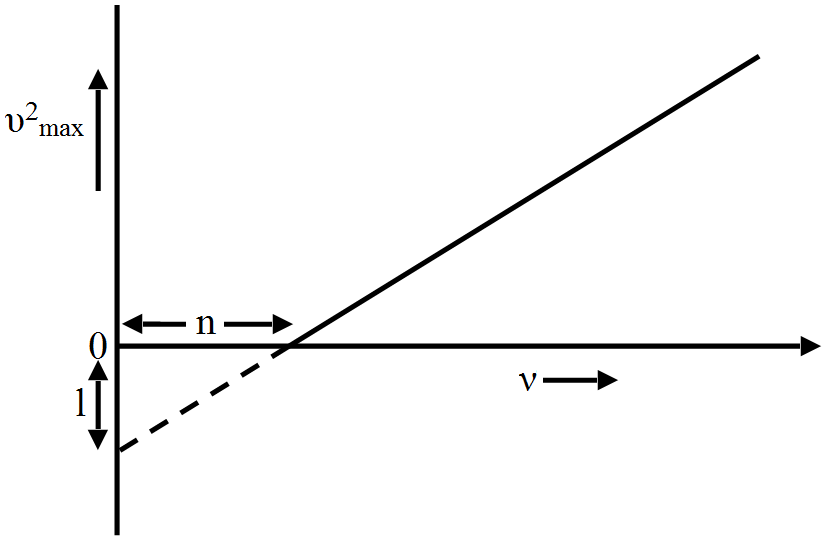
When a photosensitive material is irradiated with the light of frequency $v$, the maximum speed of electrons is given by $v_{max}.$ A plot of $v_{2max}$ is found to vary with frequency $ν$ as shown in the figure.

Use Einstein’s photoelectric equation to find the expressions for:
  1. Planck’s constant.
  2. Work function of the given photosensitive material, in terms of the parameters $l, n$ and mass $m$ of the electron.
Is it possible that in a Coolidge tube characteristic $\text{L}_\alpha \ X-$rays are emitted but not $\text{K}_\alpha \  X-$rays?
A particle of mass m and charge q is released from the origin in a region in which the electric field and magnetic field are given by
$\overrightarrow{\text{B}}=-\text{B}_0\overrightarrow{\text{j}}$ and $\overrightarrow{\text{E}}=\text{E}_0\overrightarrow{\text{k}}.$ Find the speed of the particle as a function of its z-coordinate.
Derive an expression for magnetic field intensity due to a magnetic dipole at a point on its axial line.
A system has two charges $q_A = 2.5 \times 10^{-7} C$ and $q_B = –2.5 \times 10^{-7} C$ located at points $A: (0, 0, –15 \ cm)$ and $B: (0, 0, +15 \ cm),$ respectively. What are the total charge and electric dipole moment of the system?
A diverging lens of focal length $20\ cm$ and a converging lens of focal length $30\ cm$ are placed $15\ cm$ apart with their principal axes coinciding. Where should an object be placed on the principal axis so that its image is formed at infinity?
Answer the following question:
If the earth did not have an atmosphere, would its average surface temperature be higher or lower than what it is now?
There are two current carrying planar coils made each from identical wires of length $L. C_1$ is circular $($radius $R )$ and $C_2$ is square $($side a$)$. They are so constructed that they have same frequency of oscillation when they are placed in the same uniform $B$ and carry the same current. Find a in terms of $R$.
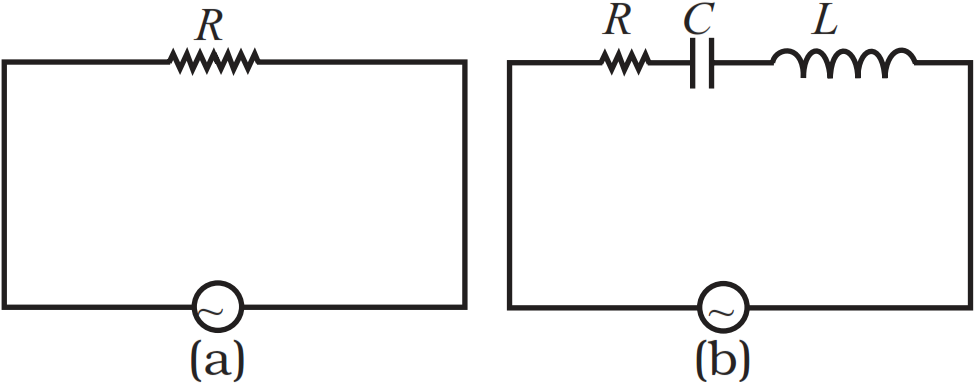
Study the circuits $(a)$ and $(b)$ shown in Fig. and answer the following questions.
  1. Under which conditions would the rms currents in the two circuits be the same?
  2. Can the rms current in circuit $(b)$ be larger than that in $(a)?$
A parallel plate capacitor is to be designed with a voltage rating $1kV,$ using a material of dielectric constant $3$ and dielectric strength about $10^7Vm^{–1}.\  ($Dielectric strength is the maximum electric field a material can tolerate without breakdown, i.e., without starting to conduct electricity through partial ionisation.$)$ For safety, we should like the field never to exceed, say $10\%$ of the dielectric strength. What minimum area of the plates is required to have a capacitance of $50pF$ ?