Question
Give a brief description of the basic elementary process involved in the photoelectric emission in Einstein’s picture.
When a photosensitive material is irradiated with the light of frequency $v$, the maximum speed of electrons is given by $v_{max}.$ A plot of $v_{2max}$ is found to vary with frequency $ν$ as shown in the figure.
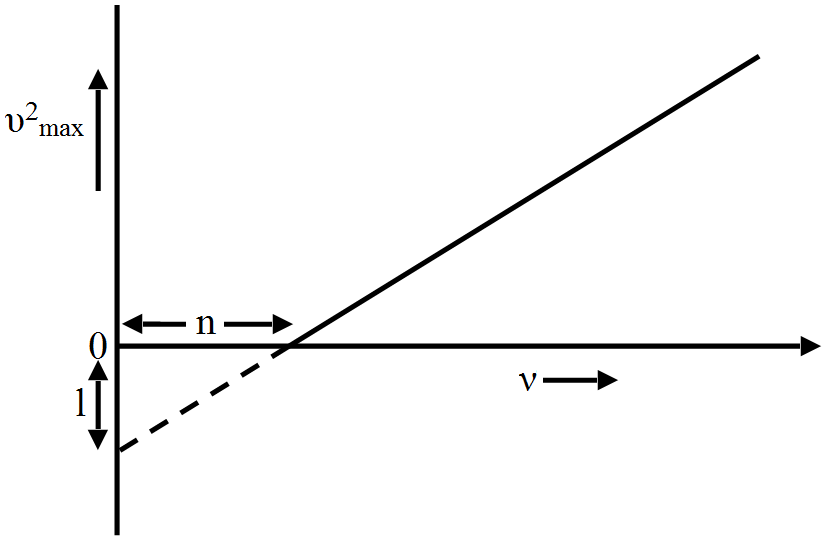
Use Einstein’s photoelectric equation to find the expressions for:
  1. Planck’s constant.
  2. Work function of the given photosensitive material, in terms of the parameters $l, n$ and mass $m$ of the electron.
Answer

  1. Planck’s constant: $\text{h}=\frac{\text{lm}}{2\text{n}}$
  2. $\nu_1^2$ and $\nu_2^2$ are the velocities of the emitted electrons for radiations of frequencies $v_1 > v$ and $v_2 > v$ respectively. 
$\text{h}\nu_1=\text{h}\nu+\frac{1}{2}\text{mv}^2_1\dots(\text{i})$
and $\text{h}\nu_2=\text{h}\nu+\frac{1}{2}\text{mv}^2_2\dots(\text{ii})$
From equation $(i)$ and $(ii),$ we get
$\text{h}(\nu_2-\nu_1)=\frac{1}{2}\text{m}(\text{v}^2_2-\text{v}^2_1)$
$\therefore\ \text{h}=\frac{\frac{1}{2}\text{m}(\text{v}^2_2-\text{v}^2_1)}{(\nu_2-\nu_1)}$
Slope of $\text{v}^2_\text{max} v_s$ frequency graph is,
$\tan\theta=\frac{\text{v}^2_2-\text{v}^2_1}{(\nu_2-\nu_1)}$
$\therefore\ \text{h}=\frac{1}{2}\text{m}.\tan\theta$
From graph $\tan\theta=\frac{1}{\text{n}}$
So, $\text{h}=\frac{1}{2}\text{m}\Big(\frac{\text{l}}{\text{n}}\Big)\dots(\text{iii})$
  • From graph, the work function of the material is,
$w = hn ...(iv)$
From equations $(iii)$ and $(iv),$ we get
$\text{w}=\frac{1}{2}\text{m}\Big(\frac{\text{l}}{\text{n}}\Big)\times\text{n}=\frac{1}{2}\text{ml}$

Need a full question paper?

Generate a complete, print-ready paper with questions like this in minutes — across 16+ boards, with answer keys.

Start Generating Free

Similar questions

Figure shows two parallel plate capacitors with fixed plates and connected to two batteries. The separation between the plates is the same for the two capacitors. The plates are rectangular in shape with width b and lengths $l_1$ and $l_2$ The left half of the dielectric slab has a dielectric constant $K_1$ and the right half $K_2$. Neglecting any friction, find the ratio of the emf of the left. battery to that of the right battery for which the dielectric slab may remain in equilibrium.
How many time constants will elapse before the energy stored in the capacitor reaches half of its equilibrium value in a charging RC circuit?
Suppose we want to verify the analogy between electrostatic and magnetostatic by an explicit experiment. Consider the motion of (i) electric dipole p in an electrostatic field E and (ii) magnetic dipole m in a magnetic field B. Write down a set of conditions on E, B, p, m so that the two motions are verified to be identical. (Assume identical initial conditions.)
It is required to construct a $10\mu\text{F}$ capacitor which can be connected across a 200V battery. Capacitors of capacitance $10\mu\text{F}$ are available but they can withstand only 50V. Design a combination which can yield the desired result.
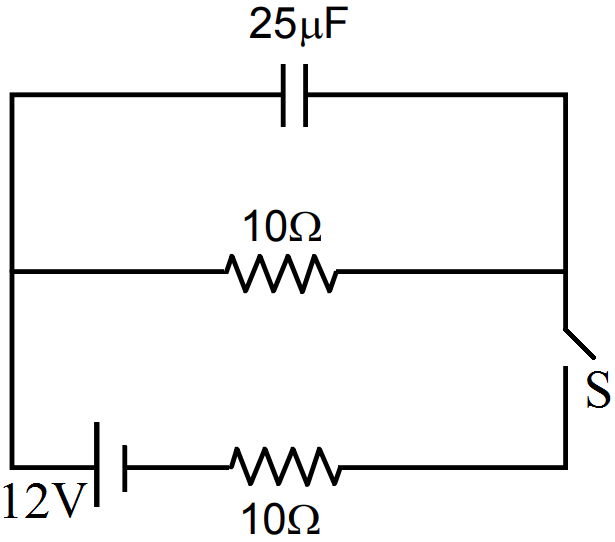
Find the potential difference between the points $A$ and $B$ and between the points $B$ and $C$ of the figure. in steady state.
The switch S shown in figure. is kept closed for a long time and is then opened at t = 0. Find the current in the middle $1.0\Omega$ resistor at t = 1ms.
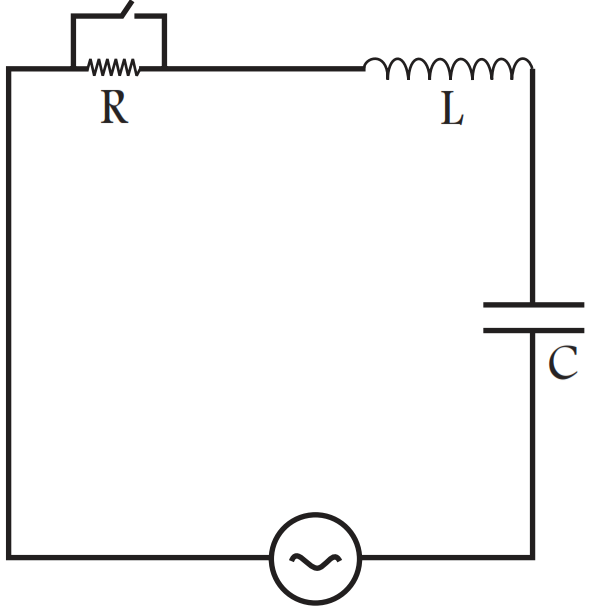
In the $\text{LCR}$ circuit shown in Fig, the ac driving voltage is $\text{v}=\text{v}_\text{m}\sin\omega\text{t}$.
  1. Write down the equation of motion for $q(t).$
  2. At $t = t_0,$ the voltage source stops and $R$ is short circuited. Now write down how much energy is stored in each of $L$ and $C.$
  3. Describe subsequent motion of charges
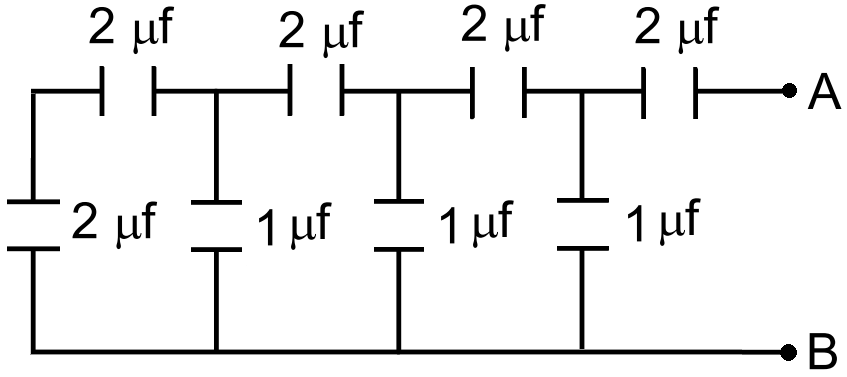
Find the capacitance of the combination shown in figure between $A$ and $B.$
A regular polygon of n sides is formed by bending a wire of total length $27\pi\text{r}$ which carries a current i.
  1. Find the magnetic field B at the centre of the polygon.
  2. By letting $\text{n}\rightarrow\infty,$ deduce the expression for the magnetic field at the centre of a circular current.
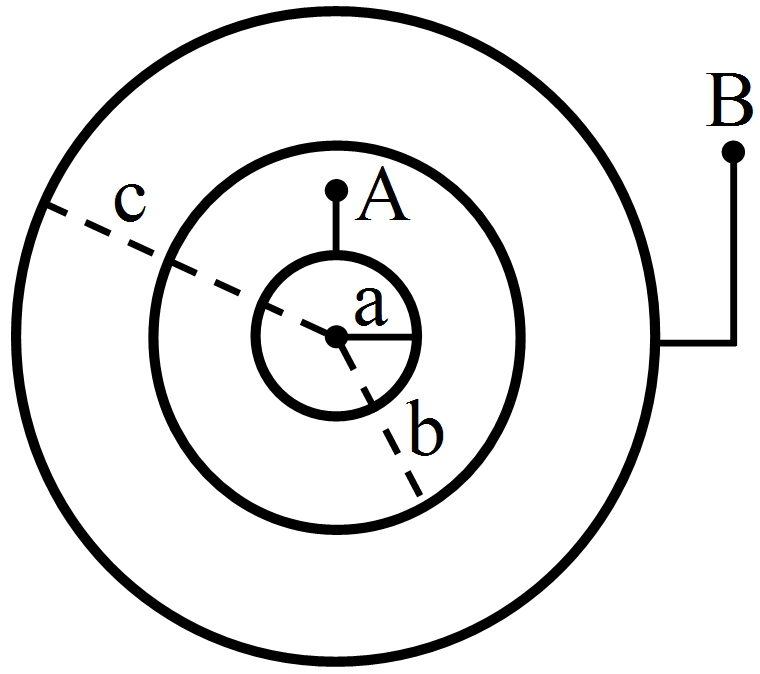
Consider an assembly of three conducting concentric spherical shells of radii $a, b$ and $c$ as shown in figure. Find the capecitance of the assembly between the poima $A$ and $B$