Question
Differentiate between the terms strong electrolyte and weak electrolyte (stating any two differences)

Answer

Strong ElectrolytesWeak Electrolytes
Electrolytes which allow a large amount of electricity to flow through them.Electrolytes which allow small amounts of electricity to flow through them.
These are good conductors of electricity.These are poor conductors of electricity.
These almost completely dissociate in the fused or aqueous solution state.These are partially dissociated in the fused or aqueous solution state.
These solutions contain only free mobile ions. These solutions contain ions as well as molecules.

Need a full question paper?

Generate a complete, print-ready paper with questions like this in minutes — across 16+ boards, with answer keys.

Start Generating Free

Similar questions

Water decomposes to $O _2$ and $H _2$ under suitable conditions as represented by the equation below:
$2 H _2 O \rightarrow 2 H _2+ O _2$
(a) If $2500 cm ^3$ of $H _2$ is produced, what volume of $O _2$ is liberated at the same time and under the same conditions of temperature and pressure?
(b) The $2500 cm ^3$ of $H _2$ is subjected to $2$ times an increase in pressure (temp. remaining constant). What volume of $H _2$ will now occupy?
(c) Taking the value of $H _2$ calculated in $5$(b), what changes must be made in Kelvin (absolute) temperature to return the volume to $2500 cm ^3$ pressure remaining constant.
Pure calcium carbonate and dilute hydrochloric acid are reacted and 2 litres of carbon dioxide were collected at $27^{\circ} C$ and normal pressure.
$
CaCO _3+2 HCl \rightarrow CaCl _2+ H _2 O + CO _2
$
Calculate:
(a) The mass of salt required.
(b) The mass of the acid required to prepare the 2 litres of $CO _2$ at $27 C$ and normal pressure.
Copy and complete the following table relating to important industrial processes output refers to the product of the process not the intermediate steps.
Name of processInputs CatalystEquation for catalysed reactionOutput
Haber processHydrogen        +
Ammonia
+
Air
Nitric acid
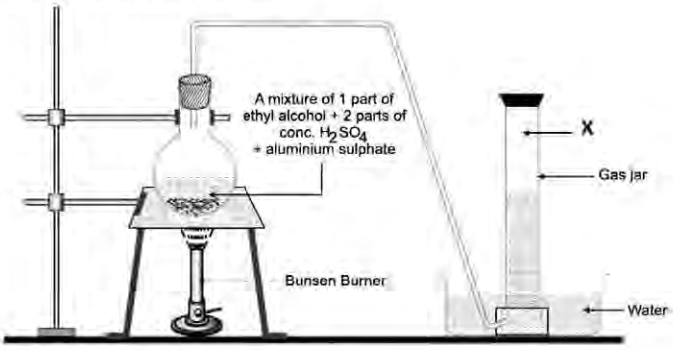
Look at the set-up of given apparatus carefully.
Image
(i) Identify 'X'.
(ii) Name the process of collection of 'X'. Justify.
(iii) Write the chemical equations involved.
(iv) What is the role of sulphuric acid in the above process?
Concentrated nitric acid oxidizes phosphorous to phosphoric acid according to the following equation :
$P + 5HNO_3 \rightarrow H_3PO_4 + H_2O + 5NO_2$
What will be the volume of steam at the same time measured at $760\ mm$ of Hg pressure and $273^\circ C$ ? $[H=1, N=14, O=16, P=31]$
Under the same conditions of temperature and pressure you collect $2L$ of carbon dioxide$, 3L$ of chlorine$, 5L$ of hydrogen$, 4L$ of nitrogen and $1L$ of sulphur dioxide. In which gas sample will there be :
$a.$ The greatest number of molecules. 
$b.$ The least number of molecules.
Justify your answer.
The table given below shows the hints about various compounds.
S.No.Hints
(i)Substance 'C' is used as a preservative
(ii)C' has two carbon atoms 'C' is obtained by the reaction of 'A' in presence of alkaline potassium permanganate followed by acidification.
(iii)Misuse of 'A' in industries is prevented by adding methanol, benzene, and pyridine to 'A'.
(iv)'F' is formed on heating 'A' in presence of conc. sulphuric acid.
(v)'F' reacts with hydrogen gas in presence of nickel and palladium catalyst.
Based on the above hints answer the following questions:
(a) Give the IUPAC names of A and F.
(b) Illustrate with the help of chemical equations the changes taking place. (A → C and A → F)
Determine the empirical formula of the compound whose composition by mass is $42\%$ nitrogen$, 48\%$ oxygen and $9\%$ hydrogen.$\ [N=14,O=16,H=1]$
Give two chemical tests to distinguish between dilute nitric acid and hydrochloric acid.
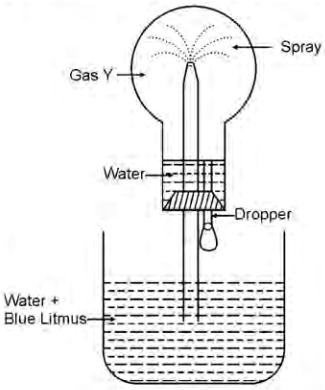
Study the figure given alongside and answer the questions that follow :
Image
(i) Name the experiment illustrated here.
(ii) Identify the gas Y.
(iii) What property of gas Y demonstrated by this experiment?
(iv) Explain the observations of the experiment.