MCQ
Digital movie projectors work on the principle of
  • Reflection from micromirrors
  • B
    Refraction from thin lenses
  • C
    Dispersion from thin prisms
  • D
    Total internal reflection from optical fibres

Answer

Correct option: A.
Reflection from micromirrors
a
(a)

Digital movie projectors need parabolic mirrors to converge all incident rays fo a point.

Need a full question paper?

Generate a complete, print-ready paper with questions like this in minutes — across 16+ boards, with answer keys.

Start Generating Free

Similar questions

The maximum number of emission lines for atomic hydrogen that you would expect to see with naked eye if the only electronic levels involved are those shown in the figure, is
A scientist claims to have a perfect technique in which he can spontaneously convert an electron completely into energy in the laboratory without any other material required. What is the conclusion about this claim from our current understanding of physics?
The activity of a sample is $64 × 10^{-5}\, Ci.$ Its half-life is $3\, days$. The activity will become $5 × 10^{-6}\, Ci$ after .........$days$
The angle of minimum deviation for a prism is $40^o $ and the angle of the prism is $60^o .$ The angle of incidence in this position will be.....$^o$
A moving coil galvanometer can be converted into voltmeter by:
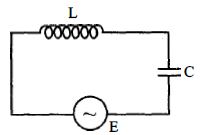
In the circuit shown here, the voltage across $L$ and $C$ are respectively $300\, V$ and $400\, V$. The voltage $E$ of the ac source is......$Volt$
A $4\  \mu F$ capacitor, a resistance of $2.5 \,MW$$\Omega$ is in series with $12\, V$ battery. Find the time after which the potential difference across the capacitor is $3$ times the potential difference across the resistor.......$s$  [Given $ln(2)= 0.693$]
The contribution in the total current flowing through a semiconductor due to electrons and holes are $\frac{3}{4}$ and $\frac{1}{4}$ respectively. If the drift velocity of electrons is $\frac{5}{2}$ times that of holes at this temperature, then the ratio of concentration of electrons and holes is
A generator produces a voltage that is given by $V = 240\,sin \,120\,t$, where t is in seconds. The frequency and $ r.m.s.$ voltage are
All the particles of a body are situated at a distance R from the origin. The distance of the centre of mass of the body from the origin is: