MCQ
Dimensions of luminous flux are
  • A
    $M{L^2}{T^{ - 2}}$
  • $M{L^2}{T^{ - 3}}$
  • C
    $M{L^2}{T^{ - 1}}$
  • D
    $ML{T^{ - 2}}$

Answer

Correct option: B.
$M{L^2}{T^{ - 3}}$
b
Luminous flux is nothing but power per unit time. Its dimension is equal to the dimension of
power.

luminous flux $=$ power $=\left[M L^{2} T^{-3}\right]$

Need a full question paper?

Generate a complete, print-ready paper with questions like this in minutes — across 16+ boards, with answer keys.
Start Generating Free

Similar questions

A shell is fired vertically upwards with a velocity $v_1$ from a trolley moving horizontally with velocity $v_2$. A person on the ground observes the motion of the shell as a parabola, whose horizontal range is ....
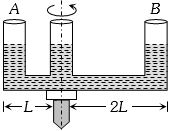
A given shaped glass tube having uniform cross section is filled with water and is mounted on a rotatable shaft as shown in figure. If the tube is rotated with a constant angular velocity $\omega $then
Elastic coefficient of material on increasing temperature :
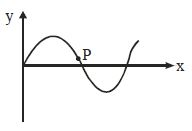
A transverse sinusoidal wave moves along a string in the positive $x-$ direction at a speed of $10\, cm/s$. The wavelength of the wave is $0.5\, m$ and its amplitude is $10\, cm$. At a prticular time $t$, the snap-shot of the wave is shown in the figure. the velocity of point $P$ when its displacement is $5\, cm$, is 
The 'Kangri' is an earthen pot used to stay warm in Kashmir during the winter months. Assume that the 'Kangri' is spherical and of surface area $7 \times 10^{-2} \,m ^{2}$. It contains $300 g$ of a mixture of coal, wood and leaves with calorific value of $30 \,kJ / g$ (and provides heat with $10 \%$ efficiency). The surface temperature of the 'Kangri' is $60^{\circ} C$ and the room temperature is $0^{\circ} C$. Then, a reasonable estimate for the duration $t$ (in h) that the 'Kangri' heat will last is (take the 'Kangri' to be a black body)
Mass density of a solid sphere is $\rho $ . Radius of the sphere is $R$. The gravitational field at a distance $r$ from the centre of the sphere inside it is
A projectile is projected from ground with initial velocity $\vec u\, = \,{u_0}\hat i\, + \,{v_0}\hat j\,$. If acceleration due to gravity $(g)$  is along the negative $y-$ direction then find maximum displacement in $x-$ direction
A sphere, a cube and a thin circular plate; all are of the same material and same mass and all of them are initially heated to same high temperature. Then:
The coordinates of a particle moving in a plane are given by $x = a\cos (pt)$ and $y(t) = b\sin (pt)$ where $a,\,\,b\,( < a)$ and $p$ are positive constants of appropriate dimensions. Then
When two tuning forks (fork $1$ and fork $2$) are sounded simultaneously, $4$ beats per second are heard. Now, some tape is attached on the prong of the fork $2$. When the tuning forks are sounded again, $6$ beats per second are heard. If the frequency of fork $1$ is $200\, Hz$, then what was the original frequency of fork $2$? .... $Hz$