Question
Distinguish between : Atrio ventricular valves and Semilunar valves.

Answer

Atrio ventricular valvesSemilunar valves
1. Atrio ventricular valves Eire present between the atria and ventricles. On the right side there is tricuspid valve whereas on the left side there is bicuspid valve.1. Semilunar valves are present at the opening of pulmonary artery and systemic aorta.
2. Atrio ventricular valves prevent the back flow of blood from ventricles to atria at the time of systole.2. Semilunar valves prevent the back flow of blood from pulmonary artery and systemic aorta back to the heart.

Need a full question paper?

Generate a complete, print-ready paper with questions like this in minutes — across 16+ boards, with answer keys.

Start Generating Free

Similar questions

Column IColumn II
(1) Graafian follicle(a) Site of implantation
(2) Uterus(b) Birth canal
(3) Fallopian tube(c) Site of fertilization
(4) Vagina(d) Release of secondary oocyte
Disease Vector species
(a) Dengue(i) Anopheles
(b) Malaria(ii) Housefly
(c) Filaria(iii) Culex
(d) Typhoid(iv) Aedes
Distinguish between: Asexual reproduction and Sexual reproduction.
Valves in heartLocation
(1) Bicuspid/Mitral valve(a) Opening of inferior vena cava
(2) Tricuspid valve(b) Opening of coronary sinus
(3) Eustachian valve(c) Left atrioventricular aperture
(4) Thebesian valve(d) Right atrioventricular aperture
Column IColumn II
(1) Acrosome(a) Completion of IInd meiotic division of secondary oocyte
(2) Penetration of sperm into ovum(b) Dissolution of zona pellucida
(3) Formation of fertilization membrane(c) Secretion of Hyaluronidase
(4) Acrosin / Zona lysine(d) Prevention of polyspermy
Outcrossing and Crossbreeding.
Read the following and answer any four questions from (i) to (v) given below:
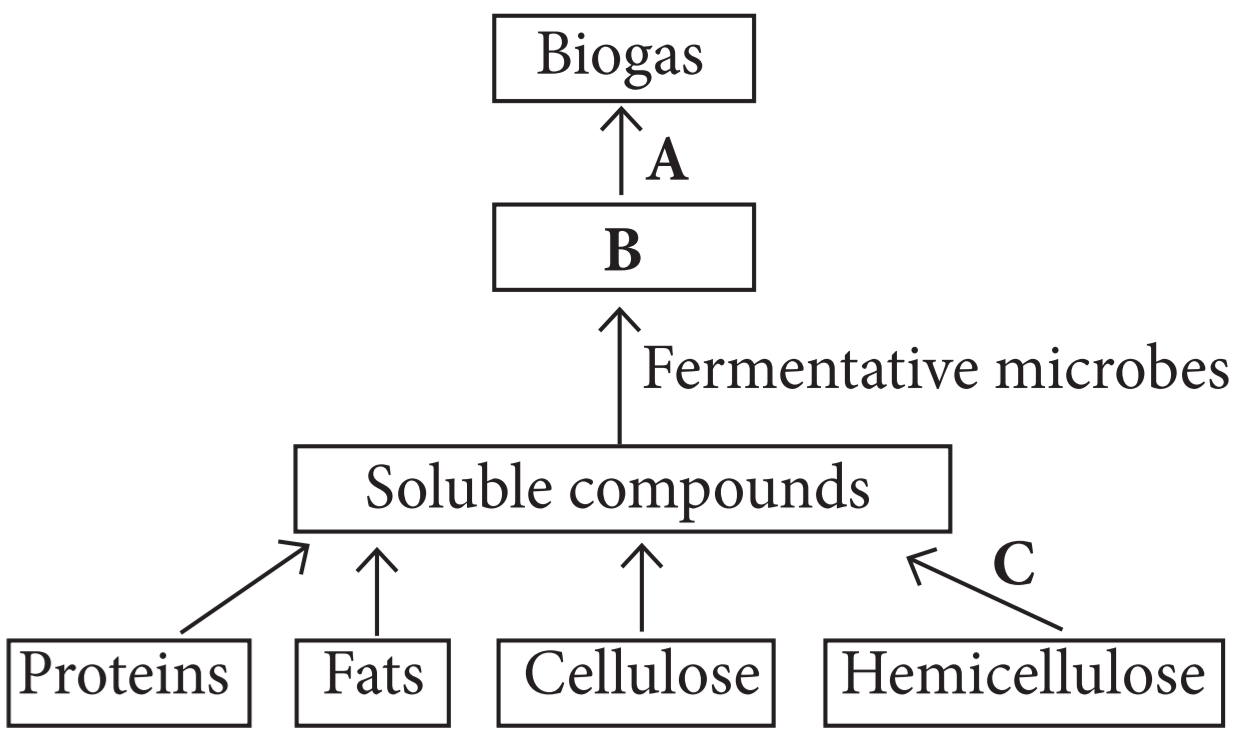
Villagers in a place near Chambur started planning to make power supply for agricultural purposes from cow dung. 'Tiley have started a biogas plant for the purpose. Study the flow chart for biogas production given below and answer the following questions.
  1. Biagas is composed of majorly:
  1. Methane, $CO_2$ and $O_2$​​​​​​​
  2. $CO_2, H_2S$ and H
  3. Methane, $CO_2​​​​​​​$
  4. $H_2S, H$ and $O_2​​​​​​​$
  1. In the given flow chart, 'A' denotes:
  1. Aerobic bacteria.
  2. Methanogenic bacteria.
  3. Cellulose degrading bacteria.
  4. Yeast and protozoa.
  1. What is represented by 'B' in the flow chart?
  1. Carbohydrates.
  2. Protein polymers.
  3. Organic acids.
  4. Fat globules.
  1. 'C' in the given flow chart causes:
  1. Aerobic breakdown of complex organic compounds.
  2. Anaerobic digestion of complex organic compounds.
  3. Fermentation of organic compounds.
  4. Fermentation of monomers.
  1. If 'A' is not added in the procedure.
  1. Methane will not be formed.
  2. $CO_2​​​​​​​$​​​​​​​ will not be formed.
  3. Organic compounds will not be converted to $H_2S$
  4. $O_2​​​​​​​$ will not be formed.
Read the following and answer any four questions from (i) to (v) given below:
During copulation, semen is released by the penis into the vagina. 'The motile sperms swim rapidly, fuse with ovum in the ampullary region, resulting in fertilisation. Haploid nucleus of sperm fuse with that of ovum to form diploid zygote.
  1. In female genital tract, sperms are made capable of fertilising the egg. This phenomenon of sperm activation is called:
  1. Amphimixis.
  2. Cortical reaction.
  3. Capacitation.
  4. Acrosomal reaction.
  1. Select the correct sequence of various physical and chemical events that take place during fertilisation.
  1. Fusion of cortical granules with plasma membrane of secondary oocyte.
  2. Formation of fertilisation cone to receive sperm.
  3. Release of sperm lysin from acrosome.
  4. Mixing up of chromosomes of a sperm and an ovum.
  1. R → Q → P → S
  2. Q → S → R → P
  3. Q → R → S → P
  4. R → P → Q → S
  1. Assertion: Only one sperm can fertilise an ovum.
Reason: The secretion of acrosome help the sperm to enter into cytoplasm of ovum through zona pellucida and plasma membrane.
  1. Both assertion and reason are true, and reason is the correct explanation of assertion.
  2. Both assertion and reason are true, but reason is not the correct explanation of assertion.
  3. Assertion is true, but reason is false.
  4. Both assertion and reason are false
  1. What is the significance of fertilisation?
  1. It restores haploid number of chromosomes.
  2. It produces offspring genetically identical to parents.
  3. It initiates cleavage.
  4. Both (b) and (c).
  1. Site of fertilisation in humans is:
  1. Endometrium of uterine cavity.
  2. Ampullary isthmic junction of oviduct.
  3. Cervix of uterus.
  4. Infundibulum of fallopian tube.
  1. What are the three options that can be thought of, to increase food production?
  2. Mention the reasons for the success of Green Revolution in increasing food production.
  3. Why do we still search for other alternatives to increase food production?
Human stageCranial capacity in CC
(1) Homo sapiens(a) 650-800
(2) Homo neanderthalensis(b) 900
(3) Homo habilis(c) 1400
(4) Homo erectus(d) 1450