Question
Distinguish between: Asexual reproduction and Sexual reproduction.

Answer

Sexual reproductionAsexual reproduction
1. Asexual reproduction requires single parent.1. Sexual reproduction needs two different parents.
2. Meiosis does not take place in asexual reproduction. Only mitosis takes place.2. Sexual reproduction involves meiosis and mitosis.
3. Gamete formation, fertilization and zygote formation does not take place.3. Gamete formation, fertilization and zygote formation are important processes in sexual reproduction.
4. Progeny and parent Eire identical genetically.4. Progeny and parents are genetically dissimilar.
5. Large number of progeny is developed by asexual reproduction. E.g. Spore formation, gemmule formation, budding, regeneration are the types of a sexual reproduction.5. Limited number of progeny is developed by sexual reproduction. E.g. Sexual reproduction is only by a single method.

Need a full question paper?

Generate a complete, print-ready paper with questions like this in minutes — across 16+ boards, with answer keys.
Start Generating Free

Similar questions

Highlight five areas where biotechnology has influenced our lives.
Distinguish between: Directional, Stabilizing and Disruptive selection.
Distinguish between: Hypohydrophily – Epihydrophily
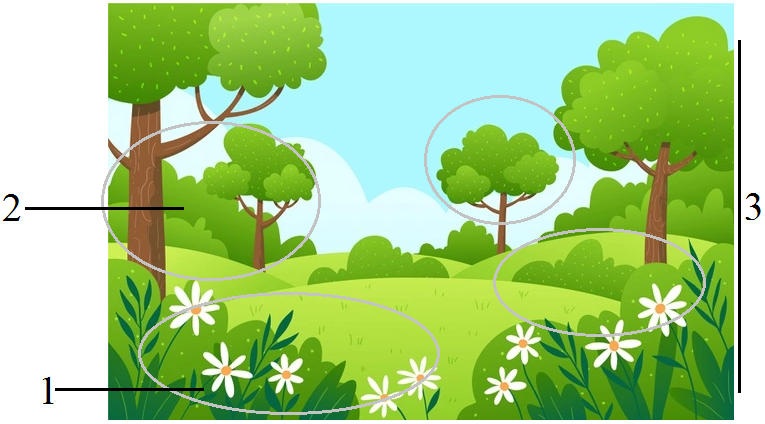
Read the following and answer any four questions from (i) to (v) given below: Ecosystem diversity is the variety of forms in the ecosystem due to diversity of niches, trophic levels and ecological processes like nutrient recycling, food webs, energy flow, etc. Study the given figure.
  1. Identify different types of diversity denoted by 1, 2 and 3 in the given figure.
 
1
2
3
(a)
Alpha diversity
Beta diversity
Gamma diversity
(b)
Gamma diversity
Alpha diversity
Beta diversity
(c)
Gamma diversity
Beta diversity
Alpha diversity
(d)
Beta diversity
Alpha diversity
Gamma diversity
  1. Alpha diversity is biodiversity present.
  1. Within conununity.
  2. Between conununities.
  3. In ranges of communities.
  4. None of these.
  1. Diversity represented by diversity of habitats over a total landscape area is:
  1. $\alpha-\text{diversity}$
  2. $\gamma-\text{diversity}$
  3. $\beta-\text{diversity}$
  4. $\delta-\text{diversity}$
  1. Concept of three types of ecological diversity was given by:
  1. Elton
  2. Odum
  3. Edward Wilson
  4. Whittaker
  1. The diversity of organisms sharing the same habitat or conununity is termed as:
  1. Alpha diversity.
  2. beta diversity.
  3. gamma diversity.
  4. delta diversity.
Distinguish between : Cerebrum and cerebellum
Read the following and answer any four questions from (i) to (v) given below:
Mutation explains the relationship between gene and DNA. The effects of large deletions and rearrangement in a segment of DNA results in loss or gain of gene and its function. Insertion or deletion of one or two bases changes the reading frame from the point of insertion or deletion. A classical example of point mutation is a change of single base pair in the gene for beta globin chain that results in change of amino acid residue glutamate to valine and results into a diseased condition called sickle cell anaemia.
  1. A mutation is a change produced by an alteration in the genetic mechanism and.
  1. May arise spontaneously.
  2. Is always induced by the environment.
  3. Is never advantageous.
  4. Is not inherited.
  1. The DNA code for glutamic acid is CTC or CTT. The code for valine is CAA or CAT. In sickle cell haemoglobin, valine is present instead of glutamic acid.
Assuming a single base pair substitution has occurred, what is the mRNA code in the affected mutant?
  1. CUU
  2. GAA
  3. GAG
  4. GUA
  1. A mutation involving the substitution of one nitrogenous base for another has altered the base sequence of a DNA molecule, coding for four amino acids, as shown below.
Normal A-G-C-A-T-G-G-A-T-C-C-T

Mutant A-G-C-A-T-G-C-A-T-C-C-T
The table shows six codons and the corresponding amino acids into which each is translated.
mRNA codon
Amino acid
AAG
Lysine
CUA
Leucine
GGA
Glycine
GUA
Valine
UAC
Tyrosine
UCG
Serine
The mutation has changed the amino acid.
  1. Leucine to valine.
  2. Lysine to glycine.
  3. Serine to leucine.
  4. Tyrosine to lysine.
  1. Assertion : Insertion or deletion of three or its multiple bases, insert or delete one or multiple codons and so one or multiple amino acids.
Reason: Reading frame remains unaltered with insertion or deletion of three or its multiple bases.
  1. Both assertion and reason are true, and reason is the correct explanation of assertion.
  2. Both assertion and reason are true, but reason is not the correct explanation of assertion.
  3. Assertion is true, but reason is false.
  4. Both assertion and reason are false.
  1. Part of the amino acid sequences in normal and sickle cell haemoglobin are shown.
Normal haemoglobin Sickle cell haemoglobin
Thr-Pro-Glu-Glu Thr-Pro-Val-Glu
mRNA codons for these amino acids are
Glutamine (Glu) GAA GAG
Praline (Pro) CCU CCC
Threonine (Thr) ACU ACC
Valine (Val) GUA GUG
Which transfer RNA molecule is involved in the formation of this part of the sickle cell haemoglobin?
Read the following and answer any four questions from (i) to (v) given below:
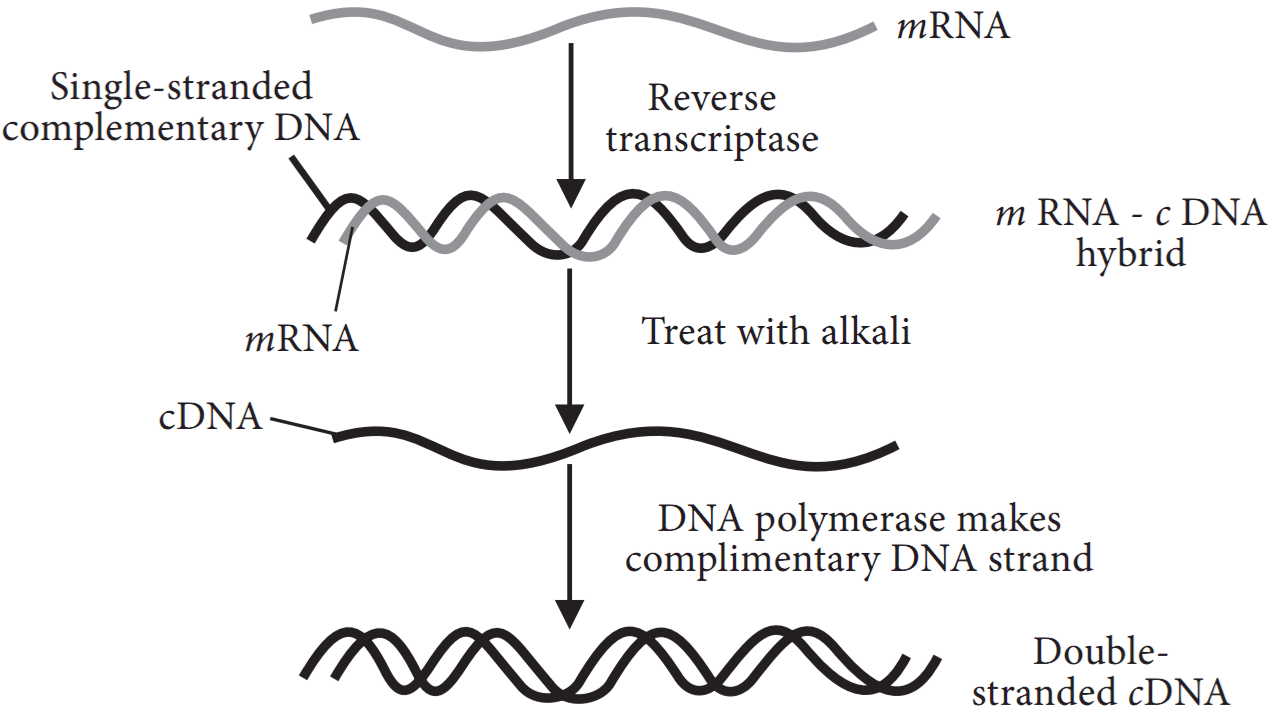
The DNA, which is transferred from one organism into another by joining it with the vehicle DNA is called passenger or foreign DNA. Generally three types of passenger DNAs are used. These are complementary DNA (cDNA), synthetic DNA (sDNA) and random DNA. Complementary DNA (cDNA) is synthesized on RNA template (usually mRNA) with the help of reverse transcriptase. Synthetic DNA (sDNA) is synthesized on DNA template or without a template. Random DNA are small fragments fanned by breaking a chromosome of an organism in the presence of restriction endonucleases.
  1. Reverse transcriptase enzyme was discovered by:
  1. Temin and Baltimore.
  2. Cohen and Boyer.
  3. Arber and Nathan.
  4. Paul Berg.
  1. During cDNA formation, what would happen if DNA formed by reverse transcriptase is not treated with the alkali?
  1. cDNA will not be digested.
  2. mRNA will not be digested.
  3. Hydrogen bonds will not form between base pairs.
  4. rnRNA will not be formed.
  1. Enzyme that helps in the formation of double stranded cDNA is:
  1. DNA synthetase
  2. Ligase
  3. DNA polymerase
  4. Helicase.
  1. DNA polymerase can be obtained form:
  1. Retrovirus.
  2. Agrobacteriurn.
  3. Tobacco mosaic virus.
  4. Thermus aquaticus.
  1. DNA synthesised without a template is referred to as:
  1. Complementary DNA.
  2. Random DNA.
  3. Synthetic DNA.
  4. Z-DNA..
Column IColumn II
(1) Graafian follicle(a) Site of implantation
(2) Uterus(b) Birth canal
(3) Fallopian tube(c) Site of fertilization
(4) Vagina(d) Release of secondary oocyte
Column AColumn B
(1) Nutritive tissue of embryo(a) Perisperm
(2) Remnants of nucellus in seed(b) Cotyledon
(3) Nutritive tissue of developing microspores(c) Endosperm
(4) First photosynthetic organ of embryo(d) Tapetum
Read the following and answer any four questions from (i) to (v) given below:
Kangaroo rat seldom drinks water. It has thick coat to minimise evaporative desiccation. TI1e animal seldom comes out of its comparatively humid and cool burrow during the day time. 90% of its water requirement is met from metabolic water (water produced by respiratory breakdown of fats) while 10% is obtained from its food. Loss of water is minimised by producing nearly solid urine and faeces. As the animal faces acute water scarcity, it develops two types of adaptations : reducing water loss and ability to tolerate desert conditions.
  1. Kangaroo rat is a:
  1. Partial regulators
  2. Partial conformer
  3. Regulator
  4. Conformer
  1. Metabolic water refers to:
  1. Water required for metabolic activities.
  2. Water present in intercellular fluid.
  3. Water produced during oxidation of fat or carbohydrate.
  4. Water taken in, to promote metabolism.
  1. Desert animals minimise water loss by:
  1. Producing highly concentrated urine.
  2. Promoting maximum reabsorption of water in kidney tubules.
  3. Possessing one of the longest loop of Henle in kidney tubules.
  4. All of these.
  1. Assertion: Kangaroo rat can tolerate and thrive in wide temperature range and is known as stenothermal.
Reason: Kangaroo rats go into hibernation during winter to escape cold weather.
  1. Both assertion and reason are true and reason is the correct explanation of assertion.
  2. Both assertion and reason are true but reason is not the correct explanation of assertion.
  3. Assertion is true but reason is false.
  4. Both assertion and reason are false.
  1. The adaptations in an organism are meant for:
  1. Optimum primary production.
  2. Optimum life span.
  3. Optimum mobility.
  4. Optimum survival and reproduction.