Question
Distinguish between: Autogamy (Self-pollination) – Xenogamy (cross pollination)

Answer

Autogamy (Self-pollination)Xenogamy (Cross pollination)
1. In self-pollination, bisexual flower is pollinated by its own pollen grains.1. In cross pollination the pollen grains from the anther are carried to the stigma of another flower of same species.
2. Self-pollination does not depend upon external agents for pollination.2. Cross pollination does depend upon external agents for pollination.
3. Self-pollination is economical as there is no wastage of pollen grains.3. Cross pollination is not economical as there is wastage of pollen grains during transfer.
4. Offspring are genetically similar to their parents; E.g. Pea4. Offspring are genetically varied due to recombination. E.g. Food and fibre crops – Maize, Rice.

Need a full question paper?

Generate a complete, print-ready paper with questions like this in minutes — across 16+ boards, with answer keys.

Start Generating Free

Similar questions

Column I [Contraceptive method]Column II [Mode of action]
(1) Pill(a) Prevents sperms reaching cervix
(2) Condom(b) Prevents implantation
(3) Vasectomy(c) Prevents ovulation
(4) Copper T(d) Semen contains no sperms
AnimalRespiratory organ
(1) Fishes(a) Trachea
(2) Birds/Reptiles(b) Moist cuticle
(3) Insects(c) Gills
(4) Earthworm(d) Lungs
Read the following and answer any four questions from (i) to (v) given below:
Intrauterine devices are most widely accepted methods of contraception. These are used by females and are inserted by doctor or nurses in the uterus through vagina. However, these devices are not recommended for those who eventually intend to conceive.
  1. How does CuT prevent conception?
  1. Cu ions make uterus unsuitable for implantation.
  2. Cu ions make cervix hostile to the sperms.
  3. Cu ions suppress sperms motility.
  4. Cu ions inhibit ovulation.
  1. Which of the following IUDs makes uterus unsuitable for implantation?
  1. LNG-20.
  2. Multiload 375.
  3. Cu7.
  4. Lippes loop.
  1. Identify the correct statement for IUDs.
  1. They slowly release synthetic progesterone in the body.
  2. They increase phagocytosis of sperms within the uterus.
  3. They block entry of sperms through the cervix.
  4. Both (b) and (c).
  1. Select the correct matched pair.
  1. Hormone releasing IUD - LNG-20.
  2. Non-medicated IUD - Progestasert.
  3. Copper releasing IUD - Lippes loop.
  4. None of these.
  1. Assertion: IUDs can cause excess menstrual bleeding and pain.
Reason: IUDs can perforate uterus.
  1. Both assertion and reason are true, and reason is the correct explanation of assertion.
  2. Both assertion and reason are true, but reason is not the correct explanation of assertion.
  3. Assertion is true, but reason is false.
  4. Both assertion and reason are false.
Distinguish between: Euchromatin and Heterochromatin.
Read the following and answer any four questions from (i) to (v) given below:
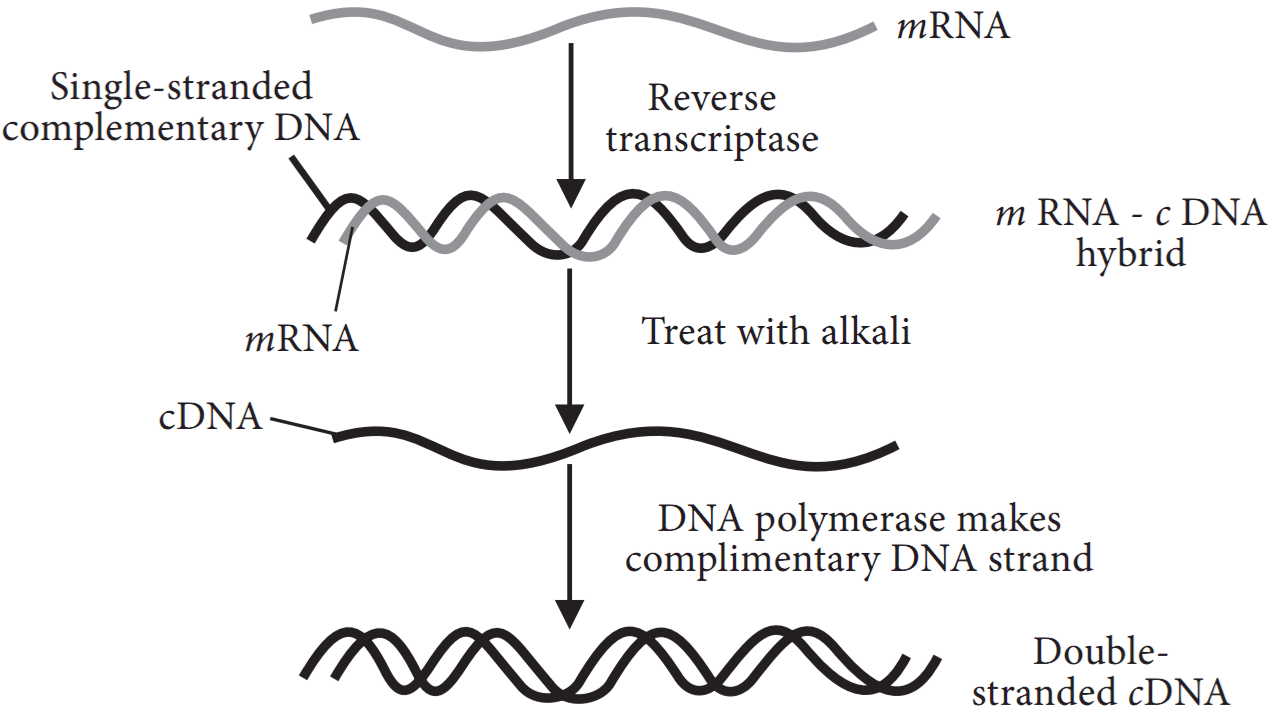
The DNA, which is transferred from one organism into another by joining it with the vehicle DNA is called passenger or foreign DNA. Generally three types of passenger DNAs are used. These are complementary DNA (cDNA), synthetic DNA (sDNA) and random DNA. Complementary DNA (cDNA) is synthesized on RNA template (usually mRNA) with the help of reverse transcriptase. Synthetic DNA (sDNA) is synthesized on DNA template or without a template. Random DNA are small fragments fanned by breaking a chromosome of an organism in the presence of restriction endonucleases.
  1. Reverse transcriptase enzyme was discovered by:
  1. Temin and Baltimore.
  2. Cohen and Boyer.
  3. Arber and Nathan.
  4. Paul Berg.
  1. During cDNA formation, what would happen if DNA formed by reverse transcriptase is not treated with the alkali?
  1. cDNA will not be digested.
  2. mRNA will not be digested.
  3. Hydrogen bonds will not form between base pairs.
  4. rnRNA will not be formed.
  1. Enzyme that helps in the formation of double stranded cDNA is:
  1. DNA synthetase
  2. Ligase
  3. DNA polymerase
  4. Helicase.
  1. DNA polymerase can be obtained form:
  1. Retrovirus.
  2. Agrobacteriurn.
  3. Tobacco mosaic virus.
  4. Thermus aquaticus.
  1. DNA synthesised without a template is referred to as:
  1. Complementary DNA.
  2. Random DNA.
  3. Synthetic DNA.
  4. Z-DNA..
Column AColumn B
(1) Walter Rosen(a) Popularisation of term biodiversity
(2) David Tillman(b) Rivet Popper Hypothesis
(3) Paul Ehrlich(c) Productivity Stability Hypothesis
(4) Edward Wilson(d) Coined
Column IColumn II
(1) Graafian follicle(a) Site of implantation
(2) Uterus(b) Birth canal
(3) Fallopian tube(c) Site of fertilization
(4) Vagina(d) Release of secondary oocyte
Distinguish between : Atrio ventricular valves and Semilunar valves.
Events in cardiac cycleTime duration
(1) Atrial systole(a) 0.3 second
(2) Atrial diastole(b) 0.5 second
(3) Ventricular systole(c) 0.1 second
(4) Ventricular diastole(d) 0.7 second
Distinguish between : Carbon cycle and phosphorus cycle.