Question
Distinguish between : Electrical and chemical synapses:

Answer

Electrical synapse Chemical synapse
1. The gap between the successive neurons in electrical synapse is very less [3.8 nm],1. The gap between two successive neurons in chemical synapse is larger than electrical synapse [10-20 nm].
2. Transmission across the gap is faster in electrical synapse.2. Transmission across the gap in chemical synapse is relatively slower than electrical synapse.
3. Electrical synapse is less common.3. Chemical synapse is more common.
4. Electrical synapse is found in those places of the body requiring instant response.4. Chemical synapse is found almost everywhere and connects neuron to neuron, muscles or glands.

Need a full question paper?

Generate a complete, print-ready paper with questions like this in minutes — across 16+ boards, with answer keys.

Start Generating Free

Similar questions

Distinguish between : Unconditional reflexes and Conditional reflexes
Distinguish between: Vasa efferentia and Vasa deferentia.
Match the layer of adrenal with its hormone.
Column A (Layers of adrenal cortex)Column B (Hormones)
(1) Zona glomerulosa (A) Cortisols
(2) Zona fasciculata(B) Androgens
(3) Zona reticularis(C) Aldosterone
Read the following and answer any four questions from (i) to (v) given below:
Aditya went to his hometown located in countryside along with his parents during his summer vacations. His grand parents' house is surrounded by farmland from all sides. Lots of crops were growing nearby and Aditya was very excited to visit the crop fields. He seeked permission from his mother to play in farmland along with his friends and then went to play in the fields. On returning back he had running nose, watering eyes and continuous sneezing which was very frequent. TI1e symptoms worsened with time. Based on the above information, answer the following questions.
  1. What could be the possible reason for Aditya's condition?
  1. Allergy
  2. Infection
  3. Malnutrition
  4. Genetic disorder
  1. How can allergy be diagnosed in a person?
  1. Presence of large amount of IgE antibodies in the blood.
  2. Presence of large number of bacteria in the blood.
  3. Presence of bilirubin and bilirubin pigments in the stool.
  4. Presence of sickle shaped RBCs in the blood
  1. The symptoms which Aditya developed on account of being allergic are consequence of?
  1. Inflammation of membrane lining the nose and conjunctiva
  2. Swelling up of tissue surrounding bronchioles of lungs
  3. Dilation of all arteries so that large amount of fluid passes from blood to tissues.
  4. All of these.
  1. Name the type of allergy that Aditya developed.
  1. Asthma
  2. Anaphylaxis
  3. Hay fever
  4. Urticaria
  1. Assertion : Hay fever is the form of allergy due to pollens of grasses and other plants.
Reason : Hay fever symptoms are due to release of histamines and often respond well to treatment with antihistamines.
  1. Both assertion and reason are true, and reason is the correct explanation of assertion.
  2. Both assertion and reason are true, but reason is not the correct explanation of assertion.
  3. Assertion is true, but reason is false.
  4. Both assertion and reason are false.
Read the following and answer any four questions from (i) to (v) given below:
During a study of inheritance of two genes, teacher asked students to perform an experiment. The students crossed white eyed, yellow bodied female Drosophila with a red eyed, brown bodied male Drosophila (i.e., wild). They observed that progenies in $F_2$ generation had 1.3 percent recombinants and 98.7 percent parental type combinations. The experimental cross with results is shown in the given figure. [Note: Dominant wild type alleles are represented with (+) sign in superscript]
  1. By conducting the given experiment, teacher can conclude that
  1. Genes for eye colour and body colour are linked
  2. Genes for eye colour and body colour show complete linkage
  3. Linked gene remain together and are inherited.
  1. A and B only
  2. B only
  3. A and C only
  4. A, Band C
  1. Teacher asked to conduct an experiment on Drosophila because.
  1. The male and female flies are easily distinguishable.
  2. It completes its life cycle in about two weeks.
  3. A single mating could produce a large number of progeny flies.
  4. All of these
  1. Genes white eyed and yellow bodied located very close to one another on the same chromosome tend to be transmitted together are called.
  1. Allelomorphs.
  2. Identical genes.
  3. Iinked genes.
  4. Recessive genes.
  1. Select the correct statement regarding the given experiment.
  1. The physical distance between two genes determines strength of linkage.
  2. The physical distance between two genes determines frequency of crossing over.
  3. The two linked genes always segregate independently of each other.
  4. Both (a) and (b)
  1. Assertion: When yellow bodied, white eyed Drosophila females were hybridised with brown-bodied, red eyed males and $F_1$ progeny was intercrossed, $F_2$ ratio deviated from 9 : 3 : 3 : 1.
Reason : When two genes in a dihybrid are on the same chromosome, the proportion of parental gene combinations are much higher than the non-parental type
  1. Both assertion and reason are true and reason is the correct explanation of assertion.
  2. Both assertion and reason are true but reason is not the correct explanation of assertion.
  3. Assertion is true but reason is false.
  4. Both assertion and reason are false.
Read the following and answer any four questions from (i) to (v) given below:
Intrauterine devices are most widely accepted methods of contraception. These are used by females and are inserted by doctor or nurses in the uterus through vagina. However, these devices are not recommended for those who eventually intend to conceive.
  1. How does CuT prevent conception?
  1. Cu ions make uterus unsuitable for implantation.
  2. Cu ions make cervix hostile to the sperms.
  3. Cu ions suppress sperms motility.
  4. Cu ions inhibit ovulation.
  1. Which of the following IUDs makes uterus unsuitable for implantation?
  1. LNG-20.
  2. Multiload 375.
  3. Cu7.
  4. Lippes loop.
  1. Identify the correct statement for IUDs.
  1. They slowly release synthetic progesterone in the body.
  2. They increase phagocytosis of sperms within the uterus.
  3. They block entry of sperms through the cervix.
  4. Both (b) and (c).
  1. Select the correct matched pair.
  1. Hormone releasing IUD - LNG-20.
  2. Non-medicated IUD - Progestasert.
  3. Copper releasing IUD - Lippes loop.
  4. None of these.
  1. Assertion: IUDs can cause excess menstrual bleeding and pain.
Reason: IUDs can perforate uterus.
  1. Both assertion and reason are true, and reason is the correct explanation of assertion.
  2. Both assertion and reason are true, but reason is not the correct explanation of assertion.
  3. Assertion is true, but reason is false.
  4. Both assertion and reason are false.
Distinguish between: m-RNA, t-RNA and r-RNA.
Read the following and answer any four questions from (i) to (v) given below:
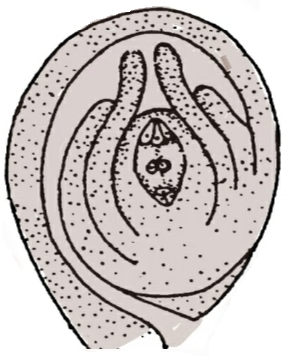
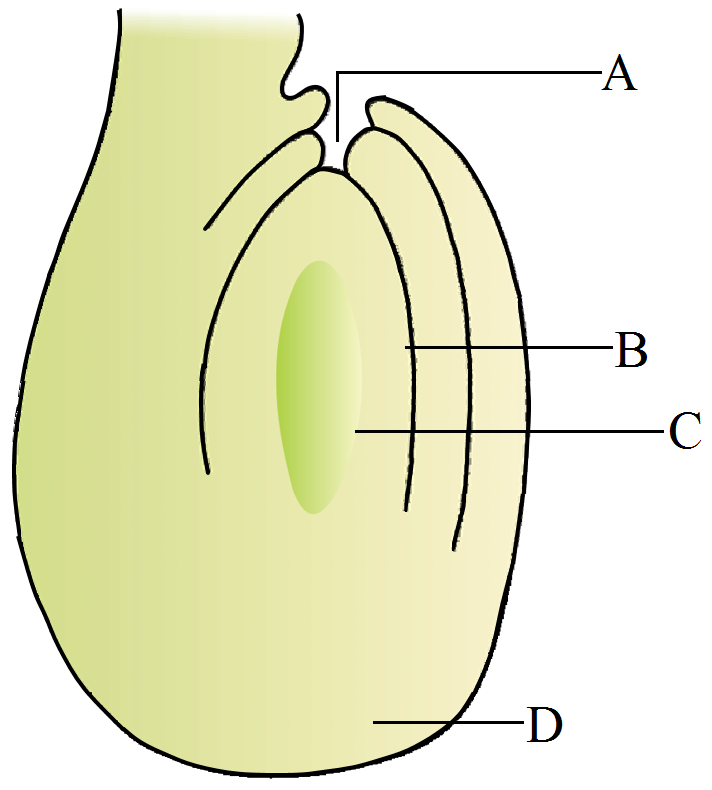
A typical angiospermic ovule is a small structure attached to the placenta by means of a stalk called funicle. The body of the ovule fuses with funicle in the region called hilum. Each ovule has one or two protective envelopes called integuments. Integuments encircle the nucellus except at the tip where a small opening called the micropyle is formed. Mature ovules are classified on the basis of funiculus. It can be orthotropous, anadromous, hernitropous, campylotropous, etc.
  1. The body of the ovule consists of a mass of parenchymatous cells called:
  1. Integuments.
  2. Nucellus.
  3. Hilum.
  4. Funiculus.
  1. Refer to the given figure and select the correct statement regarding it.
  1. This type of ovule is found in cactus.
  2. The micropyle comes to lie close to the funiculus due to unilateral growth of ovule.
  3. It is most common type of ovule found in the members of Chenopodiaceae.
  4. It is half inverted ovule.
  1. Identify the parts labelled as A, B, C and D in the given figure and select the correct option.
S. No A B C D
(a) Chalaza Female gametophyte Embryo sac Micropyle
(b) Chalaza NuceIIus Embryo sac Micropyle
(c) Micropyle Egg Embryo sac Chalaza
(d) Micropyle Nucellus Embryo sac Chalaza
  1. Mature ovules are classified on the basis of funiculus. If micropyle lie close to the funiculus, the ovule is termed as:
  1. Orthotropous.
  2. Anatropous.
  3. Hemitropous.
  4. Campylotropous.
  1. In Asphodel us, ovule is:
  1. Unitegmic.
  2. Tritegmic.
  3. Bitegmic.
  4. Ategmic.
Distinguish Between: Homozygous and Heterozygous.
Read the following and answer any four questions from (i) to (v) given below:
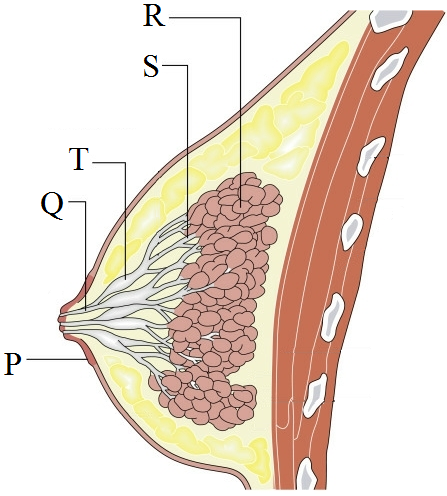
A functional mammary gland is characteristic of all female mammals. Mammary glands are paired structures that contain glandular tissue and variable amount of fat. Refer to the given figure of a mammary gland and answer the following questions.
  1. Mammary glands are modified:
  1. Sweat glands.
  2. Sebaceous glands.
  3. Sudoriferous glands.
  4. Lacrimal glands.
  1. Identify the incorrectly matched pair.
  1. P - Areola.
  2. Q - Lactiferous duct.
  3. S - Mammary duct.
  4. T - Mammary alveoli.
  1. Mammary ducts expand to form:
  1. Mammary alveoli.
  2. Mammary ampullae.
  3. Lactiferous ducts.
  4. Mammary tubules.
  1. What is areola?
  1. Grape-like clusters of milk secreting structures.
  2. Fatty tissue between the mammary lobes.
  3. Circular pigmented area of skin around nipple.
  4. Connective tissue that supports the alveoli and ducts.
  1. Assertion: The size of breast depends on the amount of adipose tissue.
Reason: The adipose tissue supports the alveoli and the ducts.
  1. Both assertion and reason are true, and reason is the correct explanation of assertion.
  2. Both assertion and reason are true, but reason is not the correct explanation of assertion.
  3. Assertion is true, but reason is false.
  4. Both assertion and reason are false.