Question
Distinguish between: m-RNA, t-RNA and r-RNA.

Answer

m-RNAt-RNAr-RNA.
1. m-RNA is a simple molecule which shows linear structure without any folds.1. t-RNA is a single stranded molecule. There is regular pattern of folding shown by this molecule.1. r-RNA is a single stranded RNA that is variously folded upon itself. In the folded regions it shows complementary base pairing.
2. It performs the function of transcription during protein synthesis.2. It performs the function of transferring the amino acids during translation.2. This RNA remains associated with the ribosomes permanently. It gives the binding site for m-RNA during the process of protein synthesis. It also orients the m-RNA molecule so as to read the message on codons properly.
3. Of the total cellular RNA, m-RNA forms 3-5%.3. Of the total cellular RNA, t-RNA forms about 10-20%.3. Of the total cellular RNA, r-RNA forms 80%
4. It has molecular weight of about 5,00,000.4. t-RNA is the smallest RNA having only 73-93 nucleotides and has molecular weight of about 23,000 to 30,000 daltons.4. Molecular weight is about 40,000 to 100,000 daltons.

Need a full question paper?

Generate a complete, print-ready paper with questions like this in minutes — across 16+ boards, with answer keys.

Start Generating Free

Similar questions

Distinguish Between: Dominant characters and Recessive characters.
Column AColumn B
(1) Rooted floating angiosperm(a) Cyperus
(2) Free-floating plant(b) Typha
(3) Reed swamp(c) Pistia
(4) Marsh-meadow(d) Lotus
Column IColumn II
(1) Parturition(a) Attachment of embryo to endometrium
(2) Gestation(b) Release of egg from Graafian follicle
(3) Ovulation(c) Delivery of baby from uterus
(4) Implantation(d) Duration between pregnancy and birth
Read the following and answer any four questions from (i) to (v) given below:
Pollen-pistil interaction is the group of events that occur from the time of pollen deposition over the stigma to the time of pollen tube entry into ovule. It is a dynamic process which has checks at several places for promotion or inhibition of pollen growth. Pollen-pistil interaction is a safety measure to ensure that illegitimate crossings do not occur. Compatibility and incompatibility of the pollen-pistil is determined by special proteins. The compatible pollens are able to absorb water and nutrients from the surface of the stigma. They germinate and produce pollen tubes. Pollen tubes grow into the style. Their growth and path through the style are also determined by specific chemicals.
  1. Which of the following parts of gynoecium determines the compatible nature of pollen?
  1. Stigma.
  2. Style.
  3. Ovary.
  4. Thalamus.
  1. In Triforium, which type of self-incompatibility is found?
  1. Gametophytic self-incompatibility (GSI).
  2. Sporophytic self-incompatibility (SSI).
  3. Both GSI and SSI.
  4. None of these.
  1. Select the incorrect statement.
  1. In Asteraceae, incompatibility is due to the genotype of the sporophytic stigmatic tissues.
  2. In members of Brassicaceae, incompatibility is due to the genotype of the pollen.
  3. Nature has imposed self-incompatibility to avoid highly homozygous individuals, which have a very low survival value.
  4. None of these.
  1. Which of the following are examples of self incompatibility?
  1. Tobacco.
  2. Potato.
  3. Crucifers.
  4. All of these.
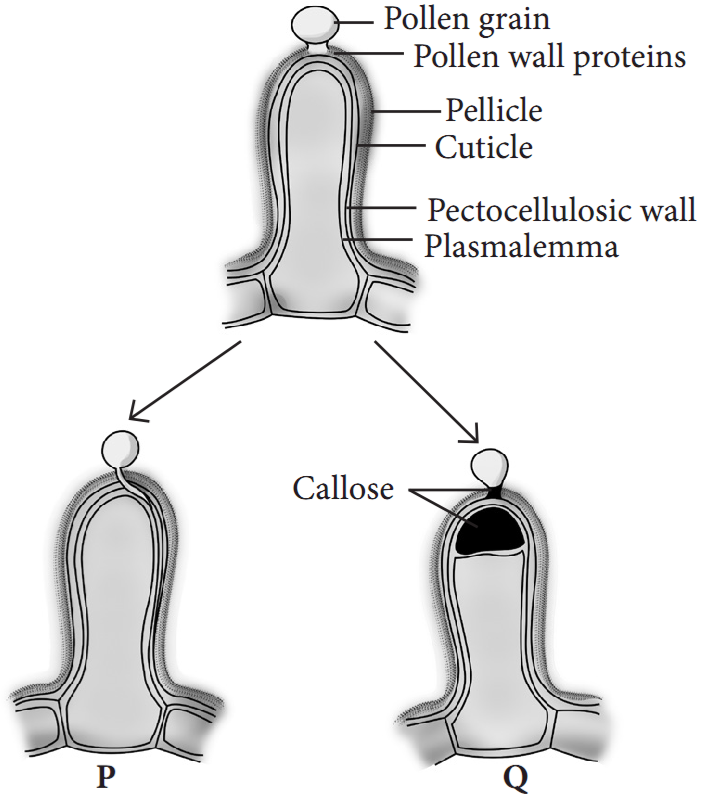
  1. Given figures show the pollen-stigma interaction, where pollen wall proteins are released onto the pellicle of stigmatic papillae, where a recognition reaction occurs.


Which of the following statements drawn from given figures is incorrect?
  1. P indicates compatible reaction in which the pollen tube penetrates the cuticle and grows down the papilla.
  2. Development of callose plug between the plasma membrane and pectocellulosic layer of stigmatic papillae results in the incompatibility reaction in Q.
  3. A callose plug, which appears at the tip of pollen in Q, is dissolved by callase enzyme secreted by stigma resulting in compatibility reaction.
  4. Deposition of callose can be employed as a reliable bioassay to detect compatibility or incompatibility reactions of pollen and stigma.
Read the following and answer any four questions from (i) to (v) given below:
Enzymes are best known for their ability to catalise biochemical reactions without undergoing any change. A large number of enzymes are being used in biotechnological industry. Most of them are obtained from microbes. Proteases degrade proteins and polypeptides. Most of the commercially applicable proteases are alkaline and are biosynthesised mainly by bacteria such as Pseudomonas, Bacillus and some fungi like, Aspergillus. These enzymes are used in clearing beer, softening of bread and meat, degumming of silk, etc. Alkaline serine proteases have the largest applications in bio-industry. Alkaline proteases have shown their capability to work under high pH, temperature and in presence of inhibitory compounds. Another important group of enzymes is amylases. Amylolytic enzymes act on starch. These are obtained from Aspergillus, Rhizopus and Bacillus sp. These are used in softening and sweetening of bread, production of alcoholic beverages from starchy materials, clearing of turbidity in juices caused by starch, etc.
  1. Polypeptides are degraded by:
  1. Amylases.
  2. Proteases.
  3. Pectinases.
  4. Lipases.
  1. Amylolytic enzymes are not obtained from:
  1. Aspergillus.
  2. Aspergillus.
  3. Mucor.
  4. Bacillus.
  1. Clearing of turbidity in juices caused by starch is achieved by:
  1. Amylases.
  2. Proteases.
  3. Rennet.
  4. Both (a) and (b).
  1. Select the incorrect option from the following.
  1. Enzymes are proteinaceous substances.
  2. Enzymes are substrate specific.
  3. Enzymes are large sized molecules.
  4. Microbial enzymes can work only in normal temperature and pH.
  1. A farmer harvests corns and prepares corn starch. He wants to prepare some corn syrup from this. for the conversion he needs to use enzyme ______.
  1. Amylase.
  2. Glucoamylases.
  3. Glucoisomerases.
  4. All of these.
Old or classical biotechnology and Modem biotechnology.
Distinguish between: Directional, Stabilizing and Disruptive selection.
Distinguish between: Euchromatin and Heterochromatin.
Distinguish between : Unconditional reflexes and Conditional reflexes
Column AColumn B (Symptoms observed)
(1) Deficiency of Cu(a) Malformed leaves
(2) Deficiency of Bo(b) Leaves with yellow edges
(3) Deficiency of Zn(c) Brown heart disease
(4) Deficiency of K(d) Die back of shoot