Question
Distinguish between longitudinal and transverse waves.

Answer

Longitudinal waves Transverse waves
1. As it travels through a medium, the particles of the medium vibrate to and fro about their mean positions along the direction of propagation of wave.
2. As the wave propagates through the medium, it causes compressions and rarefactions.
3. In case of longitudinal waves, one wavelength contains one compression and one rarefaction.
4. They can travel through all media i.e. solids, liquids and gases.
5. As the longitudinal wave propagates through a medium, there is change in density of the medium.
1. As it travels through a medium, the particles of the medium vibrate perpendicular to the direction of propagation of wave.
2. As the wave propagates through the medium, it produces crests and troughs.
3. In case of transverse waves, one wavelength contains one crest and one trough.
4. They can travel only through solids and on the surface of liquids.
5. As the transverse wave travels through a medium, there is no change in density of the medium.

Need a full question paper?

Generate a complete, print-ready paper with questions like this in minutes — across 16+ boards, with answer keys.
Start Generating Free

Similar questions

Show by a diagram how two resistors R1 and R2 are joined in parallel. Obtain an expression for the total resistance of combination.
(i) Define machine and write functions of a machine.
(ii) Describe mechanical advantage and its types.
(iii) (a) Derive relation between the efficiency, mechanical advantage, and the velocity ratio of a practical machine.
(b) Derive relation between ideal mechanical advantage and velocity ratio for a perfect machine
$2 \Omega$ resistor $A, 1 \Omega$ resistor $B$ and $4 \Omega$ resistor $C$ are connected in parallel. The combination is connected across a $2 V$ battery of negligible resistance. Draw the diagram of the arrangement and calculate:
(i) The current in each resistor $A$ and $C ,$
(ii) The current through battery.
Draw a ray diagram to show how a converging lens can form an image of the sun. Hence give a reason for the term ‘burning glass’ for a converging lens used in this manner.
Show that the sum of kinetic energy and potential energy (i.e., total mechanical energy) is always conserves in the case of a freely falling body under gravity (with air resistance neglected) from a height h by finding it when (i) the body is at the top, (ii) the body has fallen a distance x, (iii) the body has reached the ground.
Copy the given diagram of a transformer and complete it. Name the parts A and B. Name the part you have drawn to complete the diagram. What is the material of this part? Is this transformer a step-up or step-down? Give reason.
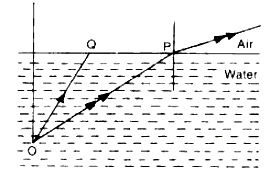
Fig. shows two rays of light Op and OQ coming from an object at the bottom of a pond, incident on the water surface.

(a) Mark on the diagram
(i) The angle of incidence of ray OP,
(ii) The angle of refraction of ray Op,
(iii) The position of image of the object as seen from above.
(iv) An approximate path of the ray OQ.
(b) Explain, why do the rays of light change directions on passing from water to air.
(c) A fish in water sees everything outside the water by rays of light entering its eye in a small cone of light. Draw a diagram and explain how does this happen.
It is dangerous to connect the switch in the neutral wire. Explain your answer.
A cell of e.m.f. ε and internal resistance 𝔯 sends current 1.0 A when it is connected to an external resistance 1.9Ω. But it sends current 0.5 A when it is connected to an external resistance 3.9 Ω.
Calculate the values of ε and 𝔯.
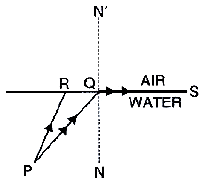
In the given figure $PQ$ and $PR$ are the two light rays emerging from an object $P.$ The ray $PQ$ is refracted as $QS.$

(a) state the special name given to the angle of incidence $\angle PQN$ of the ray $PQ.$
$$(b) what is the angle of refraction for the refracted ray $QS?$
(c) name the phenomenon that occurs if the angle of incidence $\angle PQN$ is increased.
(d) The ray PR suffers partial reflection and refraction on the water-air surface. Give reason. Draw in the diagram the refracted ray for the incident ray PR and hence show the position of image of the object $P$ by the letter $P^{\prime}$ when seen vertically from above.