Question
Distinguish between : Natural ecosystem and artificial ecosystem.

Answer

Natural ecosystemArtificial ecosystem
1. Natural ecosystems are naturally formed.1. Artificial ecosystems are man made.
2. There are no human inputs in natural ecosystems.2. Artificial ecosystem is based on all human inputs.
3. Natural ecosystems are self-sustainable.3. Artificial ecosystems are not self-sustainable.
4. In natural ecosystem, energy and materials are used and reused in cyclic manner. E.g. Ocean, forest, wetlands, estuary.4. In artificial ecosystem, Energy and materials have to be given by human intervention which requires constant inputs. E.g. Farm land, aquaculture ponds, aquarium in the house.

Need a full question paper?

Generate a complete, print-ready paper with questions like this in minutes — across 16+ boards, with answer keys.

Start Generating Free

Similar questions

Read the following and answer any four questions front (i) to (v) given below:
Gene regulation is the mechanism of switching off and switching on of the genes depending upon the requirement of cells and the state of development. Gene regulation is of two types : negative and positive. In negative generegulation the genes continue expressing their effect till their activity is suppressed. Positive gene regulation is the one in which the genes remain non-expressed unless and until they are induced to do it. Operon model is a co-ordinated group of genes such as structural gene, operator gene, promoter gene, regulator gene which function together and regulate a metabolic pathway as a unit, e.g., lac operon, trp operon, ara operon, etc.
  1. Regulation of gene expression occurs at the level of.
  1. Transcription
  2. Processing/splicing
  3. Translation
  4. All of these.
  1. Inducible operon system usually occurs in A pathways. Nutrient molecules serve as B to stimulate production of the enzymes necessary for their breakdown. Genes for inducible operon are usually switched C and the repressor is synthesised in an D form.
S.no
A
B
C
D
(a)
anabolic
corepressor
on
inactive
(b)
anabolic
inducer
off
active
(c)
catabolic
inducer
off
active
(d)
catabolic
corepressor
on
inactive
  1. An mRNA molecule transcribed from the lac operon contains nucleotide sequences complementary to.
  1. Structural genes coding for the enzymes.
  2. the operator region
  3. the promotor region
  4. the repressor gene.
  1. Which statement correctly describes the control of transcription of the genes involved in the breakdown of lactose in Estherichia coli?
  1. A repressor protein binds to the operator and the genes are switched on.
  2. A repressor protein binds to the operator and the genes are switched off.
  3. A transcription factor binds to the promoter and the genes are switched on.
  4. A transcription factor binds to the promoter and the genes are switched off.
  1. Function of catabolic activator protein in lac operon is.
  1. To form mRNA
  2. Help to bind RNA polymerase
  3. Code for repressor
  4. To activates lac gene when glucose is absent.
Column AColumn B
(1) Frederick Griffith(a) Test tube assay
(2) Avery, McCarty and MacLeod(b) Streptococcus pneumoniae
(3) Alfred Hershey and Martha Chase(c) E. coli
(4) Meselson and Stahl(d) Bacteriophages
Read the following and answer any four questions from (i) to (v) given below:
A typical angiospermic ovule is a small structure attached to the placenta by means of a stalk called funicle. The body of the ovule fuses with funicle in the region called hilum. Each ovule has one or two protective envelopes called integuments. Integuments encircle the nucellus except at the tip where a small opening called the micropyle is formed. Mature ovules are classified on the basis of funiculus. It can be orthotropous, anadromous, hernitropous, campylotropous, etc.
  1. The body of the ovule consists of a mass of parenchymatous cells called:
  1. Integuments.
  2. Nucellus.
  3. Hilum.
  4. Funiculus.
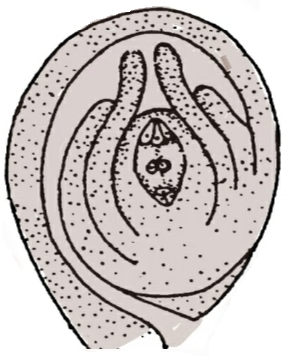
  1. Refer to the given figure and select the correct statement regarding it.
  1. This type of ovule is found in cactus.
  2. The micropyle comes to lie close to the funiculus due to unilateral growth of ovule.
  3. It is most common type of ovule found in the members of Chenopodiaceae.
  4. It is half inverted ovule.
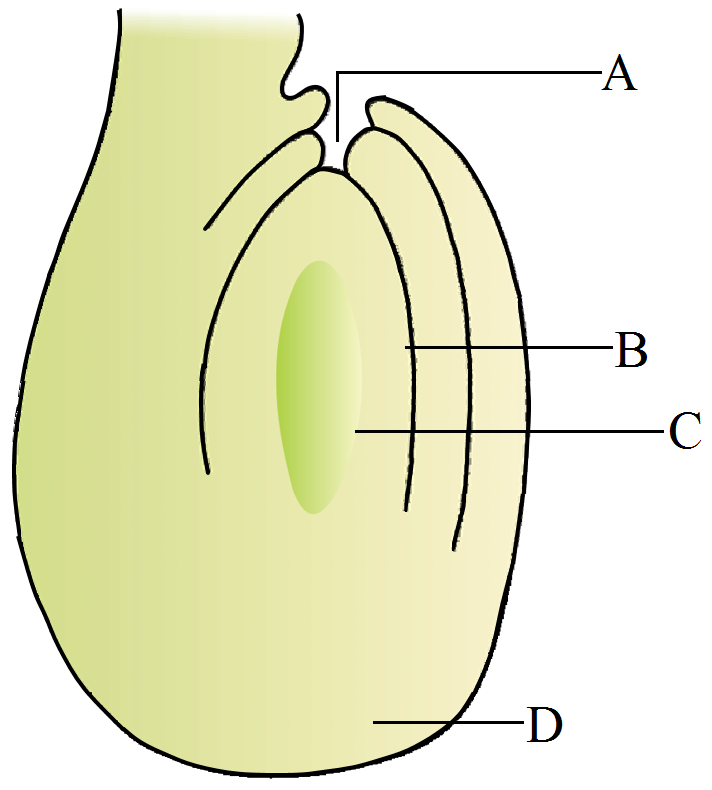
  1. Identify the parts labelled as A, B, C and D in the given figure and select the correct option.
S. No A B C D
(a) Chalaza Female gametophyte Embryo sac Micropyle
(b) Chalaza NuceIIus Embryo sac Micropyle
(c) Micropyle Egg Embryo sac Chalaza
(d) Micropyle Nucellus Embryo sac Chalaza
  1. Mature ovules are classified on the basis of funiculus. If micropyle lie close to the funiculus, the ovule is termed as:
  1. Orthotropous.
  2. Anatropous.
  3. Hemitropous.
  4. Campylotropous.
  1. In Asphodel us, ovule is:
  1. Unitegmic.
  2. Tritegmic.
  3. Bitegmic.
  4. Ategmic.
Read the following and answer any four questions from (i) to (v) given below:
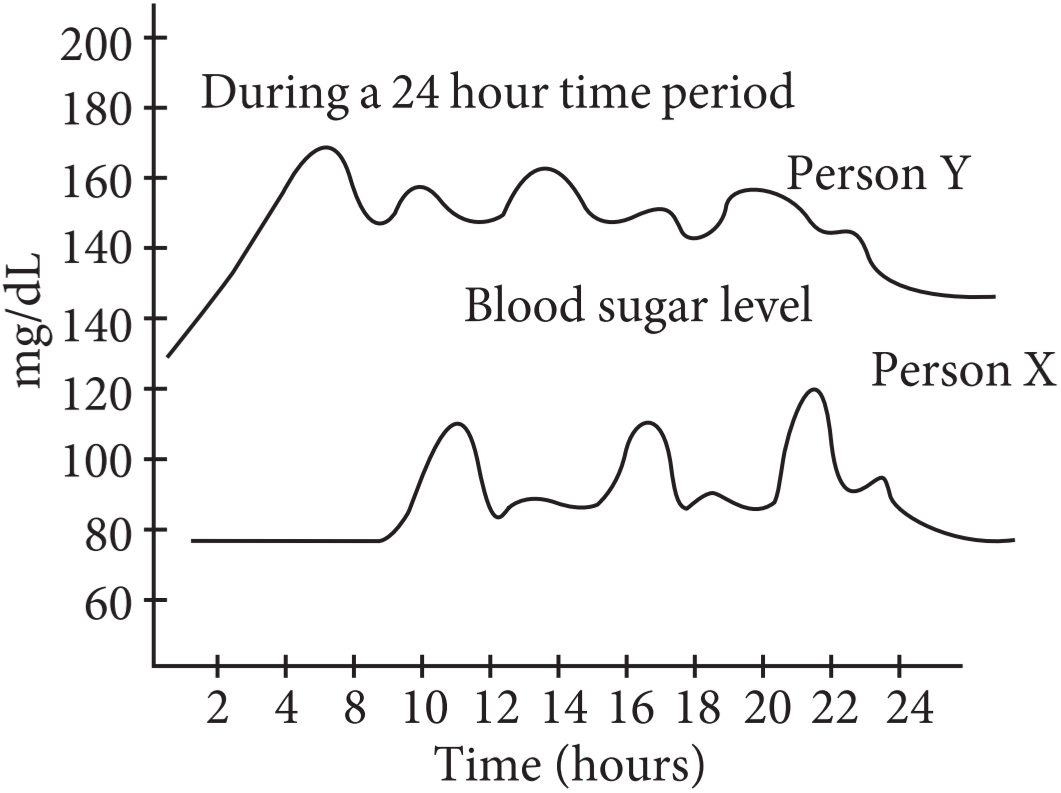
The given graphs show fluctuations in blood sugar of person X and Y during a 24 hour time period.

Based on the above information, answer the following questions.
  1. Which of the following holds true for person X?
  1. Person X is suffering from type I diabetes.
  2. Person X shows severe insulin deficiency and beta cell depletion.
  3. Person X is normal and shows good control of blood sugar level.
  4. Person X is subjected to excessive urination and abnormal thrust.
  1. The given graph indicates that person Y is suffering from.
  1. Diabetes
  2. Hypertension
  3. Atherosclerosis
  4. Rheumatic heart disease.
  1. Which of the following conditions are common in person Y?
  1. Excretion of glucose in urine and excessive urination.
  2. Polydipsia and mild beta cell depletion.
  3. Progressive erosion of articular cartilage at synovial joint.
  4. Both (a) and (b).
  1. A person suffering from diabetes mellitus becomes weak because.
  1. The cells are unable to utilise glucose and other carbohydrates for energy production.
  2. Degradation of fat increases production of toxic ketone bodies.
  3. Cells utilise proteins for obtaining energy
  4. All of these.
  1. Assertion: Type I diabetes involves failure of insulin to facilitate the movement of glucose into cells.
Reason: Type II diabetes is caused by failure of beta cells to produce adequate amount of insulin due to beta cell depletion.
  1. Both assertion and reason are true, and reason is the correct explanation of assertion.
  2. Both assertion and reason are true, but reason is not the correct explanation of assertion.
  3. Assertion is true, but reason is false.
  4. Both assertion and reason are false.
Column IColumn II
(1) Graafian follicle(a) Site of implantation
(2) Uterus(b) Birth canal
(3) Fallopian tube(c) Site of fertilization
(4) Vagina(d) Release of secondary oocyte
Read the following and answer any four questions from (i) to (v) given below:
The endosperm makes the main source of food for the embryo. Generally the endosperm nucleus divides after the division of the oospore, but in several cases the endosperm is formed to a great extent even before the first division of the oospore. There are three general types of endosperm formation: (a) nuclear type, (b) cellular type and (c) helobial type. The endosperm is usually triploid, but haploid endosperm is also found. Endosperm may either be completely consumed by the developing embryo before seed maturation, or it may persist in the mature seed.
  1. Haploid endosperm is found in:
  1. Pin us.
  2. Cauliflower.
  3. Sunflower.
  4. Pea.
  1. Persistent endosperm is found in:
P. Pea Q. Castor R. Bean S. Coconut T. Groundnut.
  1. Q and S.
  2. P and T.
  3. R, S and T.
  4. P, S and T.
  1. Milk of tender coconut represents (A) and the surrounding white coconut meal represents (B).
S. No
A
B
(a)
Cellular endosperm
Free- nuclear endosperm
(b)
Free-nuclear endosperm
Cellular endosperm
(c)
Helobial endosperm
Cellular endosperm
(d)
Free-nuclear endosperm
Helobial endosperm
  1. If an endosperm cell of a gymnosperm contains 12 chromosomes, the number of chromosomes in each cell of the root will be:
  1. 4
  2. 24
  3. 16
  4. 6
  1. In angiosperms, normally after fertilization:
  1. The zygote divides earlier than the primary endosperm nucleus.
  2. The primary endosperm nucleus divides earlier than the zygote.
  3. Both the zygote and primary endosperm nucleus divide simultaneously.
  4. Both the zygote and primary endosperm nucleus undergo a resting period.
Distinguish between: Autogamy (Self-pollination) – Xenogamy (cross pollination)
Match the hormones with their sourc
Column AColumn B
(1) Glucagon(i) Neurohypophysis
(2) Adrenaline(ii) Islets of Langerhans
(3) Somato tropins(iii) Adenohypophysis
(4) ADH(iv) Medulla 
Column AColumn B (Symptoms observed)
(1) Deficiency of Cu(a) Malformed leaves
(2) Deficiency of Bo(b) Leaves with yellow edges
(3) Deficiency of Zn(c) Brown heart disease
(4) Deficiency of K(d) Die back of shoot
Active absorption and Passive absorption.