Question
Distinguish between: Proliferative Phase and Secretory Phase.

Answer

Proliferative PhaseSecretory Phase
1. Proliferative phase begins with the repair of endometrium.1. Secretory phase begins with ovulation.
2. Time required for proliferative phase is 5th to 13th day of menstrual cycle.2. Time required for secretory phase is 15th to 28th day of menstrual cycle.
3. Proliferative phase always ends with ovulation.3. Secretory phase ends with menstruation if egg is not fertilized. It continues further if egg is fertilized.
4. Proliferative phase is in uterus which coincides . with follicular phase in ovary during which there is formation of Graafian follicle.4. Secretory phase is in uterus which coincides with luteal phase in ovary during which there is formation of corpus luteum.
5. Proliferative phase is controlled by FSH from anterior pituitary.5. Secretory phase is controlled by LH from anterior pituitary.
6. Hormone estrogen is secreted during this phase.6. Hormone progesterone is secreted during this phase.
7. It causes the development of blood vessels and thickening of endometrium of uterus.7. It causes further thickening and secretory activity of the glands of endometrium of uterus.

Need a full question paper?

Generate a complete, print-ready paper with questions like this in minutes — across 16+ boards, with answer keys.

Start Generating Free

Similar questions

What is meant by chromosomal mutation?
Read the following and answer any four questions from (i) to (v) given below:
Reerna, Jai and Ankit are suffering from autoimmune diseases of adrenal cortex, joints and thyroid gland, respectively. Their immune system failed to recognise self and non-self and started destroying their body's own proteins. They are seeking proper medical help for their conditions but their condition cannot be cured completely.
Based on the above information, answer the following questions.
  1. Select the option that correctly identifies autoimmune diseases of Reema, Jai and Ankit.
S no.
Reema
Jai
Ankit
(a)
Diabetes
Grave's disease
Rheumatic fever
(b)
Pernicious anaemia
Multiple sclerosis
Myasthenia gravis
(c)
Addison's disease
Rheumatoid arthritis
Hashismoto's thyroiditis
(d)
Systemic lupus erythematosus
Severe combined immunodeficiency disease
AIDS
  1. Reema's autoimmune condition is characterised by
  1. Undersecretion of insulin.
  2. Destruction of RB Cs and low RB C count.
  3. Undersecretion of adrenal cortex hormones.
  4. Low production of intrinsic factor required for absorption of $B_12$
  1. What do you think is the major cause of Jai's condition?
  1. Deterioration of myelin sheath around nerve cells, leading to loss of precise muscle control
  2. Destruction of heart cells, leading to weakening of entire heart wall.
  3. Destruction of beta cells, leading to undersecretion of insulin.
  4. Deposition of immune complexes of IgM, IgG and complement in joints thereby inflaming joints, destroying articular cartilage and fusing bones.
  1. How do you think Ankit's condition got diagnosed?
  1. Low level of thyroid hormone and elevated levels of TSH in Ankit's blood.
  2. Presence of antibodies against thyroid pen oxidase (TPO antibodies) in Ankit's blood.
  3. Elevated erythrocyte sedimentation rate (ESR), reduced C-reactive protein (CRP) in Ankit.
  4. Both (a) and (b)
  1. Assertion: Immunosuppressive drugs often reduce the severity of autoimmune disorders.
Reason: Monoclonal antibodies have been successfully used in the treatment of autoimmune disease.
  1. Both assertion and reason are true, and reason is the correct explanation of assertion.
  2. Both assertion and reason are true, but reason is not the correct explanation of assertion.
  3. Assertion is true, but reason is false.
  4. Both assertion and reason are false.
Waves recorded in ECGHeart activity
(1) P wave(a) Ventricular repolarization
(2) QRS complex(b) Atrial depolarization
(3) T wave(c) Isoelectric segment
(4) ST segment(d) Ventricular depolarization
Read the following and answer any four questions from (i) to (v) given below:
The process of translation requires transfer of genetic information from a polymer of nucleotides to synthesise a polymer of amino acids. The relationship between the sequence of amino acids in a polypeptide and nucleotide sequence of DNA or mRNA is called genetic code. George Gamow suggested that in order to code for all the 20 amino acids, code should be made up of three nucleotides.
  1. What is a codon?
  1. A length of DNA which codes for a particular protein.
  2. A part of the tRNA molecule to which a specific amino acid is attached.
  3. A part of the tRNA molecule which recognises the triplet code on the messenger RNA.
  4. A part of the messenger RNA molecule that has a sequence of bases coding for an amino acid.
  1. Three consecutive bases in the DNA molecule provide the code for each amino acid in a protein molecule. What is the maximum number of different triplets that could occurs?
  1. 16
  2. 20
  3. 24
  4. 64
  1. Listed below are some amino acids and their corresponding mRNA triplets.
Amino acid
mRNA triplet
Phenylalanine
UUU
Lysine
AAG
Arginine
CGA
Alanine
GCA
Which DNA sequence would be needed to produce the following polypeptide sequence? Alanine-Arginine-Lysine-Phenylalanine
  1. $\text{CGT}\ \ \ \text{GCT}\ \ \ \text{TTC}\ \ \ \text{AAA}$
  2. $\text{CGT}\ \ \ \text{GCT}\ \ \ \text{TTC}\ \ \ \text{TTT}$
  3. $\text{CGU}\ \ \ \text{GCU}\ \ \ \text{UUC}\ \ \ \text{AAA}$
  4. $\text{CGU}\ \ \ \text{GCU}\ \ \ \text{UUC}\ \ \ \text{TTT}$
  1. Identify the non-sense codons among the following.
  1. AUG
  2. GUG
  3. UAA
  4. UGG
  1. A polypeptide is made using synthetic mRNA molecules as shown.
Synthetic mRNA used
Polypeptide produced
UUUAAAUUUAAA
Phenylalanine-Iysine-phenylalanine-Iysine
What are the DNA codes for the amino acids phenylalanine and lysine?
S.no
Phenylalanine
Lysine
(a)
AAA
TTT
(b)
AAA
UUU
(c)
GGG
CCC
(d)
TTT
GGG
Distinguish between : Primary and secondary succession.
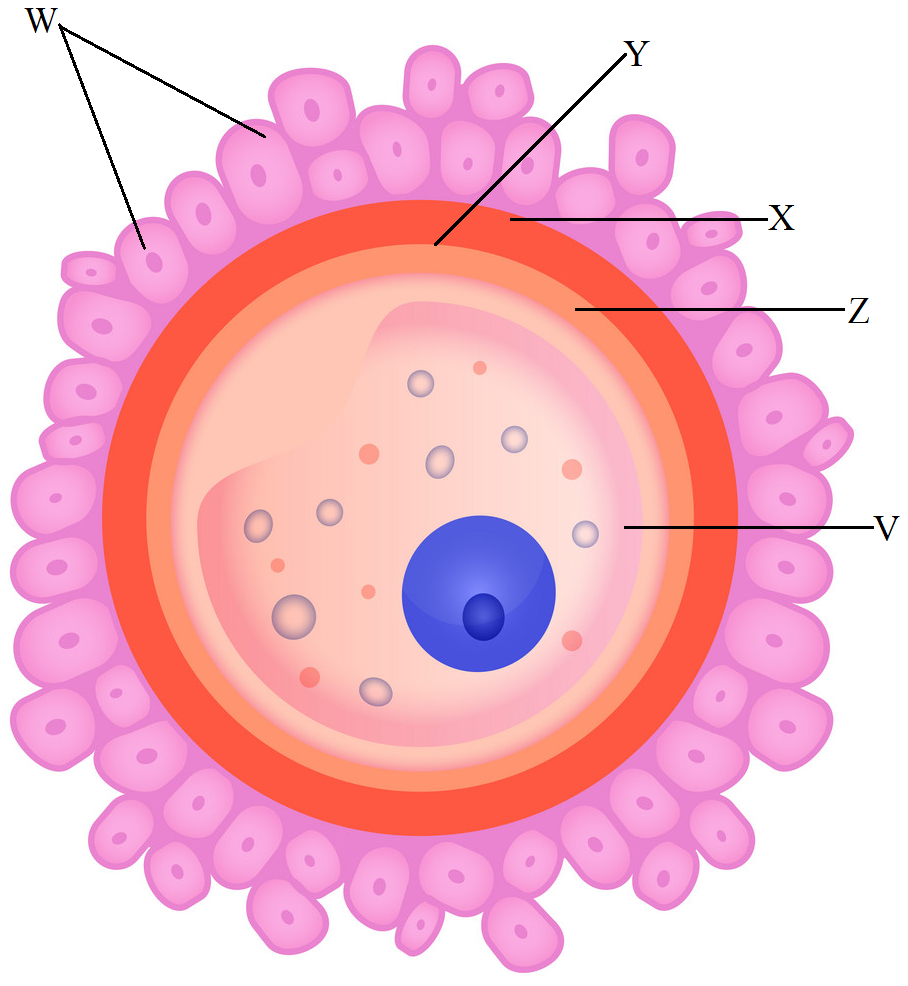
Read the following and answer any four questions from (i) to (v) given below: The mature ovum or a female gamete is spherical in shape. The human ovum is almost free of yolk and is said to be alecithal. Human ovum loses its ability to be fertilised about 24 hours after ovulation. Refer to the given structure of ovum and answer the following questions.
  1. Thick cellular layer formed of radially elongated follicular cells is:
  1. Zona pellucida.
  2. Plasma membrane.
  3. Perivitelline membrane.
  4. Corona radiata.
  1. In humans, at which stage does ovum get released from ovary?
  1. Secondary oocyte.
  2. Oogonium.
  3. Primary oocyte.
  4. First polar body.
  1. Cytoplasm of an ovum is enveloped by _____.
  1. Zona pellucida.
  2. Corona radiata.
  3. Cell membrane.
  4. Perivitelline space.
  1. Select the correct option:
S. No
V
W
X
(a)
Cytoplasm
Zona pellucida
Plasma membrane
(b)
Cortical granules
Corona radiata
Zona pellucida
(c)
Cortical granules
Plasma membrane
Corona radiata
(d)
Cytoplasm
Corona radiata
Zona pellucida
  1. Which of the following is not a characteristic of an ovum?
  1. Nucleus of an ovum has prominent nucleolus.
  2. Only one ovum formed from one oogonium.
  3. It lacks centrioles.
  4. It has very small amount of ooplasm.
Geological timeAnimal life
(1) Cambrian(a) Amphibians
(2) Ordovician(b) First terrestrial animals
(3) Silurian(c) Jawless fishes
(4) Devonian(d) Trilobite
Column AColumn B
(1) Walter Rosen(a) Popularisation of term biodiversity
(2) David Tillman(b) Rivet Popper Hypothesis
(3) Paul Ehrlich(c) Productivity Stability Hypothesis
(4) Edward Wilson(d) Coined
Read the following and answer any four questions from (i) to (v) given below:
In recombinant DNA technology, the fragments of DNA generated after cutting the DNA by restriction enzymes are separated according to their size or length by gel electrophoresis. Gel electrophoresis is performed in a gel matrix so that molecules of similar electric charges can be separated on the basis of size. Most commonly used matrix in gel electrophoresis is agarose. The fragments are separated under the influence of electric field. The separated DNA fragments can be seen only after staining the DNA with compound known as ethidium bromide (EtBr) followed by exposure to UV radiation as bright orange band.
  1. Gel electrophoresis is used for the separation of
  1. DNA only.
  2. DNA and RNA only.
  3. DNA and proteins only.
  4. DNA, RNA and proteins.
  1. Most commonly used matrix is _____ which is a ______ extracted from _______.
  1. (i) agarose (ii) polysaccharide (iii) sea weed
  2. (i) agarose (ii) protein (iii) sea weed
  3. (i) EtBr (ii) polysaccharide (iii) sea weed
  4. (i) EtBr (ii) protein (iii) bacteria
  1. A DNA molecule was treated with a restriction endonuclease and three fragments of size (i) 426kb, (ii) 129kb and (iii) 46kb were obtained. Identify the order in which these bands will arrange themselves in the gel plate after gel electrophoresis is completed. (Assuming that negative part of electrode is towards the well)
  1. (iii) → (ii) → (i)
  2. (i) → (ii) → (iii)
  3. (i) → (iii) → (ii)
  4. (iii) → (i) → (ii)
  1. Which of the following statements regarding gel electrophoresis is incorrect?
  1. Separated DNA fragments can be seen only after staining DNA with EtBr.
  2. DNA fragments are separated according to their size.
  3. Under the influence of electric field, positively charged molecules move towards the anode and negatively charged molecules move towards the cathode.
  4. None of these.
  1. The factor that will not affect the rate of DNA migration in gel electrophoresis is:
  1. Size of DNA molecule.
  2. Concentration of DNA.
  3. Voltage supplied.
  4. Concentration of the gel.
Read the following and answer any four questions from (i) to (v) given below:
Ginkgo tree has been saved from extinction by selective breeding followed by channeling into trade of nature lovers. This is an ex-situ conservation, where endangered species are protected from all adverse factors. Offspring produced in captive breeding are released in natural habitat for acclimatisation.
  1. What is the significance of offsite collections?
  1. Restock depleted populations.
  2. Protection of endangered species.
  3. Reintroduce species in wild.
  4. All of these.
  1. Which of the following is not an ex-situ conservation?
  1. Wetlands
  2. Orchards
  3. Aquaria
  4. Botanical gardens.
  1. Select the incorrect statements for ex-situ conservation.
  1. It is conservation of species outside their natural habitats.
  2. Endangered species are kept under human supervision and provided all the essentials.
  3. The species population recovers in natural environment.
  4. Both (b) and (c).
  1. Conditions maintained in seed banks for orthodox seeds are:
  1. Low moisture content.
  2. Anaerobic conditions.
  3. Low temperature.
  4. All of these.
  1. Assertion: Animal species which have become extinct in wild continue to be maintained in zoological parks.
Reason: Captive breeding is the conservation of those cases where these is no realistic chance of in-situ survival.
  1. Both assertion and reason are true and reason is the correct explanation of assertion.
  2. Both assertion and reason are true but reason is not the correct explanation of assertion.
  3. Assertion is true but reason is false.
  4. Both assertion and reason are false.